Comparing Peptides Studied in Growth Hormone Signaling
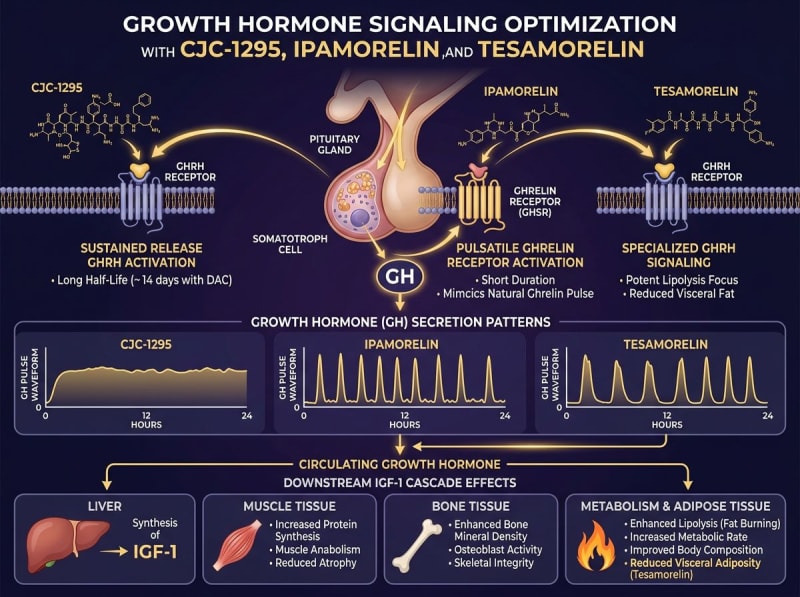
CJC-1295, ipamorelin, and tesamorelin are distinct peptides associated with growth hormone (GH) signaling research. CJC-1295 and tesamorelin are growth hormone-releasing hormone (GHRH) analogs; ipamorelin is a growth hormone secretagogue receptor (GHSR) agonist. Their receptor classification, chemical modifications, and experimental context must be distinguished before comparing laboratory results.
This comparison focuses on molecular identity, the scope of the supplied literature, and analytical considerations for nonclinical laboratory work. Published studies concern the materials and models investigated in those studies, not necessarily materials sold by Alpha Carbon Labs.
Pathways and Experimental Readouts
GHRH receptor signaling contributes to GH synthesis and release in anterior pituitary cells, while somatostatin inhibits GH release. GHSR represents a separate receptor pathway associated with ghrelin signaling. Receptor activation, GH secretion, and downstream insulin-like growth factor I (IGF-I) measurements are different endpoints; one cannot be substituted for another without supporting data.
An isolated-cell assay does not reproduce the complete hypothalamic–pituitary regulatory system. Likewise, a circulating hormone measurement in an animal or human study is not a direct measure of receptor binding or peptide stability in a laboratory preparation.
CJC-1295: Chemical Modification and Nomenclature
CJC-1295 is a modified GHRH analog. The albumin-binding form incorporates a reactive modification commonly described as a Drug Affinity Complex (DAC). This distinction matters because an albumin-binding derivative and a peptide without that modification are not interchangeable analytical materials.
The label “CJC-1295 no DAC” is used for modified GRF(1–29), a 29-residue GHRH analog with four amino-acid substitutions. Researchers should establish the exact sequence and modification from the material documentation rather than relying on that label. Pharmacokinetic findings for albumin-binding CJC-1295 should not be assigned to modified GRF(1–29).
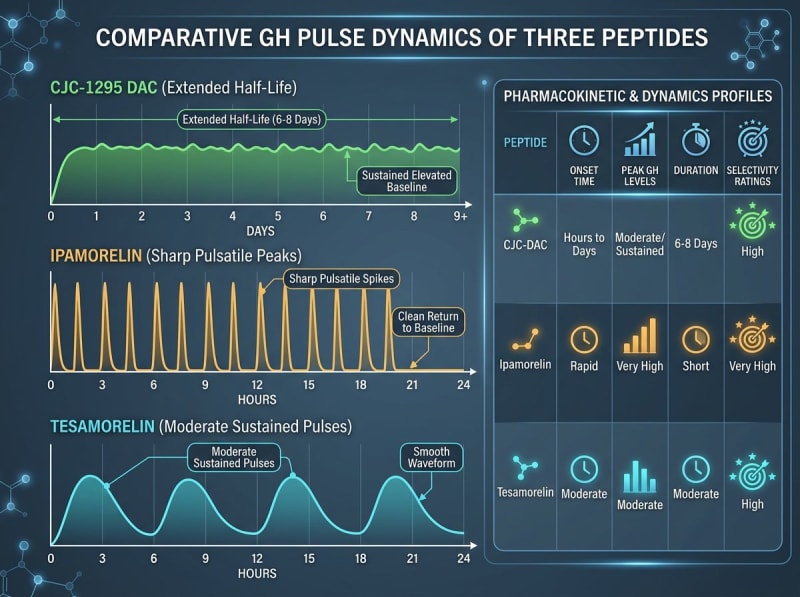
In the human study of healthy adults reported by Teichman et al. (2006), the long-acting CJC-1295 preparation had an estimated half-life of approximately 6–8 days, and GH and IGF-I secretion were measured [2]. That estimate belongs to the investigated preparation and study population. It does not establish a half-life for a no-DAC material, stability in cell-culture medium, or performance of an Alpha Carbon Labs product.
The supplied Alba et al. (2006) reference concerns CJC-1295 in GHRH-deficient generalized growth-retarded lit/lit mice [6]. This is animal evidence from a specific genetic model, not a head-to-head comparison of the three peptides or evidence about a supplier's material.
Ipamorelin: Receptor Classification and Selectivity Limits
Ipamorelin is a synthetic pentapeptide and GHSR agonist, rather than a GHRH analog. Other secretagogues, including GHRP-2 and GHRP-6, can provide receptor-class context, but their effects cannot be used to infer ipamorelin's experimental profile.
The supplied Svensson et al. (1999) reference addresses GH release and selectivity in viable rat anterior pituitary cells [3]. This is an in-vitro model using animal-derived cells, not a human study. Selectivity measured in that setting does not establish an absence of cortisol, prolactin, appetite, or metabolic effects in an intact organism.
A selectivity claim requires the measured endpoints, comparator, exposure conditions, assay sensitivity, and model to be specified. The source article's descriptions of a “clean” pulse and no collateral endocrine effects are not retained because they overstate what a model-specific finding can establish.
Tesamorelin: Structure and Evidence Scope
Tesamorelin is a 44-amino-acid GHRH analog bearing an N-terminal trans-3-hexenoyl modification. Its structural classification does not establish preferential targeting of an adipose-tissue compartment or a separate, lipid-specific receptor mechanism.
The supplied Clemmons et al. (2012) reference describes a randomized placebo-controlled human trial involving people with HIV and abdominal fat accumulation [4]. That population and clinical study design must remain explicit when interpreting the reference. It does not establish performance in a cell assay, suitability for another population, or properties of tesamorelin sold by Alpha Carbon Labs.
Comparison for Nonclinical Study Planning
| Material | Molecular or receptor distinction | Key documentation question |
|---|---|---|
| CJC-1295 with DAC | Albumin-binding GHRH analog | Is the albumin-binding modification identified and analytically supported? |
| Modified GRF(1–29), often labeled “CJC-1295 no DAC” | Modified 29-residue GHRH analog without the DAC modification | Are the sequence and modification state explicitly documented? |
| Ipamorelin | Pentapeptide GHSR agonist | Does the assay distinguish receptor activity from downstream GH secretion? |
| Tesamorelin | N-terminally modified 44-residue GHRH analog | Are peptide identity and the N-terminal modification confirmed? |
No uniform half-life or cortisol/prolactin ranking is presented here. Such a comparison would require comparable preparations, models, sampling schedules, and analytical methods. The supplied references do not establish a matched comparison across all listed materials.
Separating Persistence, Secretion, and Interaction Claims
Peptide elimination half-life, stability in an experimental matrix, duration of receptor signaling, and the timing of GH secretion describe different processes. Prolonged peptide exposure alone does not establish continuous hormone secretion, loss of pulsatility, or receptor desensitization.
Different receptor targets also do not establish synergy. A synergy conclusion requires a defined interaction model and comparative data supporting a departure from the expected additive response. The supplied information does not support recommending a CJC-1295/ipamorelin combination or assigning it a reproducible secretion pattern.
The Vitiello et al. (2006) reference concerns GHRH research in healthy older human adults [1]; it is not evidence for equivalent effects of each peptide discussed here. The review references [5, 8] do not, by themselves, supply a matched experimental model or head-to-head dataset. No in-silico findings are evaluated in this comparison.
Analytical Documentation and Laboratory Handling
Comparative interpretation depends on more than a reported purity percentage. Researchers should distinguish identity, chromatographic purity, peptide content, and biological activity. A chromatographic purity result alone does not establish sequence, concentration, sterility, or functional activity.
- Record the exact material name, sequence or modification description, lot identifier, and experimental matrix.
- Review the analytical method, acceptance criteria, and results available for the specific lot; do not assume a general specification applies to every material.
- Use model-appropriate controls and document sampling intervals, assay limits, and potential matrix interference.
- Evaluate stability under the actual laboratory conditions rather than treating an in-vivo half-life as a storage or assay-stability specification.
Alpha Carbon Labs provides pages for peptide synthesis, quality control, and COA documents. These resources should be reviewed for their stated scope; their presence does not establish that a particular analytical test was performed or that a product matches a published study preparation.
The supplied article contains no lot-specific analytical results, validated handling conditions, or material-specific hazard data. Consult the applicable safety data sheet and institutional risk assessment, use appropriate laboratory protective measures, and follow local procedures for containment and disposal. Incomplete hazard information should not be interpreted as evidence of low risk.
References
- Vitiello, M. V., et al. (2006). Growth hormone-releasing hormone improves the cognitive performance of healthy older adults. Archives of General Psychiatry. — https://pubmed.ncbi.nlm.nih.gov/16754838/
- Teichman, S. L., et al. (2006). Prolonged stimulation of growth hormone (GH) and insulin-like growth factor I (IGF-I) secretion by CJC-1295, a long-acting analog of GH-releasing hormone, in healthy adults. The Journal of Clinical Endocrinology & Metabolism. — https://academic.oup.com/jcem/article/91/3/799/2843281
- Svensson, J., et al. (1999). The GH secretagogue ipamorelin: GH-releasing effect and selectivity in viable rat anterior pituitary cells. Endocrinology. — https://pubmed.ncbi.nlm.nih.gov/10342345/
- Clemmons, D. R., et al. (2012). Tesamorelin, a growth hormone-releasing factor analogue, in HIV-infected patients with abdominal fat accumulation: a randomized placebo-controlled trial. PLOS ONE. — https://journals.plos.org/plosone/article?id=10.1371/journal.pone.0042238
- Sigalos, J. T., & Pastuszak, A. W. (2018). The Safety and Efficacy of Growth Hormone Secretagogues. Sexual Medicine Reviews. — https://www.ncbi.nlm.nih.gov/pmc/articles/PMC6240568/
- Alba, M., et al. (2006). Once-daily administration of CJC-1295, a long-acting growth hormone-releasing hormone (GHRH) analog, normalizes growth in the GHRH-deficient generalized growth-retarded (lit/lit) mouse. American Journal of Physiology-Endocrinology and Metabolism. — https://pubmed.ncbi.nlm.nih.gov/16303831/
- Raun, K., et al. (1998). Ipamorelin, the first selective growth hormone secretagogue. European Journal of Endocrinology.
- Sinha, D. K., et al. (2020). Ipamorelin/CJC-1295 Therapy: A Comprehensive Review. International Journal of Molecular Sciences. — https://www.ncbi.nlm.nih.gov/pmc/articles/PMC7108996/
Limitations
Alpha Carbon Labs materials are intended solely for nonclinical laboratory research. Published findings do not establish the safety, effectiveness, approval, or suitability of the material sold for human or veterinary use.