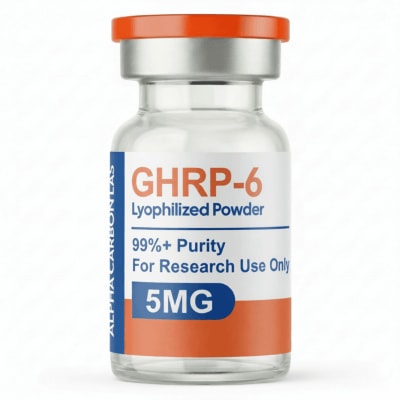
This product is for research purposes only. Not for human consumption.
Purity: >98% (HPLC verified)
Formulation: Lyophilized powder
Molecular Formula: C46H56N12O6
Molecular Weight: 872.97 g/mol
CAS Number: 87616-84-0
PubChem CID: N/A
GHRP-6
Overview
GHRP-6 (Growth Hormone Releasing Peptide-6) is a synthetic hexapeptide with the sequence His-D-Trp-Ala-Trp-D-Phe-Lys-NH2 and was one of the first growth hormone releasing peptides developed in the 1980s. Like other GHRPs, it acts as a potent agonist of the ghrelin receptor (GHS-R1a), stimulating growth hormone secretion from the pituitary gland.
Key Characteristics
GHRP-6 is notable for producing significant GH release while also having pronounced effects on hunger and appetite through ghrelin receptor activation. Unlike growth hormone releasing hormone (GHRH), which works through a separate receptor pathway, GHRP-6's ghrelin receptor agonism provides a distinct and complementary mechanism for stimulating the somatotropic axis.
Research Applications
The peptide has been extensively studied as a research tool to understand GH regulation and as a potential therapeutic agent for conditions characterized by GH deficiency or muscle wasting. Its strong appetite-stimulating properties distinguish it from some other GHRPs like Ipamorelin, which has more selective GH release without significant hunger effects.
Synergy with GHRH
One of GHRP-6's most notable characteristics is its synergistic effect with GHRH. When administered together, these peptides produce GH release that exceeds the sum of their individual effects, a property that has been extensively studied in clinical research and is attributed to their complementary receptor mechanisms.
Mechanism of Action
GHRP-6 binds to and activates the growth hormone secretagogue receptor type 1a (GHS-R1a), the same receptor activated by the endogenous hunger hormone ghrelin. This receptor activation triggers intracellular signaling cascades that stimulate GH synthesis and secretion from somatotroph cells in the anterior pituitary.
Signal Transduction Pathway
Upon GHS-R1a binding, GHRP-6 activates G-protein coupled receptor signaling, primarily through Gq/11 proteins. This leads to phospholipase C activation, inositol trisphosphate (IP3) generation, and calcium release from intracellular stores. The resulting calcium influx triggers GH granule exocytosis and stimulates GH gene transcription.
Synergy with GHRH
The GH-releasing effects of GHRP-6 are synergistic with GHRH, meaning combined administration produces greater GH release than either peptide alone. This synergy occurs because GHRH works through a different receptor (GHRH-R) that couples to Gs proteins and increases cAMP, providing a complementary pathway for GH secretion.
Appetite Stimulation
Beyond GH stimulation, GHRP-6's activation of ghrelin receptors in the hypothalamus produces strong orexigenic (appetite-stimulating) effects, increasing food intake and preferentially stimulating consumption of palatable foods. The arcuate nucleus contains neurons expressing both ghrelin receptors and neuropeptide Y (NPY), creating a direct pathway for hunger signaling.
Secondary Hormonal Effects
The peptide also has mild effects on cortisol and prolactin secretion due to partial ghrelin receptor activation in corticotroph and lactotroph cells, though these effects are secondary to its GH effects and generally not clinically significant at typical research doses.
Research Findings
GHRP-6 has been studied extensively in both preclinical and clinical research since its development in the 1980s. Early pharmacological studies by Cyril Bowers and colleagues characterized its potent GH-releasing properties, establishing it as one of the most effective first-generation GHRPs.
Clinical Pharmacology Studies
Clinical trials in healthy subjects demonstrated dose-dependent GH release, with peak GH levels occurring 30-45 minutes after subcutaneous or intravenous administration. Studies showed that GHRP-6 doses of 1-2 mcg/kg body weight produce substantial GH elevation, with higher doses showing a ceiling effect. The peptide maintains GH-releasing efficacy with repeated administration, unlike some GH secretagogues that show tachyphylaxis.
Appetite and Metabolic Research
Research into appetite regulation has used GHRP-6 as a tool to understand ghrelin system function, with studies confirming its strong hunger-inducing effects in both animals and humans. Controlled human studies showed significant increases in food intake following GHRP-6 administration. Body composition studies showed that chronic GHRP-6 administration increased lean mass and reduced fat mass, though weight gain can occur due to increased food intake if not controlled.
Muscle Wasting and Cachexia
Studies in muscle wasting conditions explored GHRP-6 for cachexia and sarcopenia, with the dual benefits of GH stimulation and appetite enhancement potentially valuable in these contexts. Research in aging populations examined whether GHRP-6 could restore youthful GH secretion patterns.
Cardiovascular Research
Cardiac research investigated GHRP-6's effects on cardiac function, with some studies suggesting cardioprotective properties independent of GH effects. The peptide has been studied in wound healing and tissue repair contexts, where GH augmentation might support recovery processes.
Research Applications
- Growth hormone secretion research
- Appetite regulation and ghrelin system studies
- Cachexia and muscle wasting research
- Body composition and metabolism studies
- GH secretagogue receptor pharmacology
- Cardioprotection research
- Growth hormone deficiency studies
- Aging and somatopause research
- Wound healing and tissue repair studies
- Neuroendocrine axis regulation research
Safety Profile
GHRP-6 clinical research has shown generally acceptable tolerability across numerous studies, though it has not been approved for therapeutic use by regulatory agencies. The peptide's safety profile reflects both its GH-releasing properties and its ghrelin receptor agonism.
Appetite Effects
The most prominent effect of GHRP-6 is significantly increased appetite and hunger, which is more pronounced than with most other GHRPs. This effect can be beneficial in conditions like cachexia or sarcopenia where appetite stimulation is desired, but may be problematic in contexts where weight management is a concern.
Common Effects
Other reported effects include water retention and mild edema in some subjects (related to GH's effects on sodium retention), transient increases in cortisol (generally not clinically concerning and normalized between doses), possible fatigue or lethargy in some individuals, and flushing or dizziness shortly after injection.
Theoretical Concerns
Theoretical concerns with chronic use mirror those of other GH secretagogues, including long-term effects of elevated GH/IGF-1 levels on tissue growth and metabolism, potential effects on glucose homeostasis, and cardiovascular considerations with sustained GH elevation.
Quality Considerations
Quality control is a concern with research chemical suppliers. Ensuring peptide purity, sterility, and proper storage conditions is essential for research applications. Third-party testing and certificates of analysis help verify product quality.
Scientific References
Customer Reviews
No reviews yet. Be the first to review this product!
Please sign in to write a review.
Research Use Only
This product is intended for research purposes only and is not for human consumption, therapeutic use, or diagnostic applications. Please ensure compliance with all applicable regulations and institutional guidelines.