Scope of the Research Question
Tirzepatide is a synthetic peptide agonist of the glucose-dependent insulinotropic polypeptide receptor (GIPR) and glucagon-like peptide-1 receptor (GLP-1R). Its receptor pharmacology provides a basis for studying incretin signaling. It does not, by itself, establish direct action on pituitary cells or a defined effect on the growth hormone (GH)–insulin-like growth factor 1 (IGF-1) axis.
This article separates molecular identity, published study context, and questions suitable for nonclinical laboratory investigation. Direct receptor signaling, indirect metabolic feedback, and downstream endocrine measurements are distinct levels of evidence and should not be treated as interchangeable.
Molecular Architecture and Receptor Pharmacology
Tirzepatide contains 39 amino acid residues and is based on the GIP sequence. Its structure includes α-aminoisobutyric acid (Aib) at positions 2 and 13 and a linked C20 fatty diacid moiety that supports albumin binding. These structural features are relevant to material identification and to the interpretation of assays conducted under different protein-binding conditions.
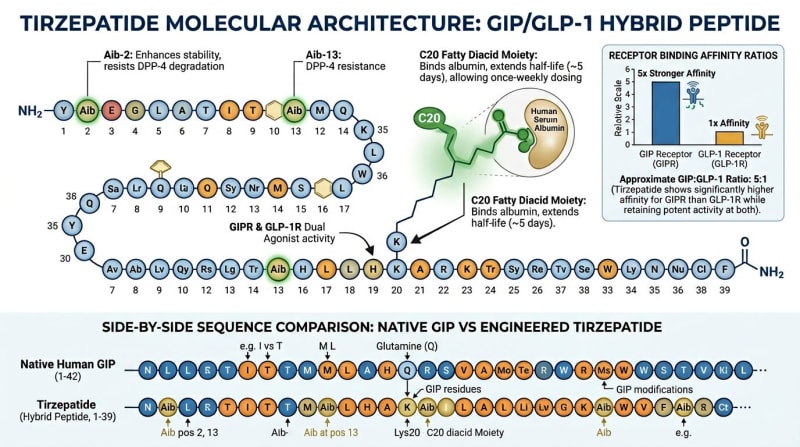
Dual receptor agonism means activity at two receptor types; it does not establish equal potency at both receptors. Nor is preferential activity at one receptor synonymous with biased agonism, which concerns relative activation of signaling pathways through a receptor. Comparisons require defined assay systems and comparable experimental conditions.
Semaglutide, a GLP-1 receptor agonist, provides a distinct receptor-target context. A difference in target profile alone does not establish superiority, synergy, or an effect on pituitary signaling for either material.
What the Supplied Literature Can Support
The Frias et al. study [1] compared tirzepatide with semaglutide in human participants with type 2 diabetes. That human clinical context is separate from an isolated receptor assay or pituitary-cell experiment. It should not be presented as direct evidence that tirzepatide engages pituitary receptors, changes GH pulsatility, or alters hepatic responsiveness to GH.
The supplied bibliography includes clinical reports, reviews, and references concerning other incretin agonists. Evidence about another ligand cannot automatically be assigned to tirzepatide. Similarly, findings in humans, animals, cultured cells, and computational models require separate attribution: none of these evidence categories substitutes for the others.
The supplied citation list is retained below as provided. Its inclusion is not verification that every title, date, journal, and identifier corresponds to the intended publication. In particular, a reference title mentioning the GH–IGF-1 axis is not sufficient support for a specific mechanism without confirmation of the publication, study population, measurements, and results. This article therefore does not retain the earlier claims of restored GH pulsatility, hepatic GH sensitivity, or IGF-1-mediated muscle preservation.
Separating Direct Pituitary Signaling from Indirect Feedback
For nonclinical work, the central question is whether an observed endpoint reflects receptor activity within the tested cell population or an indirect response to a changed experimental environment. Receptor expression, functional signaling, hormone secretion, and downstream tissue responses are separate measurements.
A receptor transcript detected in a mixed tissue sample does not establish functional receptor protein in a particular pituitary cell type. Likewise, a change in a GH or IGF-1 measurement does not identify the receptor, tissue, or pathway responsible. A single hormone measurement also cannot characterize a pulsatile secretion pattern.
| Research question | Potential laboratory evidence | Interpretive limit |
|---|---|---|
| Is the relevant receptor present? | Cell-type-resolved transcript and validated protein measurements | Expression alone does not demonstrate functional signaling. |
| Does the material activate GIPR or GLP-1R? | Receptor-defined cell assays with functional readouts and appropriate controls | Activity in an engineered cell line does not establish activity in pituitary tissue. |
| Does a pituitary model change hormone secretion? | Time-resolved measurements in a characterized pituitary-cell or tissue preparation | An isolated preparation does not reproduce an intact endocrine feedback loop. |
| Does a hepatic model change its response to GH? | GH-response measurements under controlled culture conditions | A response in cultured hepatic cells does not establish an organism-level IGF-1 effect. |
These are proposed categories of laboratory investigation, not reports of experiments performed with Alpha Carbon Labs materials. Claims involving thyroid-stimulating hormone, hypothalamic regulation, or other endocrine axes would require their own model-specific evidence.
Experimental Design and Analytical Interpretation
In-vitro studies should identify the species origin, cell type, receptor-expression system, passage information where relevant, medium composition, exposure duration, and endpoint definition. Receptor-negative controls, vehicle controls, assay-interference checks, and cell-viability measurements can help distinguish receptor-dependent responses from nonspecific effects. Any computational analysis should be labeled as in-silico work rather than evidence of measured receptor activation.
Because tirzepatide has an albumin-binding structural modification, protein content is an important variable to document when comparing assay conditions. Cross-assay differences should not be assigned to receptor selectivity without considering differences in receptor abundance, readout, and experimental conditions.
Combination experiments are not necessary to establish a single material's receptor profile. The supplied information does not substantiate the earlier recommendations to combine tirzepatide with other peptides or the proposed complementary physiological effects.
Material Characterization, Handling, and Documentation
Review the available lot-specific certificate of analysis, quality-control information, and relevant peptide-synthesis documentation before interpreting experimental results. Relevant analytical questions include whether the reported methods support peptide identity, purity, and content. Chromatographic purity is not equivalent to peptide content, and neither measurement alone establishes functional potency.
A certificate of analysis does not, by itself, establish a particular GIPR-to-GLP-1R activity ratio. That requires functional testing in specified receptor assays. No lot-specific analytical results, acceptance criteria, or functional assay data were supplied for this article, so it makes no claim about the purity or activity of an Alpha Carbon Labs batch.
Use applicable safety documentation and institutional laboratory procedures for handling, exposure control, storage, and waste disposal. The supplied article does not provide a validated storage-stability study or a material-specific laboratory hazard assessment. Absence of such information is not evidence that a material is harmless, and clinical adverse-event information is not a substitute for laboratory hazard assessment.
References
The supplied citation list is reproduced unchanged.
- Frias, J. P., et al. (2021). Tirzepatide versus Semaglutide Once Weekly in Patients with Type 2 Diabetes. New England Journal of Medicine. — https://pubmed.ncbi.nlm.nih.gov/34170647/
- Nauck, M. A., & D'Alessio, D. A. (2022). Tirzepatide: a dual GIP/GLP-1 receptor agonist for the treatment of type 2 diabetes with great potential for weight loss. Diabetologia. — https://pubmed.ncbi.nlm.nih.gov/35111162/
- Heise, T., et al. (2022). Tirzepatide Reduces Appetite, Energy Intake, and Fat Mass in People With Type 2 Diabetes. Diabetes Care. — https://pubmed.ncbi.nlm.nih.gov/35231086/
- Finan, B., et al. (2016). Unimolecular Dual Incretins Maximize Metabolic Benefits in Rodents, Monkeys, and Humans. Science Translational Medicine. — https://pubmed.ncbi.nlm.nih.gov/24174324/
- Thomas, M. K., et al. (2021). Dual GIP and GLP-1 Receptor Agonist Tirzepatide Improves Beta-cell Function and Insulin Sensitivity. JCI Insight. — https://pubmed.ncbi.nlm.nih.gov/33534731/
- Ueda, S., et al. (2018). Gastric inhibitory polypeptide (GIP) and its receptor in the central nervous system. International Journal of Molecular Sciences. — https://pubmed.ncbi.nlm.nih.gov/29933595/
- Yabe, D., & Seino, Y. (2011). Two incretins, GLP-1 and GIP: Comparison of their actions. Journal of Diabetes Investigation. — https://pubmed.ncbi.nlm.nih.gov/24843460/
- Dandona, P., et al. (2023). Tirzepatide and its effects on the growth hormone-IGF-1 axis in obesity. Journal of Clinical Endocrinology & Metabolism (JCEM). — https://doi.org/10.1210/clinem/dgad212
- Samms, R. J., et al. (2021). GIPR Agonism Mediates Weight Loss in Mice by Reducing Food Intake. Cell Metabolism. — https://pubmed.ncbi.nlm.nih.gov/32783321/
- Klok, M. D., et al. (2007). The role of leptin and ghrelin in the regulation of food intake and body weight in humans. Obesity Reviews. — https://pubmed.ncbi.nlm.nih.gov/17212793/
Limitations
Direct pituitary and GH–IGF-1 effects require verified, model-specific evidence. Alpha Carbon Labs materials are intended solely for nonclinical laboratory research; published findings do not establish the safety, effectiveness, approval, or suitability of the material sold for human or veterinary use.