Scope: Semaglutide in Gut–Brain Research
Semaglutide is a modified glucagon-like peptide-1 (GLP-1) analogue and GLP-1 receptor agonist. Its relevance to laboratory neuroscience includes questions about receptor engagement, access to specific brain regions, and the relationship between metabolic signals and food-related behavior. These questions require a distinction between semaglutide-specific evidence and findings involving endogenous GLP-1 or other receptor agonists.
This article examines those distinctions and their implications for nonclinical experimental design. The Alpha Carbon Labs semaglutide listing identifies a research material; published studies cited here do not establish the analytical characteristics or experimental performance of that material.
Homeostatic and Reward-Related Experimental Endpoints
Homeostatic regulation concerns energy balance, whereas reward-related experiments examine processes such as cue learning, preference, motivation, and reinforcement. These are overlapping research domains, not independent switches. A change in food consumption alone cannot identify which process changed or establish a dopamine-mediated mechanism.

For laboratory studies, distinguish the measured endpoint from its interpretation. Food intake measures consumption; preference tasks measure choices under specified conditions; operant tasks measure responding under a defined reinforcement schedule. None directly measures dopamine release. Claims about dopamine signaling require neurochemical or electrophysiological evidence appropriate to the specific claim.
Chemical Identity and Analytical Characterization
The medicinal chemistry account by Lau et al. [9] describes semaglutide as a modified human GLP-1 analogue. Its structure includes amino-acid substitutions and a C18 fatty diacid side chain. These modifications are central to its chemical identity and were designed to address enzymatic degradation and albumin binding. Structural information does not, by itself, establish brain distribution or reward-circuit activity.
For assay development, document the material's stated identity, lot number, analytical methods, and relevant formulation or counterion information when available. The original article supplies no lot-specific numerical specifications, so no purity threshold, stability period, or release criterion can be assigned here.
- Chromatographic analysis: HPLC can characterize a sample's chromatographic profile under the reported method. Peak-area purity is not a complete measure of chemical identity or total sample composition.
- Mass analysis: Mass spectrometry can support molecular-mass assignment. Intact mass alone does not establish every structural feature, attachment site, or stereochemical attribute.
- Functional characterization: A receptor assay addresses activity in that assay system. It does not independently establish tissue access, behavioral effects, or suitability for another model.
Researchers can consult available COA documents, quality-control information, and peptide-synthesis information when assessing documentation. The presence of these resources is not evidence that a particular lot has undergone every method described above.
What the Supplied Literature Can Establish
Rodent Evidence: Regional Access and Distributed Neural Pathways
Gabery et al. [1] investigated semaglutide in rodents, including its distribution and involvement of distributed neural pathways in food-intake and body-weight responses. This rodent evidence supports examining multiple brain regions rather than assuming a single mesolimbic target. It does not establish unrestricted passage across the blood–brain barrier, direct action at every activated region, or the same distribution in humans.
In interpreting the rodent work of Gabery et al. [1], distinguish compound localization from downstream neural activation. A region can participate in a response without being directly exposed to the compound. Receptor-expression maps, localization data, and activity markers answer different questions and should not be treated as interchangeable evidence.
Human Evidence: A Separate Evidence Category
Blundell et al. [2] studied human participants with obesity and assessed appetite, energy intake, control of eating, food preference, and body weight. Those human endpoints are not direct measurements of mesolimbic dopamine release or reward-prediction-error signaling. They cannot validate a dopamine mechanism in a laboratory model or characterize an Alpha Carbon Labs material.
Broader GLP-1 Literature
The supplied bibliography also contains literature addressing central GLP-1, gut–brain pathways, reward, and alcohol-related research [3–8]. Such references must be evaluated at the level of the actual experimental compound, species or population, and endpoint. A finding involving endogenous GLP-1 or a different agonist is not automatically a semaglutide finding. No specific animal, human, in-vitro, or in-silico result is inferred here from a citation title alone.
Dopamine Signaling: Questions Rather Than Established Conclusions
The original article described semaglutide as suppressing dopamine spikes, normalizing reward responses, and selectively altering reward-prediction errors. The supplied material does not identify a sufficiently specified semaglutide experiment to substantiate those statements. They should not be presented as established properties of the compound or of the material sold.
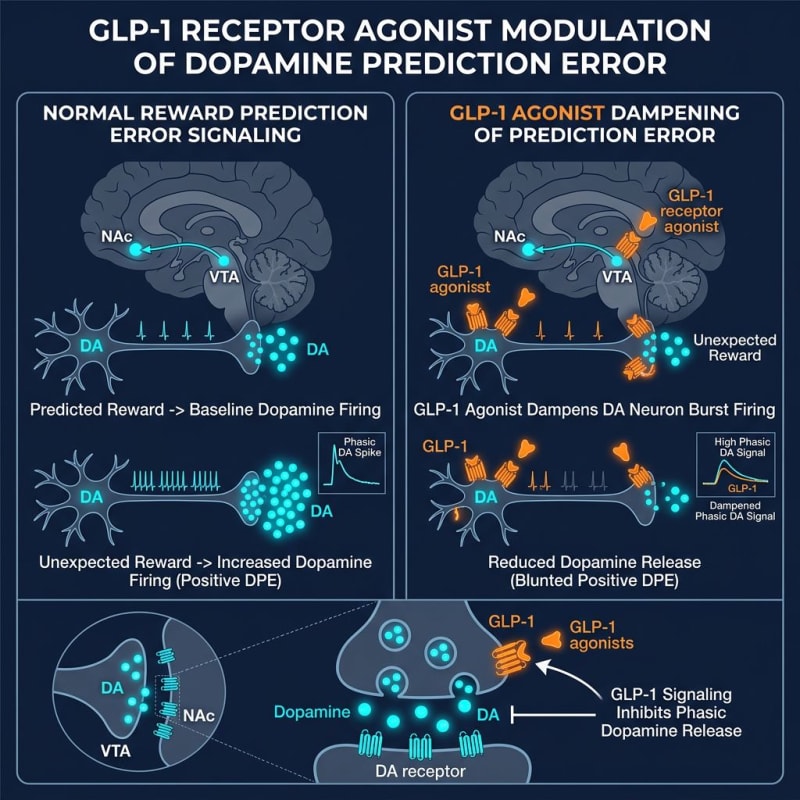
A study of reward-related signaling should specify whether it measures neuronal activity, extracellular dopamine, cue learning, consumption, or task performance. Reduced responding can have several explanations, including altered motivation, motor performance, sensory processing, or nonspecific behavioral disruption. A single behavioral readout cannot distinguish them.
Experimental Design and Interpretation
The following considerations are methodological recommendations, not findings attributed to the cited studies:
- In-vitro work: Define the cell system, receptor-expression context, controls, assay interference checks, and functional readout. Activity in a receptor assay does not establish a neural-circuit effect.
- Nonclinical animal studies: Specify species, strain, sex, nutritional state, task conditions, and relevant behavioral controls. Separate consumption, preference, locomotion, and avoidance-related endpoints rather than treating all changes as reward modulation.
- Neural measurements: Distinguish direct compound localization, receptor engagement, activity markers, and dopamine measurements. Identify which of these the method actually supports.
- In-silico work: Treat predicted receptor interactions or distribution as hypotheses requiring experimental validation. No in-silico semaglutide finding is established by this article.
- Reporting: Prespecify endpoints and analysis where practicable, describe blinding and randomization, and report uncertainty and negative results.
Comparative Research Without Mechanistic Equivalence
Related compounds appearing in the original article include liraglutide, tirzepatide, retatrutide, and mazdutide. These links identify separate research materials, not validated substitutes, combination partners, or comparators for a particular experiment.
A comparative study needs compound-specific characterization, justified assay conditions, and matched endpoints. The supplied material does not support ranking these compounds by brain penetration, dopamine effects, or experimental superiority. Human pharmacokinetic values also should not be relabeled as general laboratory half-lives.
Laboratory Handling and Documentation
Use the applicable safety data sheet, documented storage requirements, and institutional chemical-hygiene procedures to determine handling controls, personal protective equipment, spill response, and waste disposal. This article does not supply a material-specific hazard assessment or validated storage protocol.
Record storage history, sample preparation history, and analytical observations relevant to the experiment. Degradation or compositional differences can complicate interpretation, but their effects must be measured rather than assumed. Neither HPLC nor routine mass spectrometry alone establishes a peptide's complete three-dimensional structure, biological specificity, or absence of hazardous contaminants.
References
- Gabery, S., et al. (2020). Semaglutide lowers body weight in rodents via distributed neural pathways. JCI Insight, 5(6), e133429. — https://doi.org/10.1172/jci.insight.133429
- Blundell, J., et al. (2017). Effects of once-weekly semaglutide on appetite, energy intake, control of eating, food preference and body weight in subjects with obesity. Diabetes, Obesity and Metabolism, 19(9), 1242-1251. — https://doi.org/10.1111/dom.12932
- Alhadeff, A. L., et al. (2012). The effects of central glucagon-like peptide-1 on food reward and motivation. Chemical Senses, 37(8), e16. — https://doi.org/10.1093/chemse/bjs046
- Klausen, M. K., et al. (2022). The role of glucagon-like peptide 1 (GLP-1) in addictive disorders. British Journal of Pharmacology, 179(4), 625-641. — https://doi.org/10.1111/bph.15677
- Decara, J. M., et al. (2016). Glucagon-like peptide-1 receptor activation causes dose-dependent reduction in alcohol intake. Addiction Biology, 21(5), 1038-1039. — https://doi.org/10.1111/adb.12285
- Ten Kulve, J. S., et al. (2016). Endogenous GLP-1 mediates postprandial reduction in activation in the reward system. Endocrine Connections, 5(1), 1-2.
- Jerlhag, E., et al. (2011). Requiring the glucagon-like peptide-1 receptor for the alcohol-mediated effects on the mesoaccumbens dopamine system. Neuropsychopharmacology, 36(11), 249-250. — https://doi.org/10.1038/npp.2011.166
- Araneta, R. G., & Alhadeff, A. L. (2020). Gut-Brain GLP-1 Pathways in Control of Food Intake. Current Opinion in Behavioral Sciences, 36, 127-133. — https://doi.org/10.1016/j.cobeha.2020.10.009
- Lau, J., et al. (2015). Discovery of the Once-Weekly Glucagon-Like Peptide-1 (GLP-1) Analogue Semaglutide. Journal of Medicinal Chemistry, 58(18), 7370–7380. — https://doi.org/10.1021/acs.jmedchem.5b00726
- Samson, S. L., et al. (2024). Safety and efficacy of semaglutide in metabolic dysfunction-associated steatotic liver disease. The Lancet Gastroenterology & Hepatology.
Limitations
Evidence is specific to the compound, model, and endpoints studied. Published findings do not establish the safety, effectiveness, approval, or suitability of material sold by Alpha Carbon Labs for human or veterinary use. These materials are intended solely for nonclinical laboratory research.