Retatrutide Research: Receptor Pharmacology and Secondary Metabolic Questions
A research-focused review of retatrutide receptor pharmacology, unresolved HPA-axis and biliary questions, and the analytical documentation needed for nonclinical laboratory studies.
Introduction: Defining the Research Question
Retatrutide, also identified as LY3437943, is a peptide investigated for activity at the glucagon receptor (GCGR), glucose-dependent insulinotropic polypeptide receptor (GIPR), and glucagon-like peptide-1 receptor (GLP-1R). In the cell-based receptor assays reported by Coskun et al. (2022), LY3437943 exhibited agonist activity at all three receptor targets. That receptor profile provides a basis for studying multireceptor signaling; it does not establish every downstream endocrine or biliary effect proposed for the molecule.
This review focuses on how laboratory researchers can evaluate claims about secondary metabolic pathways, particularly the hypothalamic-pituitary-adrenal (HPA) axis and gallbladder physiology. Receptor activation, tissue responses, and longitudinal organism-level observations represent different levels of evidence and should not be treated as interchangeable.
Molecular Identity and Receptor Assays
Coskun et al. (2022) describe LY3437943 as a modified, acylated, 39-amino-acid peptide based on a GIP sequence, and characterize its receptor activity in cell-based assays. Structural identity and assay performance are separate questions: a sequence description alone cannot establish the activity of a particular laboratory sample.
Related research materials include semaglutide and tirzepatide. Product listings are not comparative experimental datasets. Any receptor-level comparison requires matched assay conditions and independently characterized materials rather than assumptions based on product names.
Interpreting Potency Measurements
Functional potency is not the same as binding affinity. An EC50 describes the concentration producing half of the measured maximal response under specified assay conditions; it does not independently describe receptor binding, signaling selectivity, or long-term tissue effects.
For an interpretable comparison across GCGR, GIPR, and GLP-1R assays, document:
- The cell model, receptor species, and receptor-expression system.
- The measured endpoint, exposure interval, and assay conditions.
- The reference ligand, concentration-response range, and normalization method.
- Maximal response, replicate structure, uncertainty, and controls for assay interference.
The original article's numerical potency ratios are not retained because their assay conditions and calculation basis were not specified. Relative potency values should be reported only alongside their source methods and reference ligands.
The HPA Axis: Separating Hypotheses from Findings
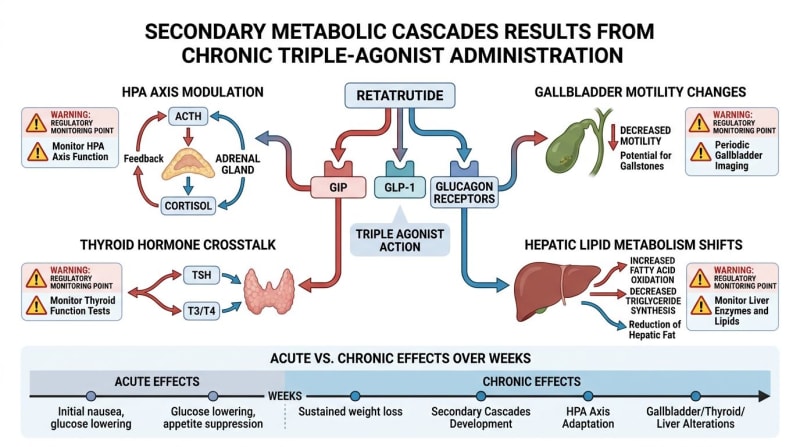
The HPA axis is a neuroendocrine feedback system involving hypothalamic, pituitary, and adrenal signaling. Establishing whether a test material changes that system requires an appropriate experimental model and direct measurements. Activity in an isolated receptor assay cannot demonstrate an integrated HPA-axis response.
The supplied article does not identify a retatrutide-specific experiment that establishes chronic HPA-axis activation, amplified glucocorticoid release, a “pseudo-fasting” state, glucocorticoid resistance, or altered 11β-HSD1 activity. These claims therefore should not be presented as observed effects. Findings about another receptor agonist would also require explicit attribution to the tested compound, species, tissue, and experimental conditions before their relevance could be assessed.
Model-Specific Questions
For nonclinical work addressing this topic, define whether the question concerns receptor signaling, steroid metabolism in an isolated tissue, or feedback across an intact endocrine system. A cell assay of 11β-HSD1 activity, for example, addresses a narrower question than HPA-axis adaptation. Record the sampled compartment, sampling time, and model-specific glucocorticoid endpoint rather than treating all hormone measurements as equivalent.
Gallbladder Motility and Biliary Endpoints
Gallbladder contraction, bile flow, bile composition, and biliary pathology are distinct endpoints. A change in one does not establish a change in the others. The supplied article does not provide model-specific experimental support for its categorical claims that the three receptor components have predictable, opposing effects on gallbladder function.
In particular, it does not establish that GCGR activity counterbalances another receptor's effect on emptying, or that a particular biliary outcome follows from retatrutide's receptor profile. A study title mentioning gallbladder health is not a substitute for checking the actual model, methods, and results.
| Research question | Endpoint to define | Interpretive boundary |
|---|---|---|
| Does an isolated preparation change its contractile response? | Contractility under defined experimental conditions | An isolated-tissue result does not establish whole-organ emptying. |
| Does bile composition differ between experimental conditions? | Specified bile constituents and the analytical method used | Composition alone does not establish obstruction or stone formation. |
| Is a longitudinal structural change observed? | Model-appropriate imaging or tissue assessment | An association does not identify the responsible receptor or mechanism. |
These are methodological distinctions, not reported retatrutide findings or recommendations for clinical monitoring. Experiments intended to assign an effect to one receptor require controls capable of distinguishing that receptor's contribution from other pathways.
Other Endocrine Pathways and Evidence Boundaries
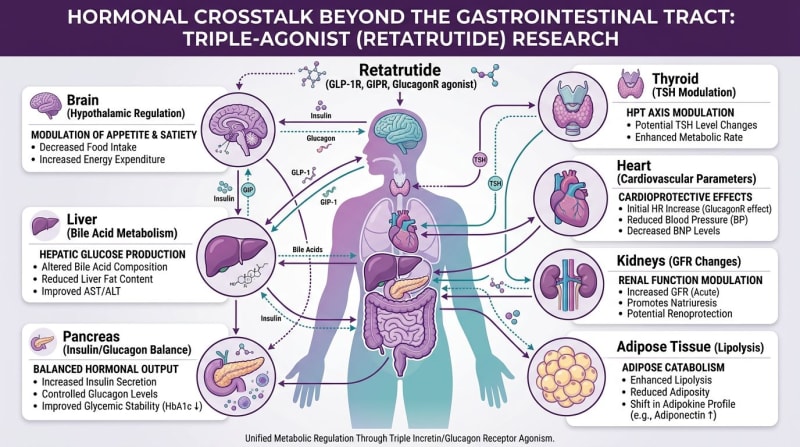
Thyroid, gonadal, hepatic, and adipose endpoints should be evaluated as separate research questions. The supplied article does not substantiate retatrutide-specific claims about peripheral thyroid-hormone conversion, suppression of hypothalamic reproductive signaling, or the need for additional peptides to preserve endocrine function. Those claims and combination recommendations have been removed.
Jastreboff et al. (2023) report a phase 2 study in human adults with obesity. That study is human clinical evidence, not an in-vitro or animal experiment, and is not a validation of an Alpha Carbon Labs material. Its population and study conditions must remain attached to any discussion of its results; it should not be used to infer unmeasured HPA-axis or biliary mechanisms.
Likewise, animal observations require species and experimental-context attribution, while cell-based findings apply to the tested assay system. Computational predictions, if considered in future work, would be in-silico hypotheses requiring experimental evaluation, not observed biological outcomes.
Material Characterization and Laboratory Documentation
For work involving retatrutide research material, review the documentation available for the specific lot. The Quality Control and COA Documents pages are relevant internal resources, but their existence does not establish that a particular lot has undergone every test required for an experiment.
- Identity: Review the reported method and supporting data rather than relying solely on a label or nominal sequence.
- Purity and content: Distinguish chromatographic purity from peptide content and other sample constituents. A single reported percentage does not establish all of these attributes.
- Functional activity: Do not infer receptor potency from an identity or purity result; functional activity requires an appropriate assay.
- Traceability: Record the lot identifier, storage history, sample preparation, and assay controls.
Background information on peptide synthesis does not replace lot-specific characterization or demonstrate equivalence to material used in published studies. No lot-specific analytical specifications, validated storage conditions, or hazard data are supplied in this article. Consult the applicable safety data sheet and institutional laboratory procedures for handling and disposal; absence of hazard information is not evidence of safety.
Research Outlook
The useful long-term question is not whether triple agonism necessarily produces a particular secondary cascade, but which effects can be demonstrated in a defined model with suitable controls. Receptor pharmacology, endocrine feedback, and biliary physiology require distinct experimental approaches. Negative findings, assay limitations, and alternative explanations are as important as positive observations.
References
- Coskun, T., et al. (2022). LY3437943, a novel triple glucagon, GIP, and GLP-1 receptor agonist for glycemic control and weight loss: From discovery to clinical proof of concept. Cell Metabolism, 34(9), 1234-1247. — https://doi.org/10.1016/j.cmet.2022.07.013
- Jastreboff, A. M., et al. (2023). Triple-Hormone-Receptor Agonist Retatrutide for Obesity — A Phase 2 Trial. New England Journal of Medicine, 389(6), 514-526. — https://doi.org/10.1056/NEJMoa2301972
- Müller, T. D., et al. (2022). The development of next-generation poly-agonists for the treatment of metabolic disease. Nature Reviews Drug Discovery, 21, 201–223.
- Heppner, K. M., et al. (2015). Glucagon regulation of energy expenditure and body weight. Molecular Metabolism, 4(2), 64-67. — https://doi.org/10.1016/j.molmet.2014.12.001
- Finan, B., et al. (2016). Multireceptor Agonists for the Treatment of Metabolic Disease. Endocrine Reviews, 37(6), 637-651.
- Evers, A., et al. (2023). From dual to triple-agonists: The next generation of metabolic drugs. Journal of Peptide Science, 29(2), e3451. — https://doi.org/10.1002/psc.3451
- Alhushki, W., et al. (2024). Triple agonists and gallbladder health: Implications for long-term administration. Gastroenterology Research and Practice. — https://pubmed.ncbi.nlm.nih.gov/38210455/
- Nauck, M. A., & Quast, D. R. (2023). Triple Agonism: The Future of Incretin-Based Therapy. Diabetologia, 66, 1789–1803.
Limitations
Evidence is specific to the tested material, model, and experimental conditions. Published findings do not establish the safety, effectiveness, approval, or suitability of material sold by Alpha Carbon Labs for human or veterinary use; these materials are intended solely for nonclinical laboratory research.
References
- 1. Coskun, T., et al. (2022). LY3437943, a novel triple glucagon, GIP, and GLP-1 receptor agonist for glycemic control and weight loss: From discovery to clinical proof of concept. Cell Metabolism, 34(9), 1234-1247.
- 2. Jastreboff, A. M., et al. (2023). Triple-Hormone-Receptor Agonist Retatrutide for Obesity — A Phase 2 Trial. New England Journal of Medicine, 389(6), 514-526.
- 3. Müller, T. D., et al. (2022). The development of next-generation poly-agonists for the treatment of metabolic disease. Nature Reviews Drug Discovery, 21, 201–223.
- 4. Heppner, K. M., et al. (2015). Glucagon regulation of energy expenditure and body weight. Molecular Metabolism, 4(2), 64-67.
- 5. Finan, B., et al. (2016). Multireceptor Agonists for the Treatment of Metabolic Disease. Endocrine Reviews, 37(6), 637-651.
- 6. Evers, A., et al. (2023). From dual to triple-agonists: The next generation of metabolic drugs. Journal of Peptide Science, 29(2), e3451.
- 7. Alhushki, W., et al. (2024). Triple agonists and gallbladder health: Implications for long-term administration. Gastroenterology Research and Practice.
- 8. Nauck, M. A., & Quast, D. R. (2023). Triple Agonism: The Future of Incretin-Based Therapy. Diabetologia, 66, 1789–1803.
Related Hormonal research
- CJC-1295 and Ipamorelin: Mechanisms and Evidence in Growth Hormone Research
- Sermorelin and Tesamorelin Comparison for Growth Hormone Research
- Oxytocin and PT-141: Evidence and Limits in Reward-Signaling Research
- Kisspeptin-10 and the HPG Axis in Metabolic Research
- Kisspeptin-10 in Energy-Balance and GnRH Pulse Research
- MK-677 and GHRP-6: Adipokine and Lipid-Flux Research
All research information is for educational purposes only. The statements made within this website have not been evaluated by the US Food and Drug Administration. The statements and the products of this company are not intended to diagnose, treat, cure or prevent any disease.