NAD+ Metabolism and Microglial Inflammatory Signaling
Nicotinamide adenine dinucleotide links cellular redox metabolism with enzyme-mediated signaling. In nonclinical central nervous system research, its relationship to microglial state requires attention to cell identity, metabolic compartment, experimental stimulus, and the endpoints measured.
Biochemical Context
NAD+ is the oxidized form of nicotinamide adenine dinucleotide; NADH is its reduced form. NAD+ is a coenzyme, not a peptide. NAD+/NADH participates in redox reactions, while NAD+ also serves as a substrate for enzymes including sirtuins, poly(ADP-ribose) polymerases (PARPs), and CD38. Redox cycling and enzymatic NAD+ consumption are distinct processes: conversion between NAD+ and NADH does not itself describe the synthesis or breakdown of the total dinucleotide pool.
Major mammalian biosynthetic routes include nicotinamide salvage, de novo synthesis from tryptophan, and the Preiss–Handler pathway from nicotinic acid. In nicotinamide salvage, NAMPT produces nicotinamide mononucleotide (NMN), and NMN adenylyltransferases subsequently produce NAD+. The relative contribution of these pathways should not be assumed to be identical in neurons, microglia, peripheral macrophages, or cultured cell lines.
Total NAD+ abundance and the NAD+/NADH ratio answer different questions. Whole-cell measurements also do not resolve nuclear, cytosolic, and mitochondrial pools. These distinctions matter when relating metabolite measurements to inflammatory signaling or mitochondrial readouts.
What the Supplied Literature Establishes—and Where It Applies
The supplied references include primary experiments and reviews. Reviews [2, 4, 7, 8, 10] provide background across multiple experimental settings rather than a single study population. They should not be treated as independent microglial experiments or as evidence about a particular commercial material.
Macrophage evidence: Minhas and colleagues [1] investigated de novo NAD+ synthesis in macrophage experimental systems in the context of aging and inflammation. This is macrophage evidence, not a direct demonstration of the same pathway relationships in brain-resident microglia. Any proposed extension to microglia requires testing in a defined microglial model.
Mouse microglial evidence: Cho and colleagues [6] examined microglial SIRT1 deficiency in mouse experiments involving aging and amyloid-beta-associated pathology. This genetic evidence is relevant to investigating microglial SIRT1, but it does not establish that adding extracellular NAD+ produces the reverse phenotype.
Mouse aging evidence outside a microglia-specific setting: Camacho-Pereira and colleagues [5] investigated CD38, age-associated NAD+ decline, and mitochondrial function in mice, with a reported SIRT3-dependent mechanism. These findings should not be rewritten as proof of a CD38–SIRT1 pathway in aging microglia.
Mouse skeletal-muscle evidence: Gomes and colleagues [9] investigated NAD+-related nuclear–mitochondrial communication in aging mouse skeletal muscle. That tissue context must remain explicit; it is not direct evidence of microglial inflammatory regulation.
Animal findings, isolated-cell experiments, and human observations are not interchangeable. A human-derived cell culture is an in-vitro model, not a human intervention study. No human-use outcome or in-silico prediction is inferred here from the experimental literature.
Microglial States: Beyond a Binary Metabolic Switch
Microglia are resident immune cells of the central nervous system. The historical M1/M2 terminology is a simplified framework and should not be used to assign all microglial responses to two fixed categories. A cytokine measurement alone does not establish a complete cell state, and neither a high NAD+/NADH ratio nor a respiratory measurement independently demonstrates a homeostatic phenotype.
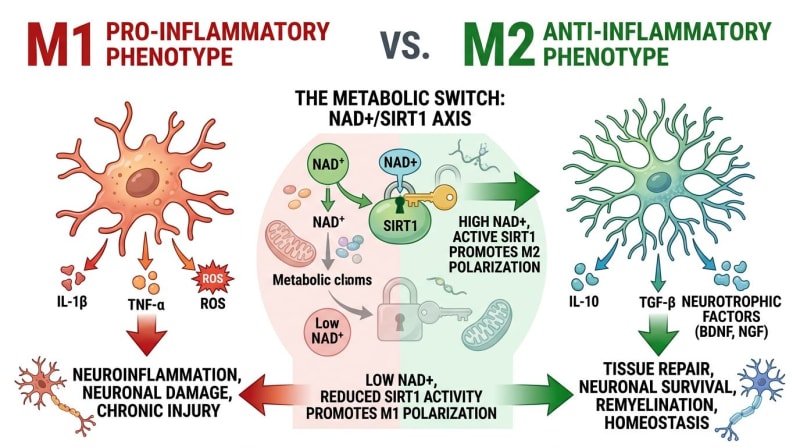
For in-vitro microglial studies, describe the species, cell source, differentiation or isolation method, culture conditions, and experimental stimulus. For animal studies, identify the species, tissue region, and method used to distinguish microglia from other myeloid cells. These details define the scope of any observed association.
| Experimental question | Potential readouts | Interpretive limitation |
|---|---|---|
| Does the dinucleotide pool change? | Separate NAD+ and NADH measurements; normalization to cell number or another justified measure | A ratio can change without an increase in total pool size. |
| Does cellular metabolism change? | Oxygen-consumption and extracellular-acidification measurements | Neither measurement alone defines an inflammatory or homeostatic state. |
| Does inflammatory signaling change? | Cytokine transcripts and proteins; NF-κB localization or transcriptional activity | Transcript, secreted protein, and pathway activity are different endpoints. |
| Is SIRT1 involved? | SIRT1 abundance, enzyme activity, and substrate-acetylation measurements | NAD+ abundance alone does not establish SIRT1 activity or causality. |
| Are cell-state measurements confounded? | Viability, cell counts, morphology, and cell-identity markers | Cell loss or a mixed population can alter apparent metabolic and inflammatory readouts. |
Investigating SIRT1 and NF-κB
SIRT1 is an NAD+-dependent deacetylase, while NF-κB is a transcription-factor family involved in inflammatory gene regulation. A proposed relationship between the two requires direct pathway measurements; it should not be reduced to an assumption that more NAD+ necessarily switches inflammatory transcription off.
In a defined in-vitro microglial experiment, researchers can compare NAD+ measurements with SIRT1 activity, acetylation of the NF-κB p65 subunit, nuclear localization, and selected transcriptional outputs. Appropriate genetic or pharmacological controls are needed to distinguish SIRT1-dependent effects from other changes. Deacetylation should not be equated automatically with complete loss of DNA binding.
The mouse microglial SIRT1-deficiency experiments reported by Cho and colleagues [6] provide a model-specific reason to examine this enzyme. They do not establish intracellular uptake, target engagement, or pathway effects for NAD+ sold by Alpha Carbon Labs.
CD38, NAD+ Consumption, and Mitochondrial Measurements
CD38 consumes NAD+ and participates in nucleotide-mediated signaling. PARPs and sirtuins also consume NAD+, but their activities are not interchangeable. Expression of an NAD+-consuming enzyme is not a direct measurement of its activity, and a change in NAD+ abundance does not identify the responsible pathway.
In the mouse aging study by Camacho-Pereira and colleagues [5], the reported mitochondrial mechanism involved SIRT3. A microglial experiment would therefore need its own cell-specific measurements before assigning the same mechanism, or substituting SIRT1 for SIRT3. A proposed feedback loop involving inflammatory signals, CD38, and NAD+ remains a hypothesis unless its individual steps are tested in the stated model.
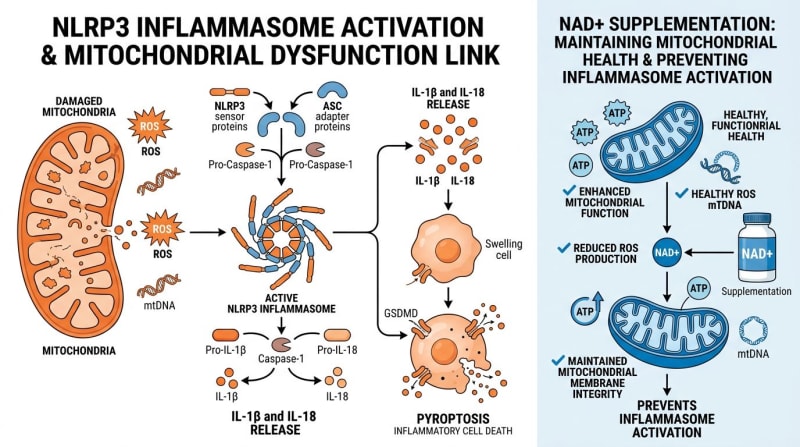
For in-vitro studies of mitochondrial stress and NLRP3, distinguish reactive-oxygen-species measurements, inflammasome assembly, caspase-1 processing, and mature IL-1β release. These endpoints are not substitutes for one another. Probe interference, changes in cell number, and viability should be considered when interpreting apparent pathway differences.
Material Documentation and Laboratory Handling
The NAD+ material listing is separate from the published literature discussed above. Before an assay, review the documented chemical form, lot-specific identity and analytical information, supplier storage instructions, and safety data sheet. The source article provides no lot-specific analytical results from which to infer purity, stability, or biological activity.
Storage and handling requirements depend on the supplied form and its documentation. Do not assume a universal storage temperature or stability period. Follow the applicable safety data sheet and institutional procedures for exposure prevention, personal protective equipment, spills, and disposal; do not infer that research use means the material is nonhazardous.
For cellular assays, an extracellular NAD+ exposure is not a measurement of intracellular NAD+ availability. Uptake, extracellular conversion, and compartment-specific changes require appropriate measurements. For biochemical assays, include blanks, calibration or recovery controls as appropriate, and checks for material-related interference.
The quality-control information can be reviewed alongside available lot documentation. Analytical characterization does not by itself establish a microglial effect or reproduce a published experiment. The supplied references do not provide direct evidence for transferring their findings to Alpha Carbon Labs products or for asserting synergy with other catalog materials.
References
- Minhas, P. S., et al. (2019). Macrophage de novo NAD+ synthesis specifies immune function in aging and inflammation. Nature Immunology, 20, 50–63. — https://doi.org/10.1038/s41590-018-0255-3
- Verdin, E. (2015). NAD⁺ in aging, metabolism, and neurodegeneration. Science, 350(6265), 1208-1213. — https://doi.org/10.1126/science.aac4854
- Gan, L., & Mucke, L. (2008). Paths of neurodegeneration: the peculiar case of autophagy in TBI. Neuron, 58(1), 10-25. (Context: Sirtuins and Neuroprotection). — https://doi.org/10.1016/j.neuron.2008.03.004
- Lautrup, S., Sinclair, D. A., Mattson, M. P., & Fang, E. F. (2019). NAD+ in Brain Aging and Neurodegenerative Disorders. Cell Metabolism, 30(4), 630-655. — https://doi.org/10.1016/j.cmet.2019.09.001
- Camacho-Pereira, J., et al. (2016). CD38 Dictates Age-Related NAD Decline and Mitochondrial Dysfunction through an SIRT3-Dependent Mechanism. Cell Metabolism, 23(6), 1127-1139. — https://doi.org/10.1016/j.cmet.2016.05.006
- Cho, S. H., et al. (2015). SIRT1 deficiency in microglia contributes to amyloid-beta-associated cognitive decline. Aging Cell, 14(6), 994-1003. — https://doi.org/10.1111/acel.12384
- Covarrubias, A. J., et al. (2021). NAD+ metabolism and its roles in cellular processes during aging. Nature Reviews Molecular Cell Biology, 22, 119–141. — https://doi.org/10.1038/s41580-020-00313-x
- Braidy, N., et al. (2019). NAD+ therapy in age-related degenerative disorders: A benefit/risk analysis. Experimental Gerontology, 115, 20-37. — https://doi.org/10.1016/j.exger.2018.11.011
- Gomes, A. P., et al. (2013). Declining NAD(+) induces a pseudohypoxic state disrupting nuclear-mitochondrial communication during aging. Cell, 155(7), 1624-1638. — https://doi.org/10.1016/j.cell.2013.11.037
- Xie, N., et al. (2020). NAD+ metabolism: pathophysiologic mechanisms and therapeutic potential. Signal Transduction and Targeted Therapy, 5, 227. — https://doi.org/10.1038/s41392-020-00311-7
Limitations
Findings are limited to the models and endpoints studied. Alpha Carbon Labs materials are intended solely for nonclinical laboratory research; published findings do not establish safety, effectiveness, approval, or suitability of the material sold for human or veterinary use.