Retatrutide as a Multi-Receptor Research Subject
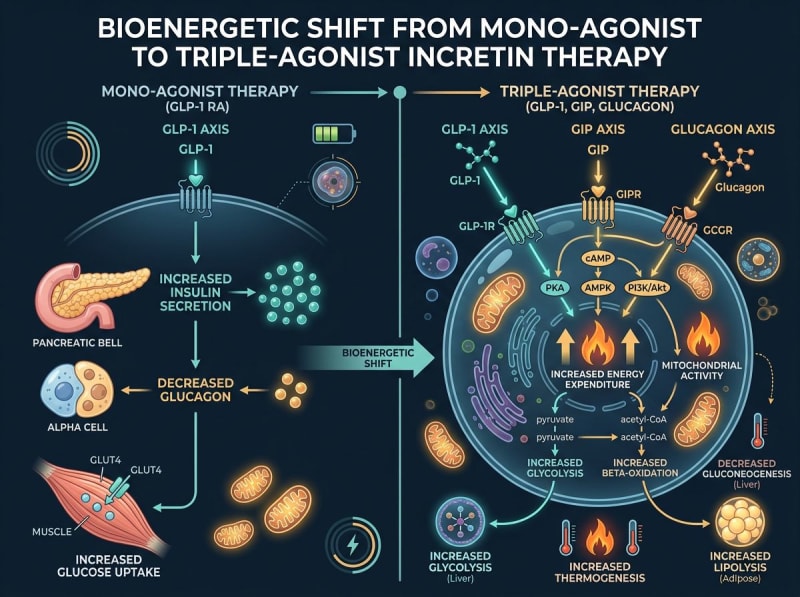
Retatrutide, also identified as LY3437943, is an engineered peptide studied for agonist activity at the glucagon-like peptide-1 receptor (GLP-1R), glucose-dependent insulinotropic polypeptide receptor (GIPR), and glucagon receptor (GCGR). In the in-vitro receptor characterization reported by Coskun and colleagues, LY3437943 showed functional activity at all three receptors [3]. This receptor profile is the basis for the term triple agonist; it does not imply equal potency across receptors or establish a particular response in every experimental system.
For nonclinical laboratory research, the central questions concern molecular identity, receptor-dependent signaling, and the conditions under which an assay response can be attributed to a particular receptor. Published results for investigational material must be distinguished from the properties of any material supplied by Alpha Carbon Labs.
Structural Biochemistry
Retatrutide is a 39-amino-acid, GIP-based peptide. The molecular description accompanying the in-vitro and preclinical characterization by Coskun and colleagues includes alpha-aminoisobutyric acid (Aib) at position 2 and a C20 fatty diacid attached through a linker at lysine 17 [3]. These structural features distinguish the molecule from unmodified endogenous peptide hormones. They do not, by themselves, verify the identity or functional activity of a supplier's batch.
The earlier description of retatrutide as both oxyntomodulin-based and GIP-based was inconsistent. Its structure should be described using the published molecular identity rather than an analogy to a different multi-receptor peptide. Likewise, the development of the published molecule should not be attributed to Alpha Carbon Labs' synthesis facilities without supporting evidence.
- Sequence identity: Confirm that analytical documentation addresses the intended sequence and relevant modifications.
- Acylation and linker identity: Treat the attachment site and linker as part of molecular identity, not as interchangeable formulation details.
- Structure versus activity: Chemical characterization and receptor functional testing answer different questions; neither should be substituted for the other.
Interpreting Triple Agonism in Laboratory Assays
Receptor binding, signaling potency, and maximal response are distinct measurements. Binding data do not independently establish agonism. Functional potency depends on the endpoint, while maximal response depends on the comparator and assay system. Labels such as “full,” “partial,” or “high” agonist activity therefore require an identified reference ligand and experimental conditions.
The in-vitro receptor findings reported for LY3437943 by Coskun and colleagues support investigation of three receptor activities [3]. They do not justify assigning a universal potency ratio, describing GCGR activity as “optimized,” or inferring that one receptor component prevents adverse effects from another. Such conclusions require evidence specific to the question being tested.
| Measurement | What it addresses | Key limitation |
|---|---|---|
| Molecular identity | Whether the analytical findings support the intended peptide structure | Does not establish receptor activity |
| Chromatographic purity | The detected component profile under a specified method | Does not independently establish peptide content or identify every impurity |
| Receptor binding | Interaction with a receptor under defined conditions | Does not establish the direction or magnitude of signaling |
| Functional concentration–response | Signaling potency and maximal response in a defined assay | Depends on receptor expression, assay timing, and the selected endpoint |
Designing Informative Nonclinical Comparisons
A cell-based investigation can evaluate each receptor separately before examining a system that expresses multiple receptors. For a cAMP endpoint, document the cell background, receptor species, receptor-expression conditions, incubation interval, detection method, and data-normalization procedure. These are assay-design considerations, not a claim that a particular protocol has been validated for Alpha Carbon Labs material.
- Reference controls: Include an appropriate reference agonist for each receptor and a vehicle control.
- Background controls: Use a suitable receptor-negative or parental-cell control where available to assess receptor-independent responses.
- Readout integrity: Assess assay interference and cell viability separately from the signaling endpoint.
- Comparability: Compare compounds under matched conditions rather than combining potency values from unrelated assays.
- Reproducibility: Report independent experiments, replicate structure, curve-fitting assumptions, and uncertainty.
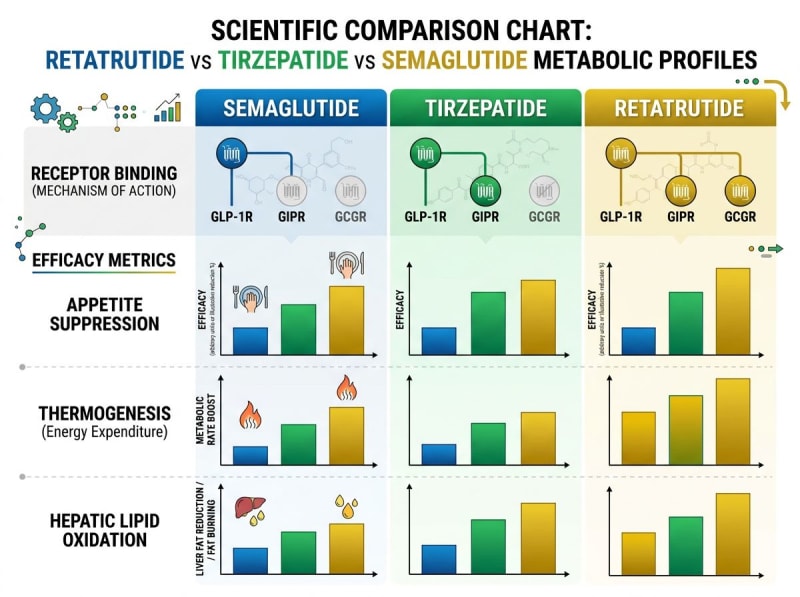
Related catalog entries include semaglutide, tirzepatide, and retatrutide. These links identify materials discussed in the broader receptor-research context; they are not evidence of equivalent composition, activity, or suitability as validated assay controls. Comparing two multi-receptor peptides alone cannot isolate the contribution of a single receptor.
Separating Evidence Types
In-vitro evidence: The receptor characterization of LY3437943 reported by Coskun and colleagues concerns defined laboratory assay systems [3]. Its interpretation is limited to the receptors, endpoints, and conditions examined. It does not establish whole-organism responses.
Animal evidence: Animal experiments must be evaluated separately from receptor assays and human studies. No animal efficacy finding is summarized here because the original article's broad claims about thermogenesis, hepatic lipid oxidation, and organ protection were not consistently tied to an identified species, model, and endpoint.
Human evidence: Jastreboff and colleagues studied retatrutide in a phase 2 trial involving adults with obesity [1]. That human clinical study is distinct from nonclinical laboratory characterization. Its findings cannot validate Alpha Carbon Labs material or establish its suitability for human or veterinary use. Clinical outcome figures and administration schedules are not reproduced here.
In-silico evidence: No computational result is summarized in this article. A proposed receptor interaction or structural analogy should not be presented as an experimentally demonstrated mechanism.
Receptor signaling alone does not establish changes in thermogenesis, autophagy, tissue lipid content, or organ function. Each proposed downstream mechanism requires a defined model, direct measurements, and controls that distinguish receptor-mediated effects from alternative explanations. The supplied bibliography remains attached, but inclusion in that list is not verification of every claim previously associated with it.
Analytical Documentation and Laboratory Handling
Review the applicable certificate of analysis and available quality-control documentation before selecting a batch for an experiment. This article does not establish a batch-specific purity threshold, peptide content, identity result, or functional potency. Documentation should be assessed for its methods, reporting limits, batch identifier, and relevance to the planned assay.
Where available, distinguish mass-spectrometric identity data, chromatographic purity, and quantitative peptide content. A chromatographic area percentage is not automatically a mass fraction. It also does not establish sterility, absence of endotoxin, or biological activity.
Use the applicable safety data sheet, batch documentation, and institutional risk assessment to determine storage, protective equipment, containment, spill response, and waste handling. Avoid generating dust or aerosols and prevent unintended exposure. No material-specific hazard classification or validated storage condition is supplied in the source article, so neither is inferred here. Record storage history and sample handling when assessing experimental variability.
References
- Jastreboff AM, et al. Triple-Hormone-Receptor Agonist Retatrutide for Obesity - A Phase 2 Trial. New England Journal of Medicine. 2023. — https://pubmed.ncbi.nlm.nih.gov/37366315/
- Knerr PJ, et al. Next generation GLP-1/GIP/glucagon triple agonists for the treatment of obesity and type 2 diabetes. Cell Metabolism. 2023. — https://doi.org/10.1016/j.cmet.2023.05.006
- Coskun T, et al. LY3437943, a novel triple glucagon, GIP, and GLP-1 receptor agonist for glycemic control and weight loss: From bench to bedside. Cell Metabolism. 2022. — https://doi.org/10.1016/j.cmet.2022.07.013
- Müller TD, et al. Glucagon-like peptide 1 (GLP-1). Molecular Metabolism. 2019. — https://doi.org/10.1016/j.molmet.2019.09.010
- Heppner KM, et al. Glucagon regulation of energy expenditure. Physiology & Behavior. 2015. — https://doi.org/10.1016/j.physbeh.2015.03.014
- Finan B, et al. A strategically designed tri-agonist multispecificity for the treatment of metabolic syndrome. Science Translational Medicine. 2014.
- Capozzi ME, et al. The Glucose-Dependent Insulinotropic Polypeptide Receptor Is Essential for the Glucoregulatory Role of the Glucagon Receptor. Diabetes. 2019.
- Sanyal AJ, et al. Retatrutide in Patients with Non-alcoholic Fatty Liver Disease: A Randomized Phase 2 Trial. Hepatology. 2023. — https://doi.org/10.1097/HEP.0000000000000609
Limitations
Alpha Carbon Labs materials are intended solely for nonclinical laboratory research. Published findings do not establish the safety, effectiveness, approval, or suitability of the material sold for human or veterinary use.