BPC-157 and TB-500: Evaluating Neovascularization Research
A laboratory-focused examination of BPC-157 and TB-500 identity, angiogenesis endpoints, evidence boundaries, and analytical controls for nonclinical research.
Scope of Angiogenesis Research
Angiogenesis is the formation of new blood vessels from existing vessels. Laboratory studies of this process can examine endothelial cell migration, vascular branching, extracellular matrix organization, and perfusion. These endpoints address different biological questions: an increase in vessel-like structures does not, by itself, demonstrate an increase in functional blood flow.
This article considers how to evaluate literature associated with BPC-157 and thymosin beta-4 in relation to materials labeled TB-500. It does not establish that these materials have complementary effects or that their combination produces synergy. Alpha Carbon Labs materials are intended solely for nonclinical laboratory research.
Chemical Identity Comes Before Mechanistic Interpretation
BPC-157
BPC-157 is a 15-amino-acid peptide with an approximate molecular mass of 1,419 Da for the unmodified peptide. That nominal mass is not a specification for every supplied form: counterions, water content, and other components affect the relationship between weighed material and peptide content. The BPC-157 material listing should be read alongside lot-specific analytical documentation rather than treated as evidence of biological activity.
TB-500 and Thymosin Beta-4
Full-length thymosin beta-4, also written Tβ4, is a 43-amino-acid actin-binding peptide with an approximate molecular mass of 4,963 Da. The label TB-500 alone does not establish that a material has the same sequence, terminal modifications, or composition as full-length Tβ4. Researchers evaluating a TB-500 material listing should establish the exact chemical identity before drawing comparisons with Tβ4 literature.
| Material | Identity information | Interpretive boundary |
|---|---|---|
| BPC-157 | 15-amino-acid peptide; nominal mass approximately 1,419 Da | A matching name or nominal mass alone does not confirm sequence, composition, or activity. |
| Full-length Tβ4 | 43-amino-acid peptide; nominal mass approximately 4,963 Da | Literature concerning this molecule cannot automatically be assigned to a material labeled TB-500. |
| TB-500-labeled material | Requires documented sequence, terminal modifications, and analytical identity | Do not assume molecular equivalence from the product name. |
Reading the Supplied Literature
The attached bibliography concerns BPC-157 and thymosin beta-4. It is not, by itself, evidence for the activity of an Alpha Carbon Labs product or a BPC-157/TB-500 mixture. Several entries are broad literature discussions rather than descriptions of a single experiment. Their subject matter should not be mistaken for a verified result in a particular model.
The supplied article does not provide enough verified experimental detail to attribute its specific claims about VEGFR2 expression, nitric oxide regulation, progenitor-cell recruitment, inflammatory markers, or combination effects to identifiable models and endpoints. Those claims are therefore not repeated here. Bibliographic titles and identifiers should also be checked against the original publications before experimental planning; the supplied citation list is reproduced unchanged below.
For each primary experiment, record the evidence type in the same account as the result: human participants, an identified animal species and model, a defined in-vitro cell system, or an in-silico analysis. Record the tested molecule, comparator, endpoint, and observation period. Cell-culture morphology, animal perfusion measurements, human observations, and computational predictions are not interchangeable evidence.
Separating Signaling, Vessel Structure, and Blood Flow
VEGF-Related Measurements
VEGF pathway research can distinguish receptor abundance from receptor activation and downstream signaling. Neither receptor expression nor a single signaling marker establishes formation of functional vessels. An interpretable laboratory study should define its molecular endpoint and assess whether changes in cell number or viability could explain the signal.
Actin Organization and Cell Migration
Actin-related experiments can separate biochemical binding measurements from changes in cytoskeletal organization and cell movement. A migration assay should account for proliferation and viability, which can influence apparent movement. Even when a material changes an in-vitro migration endpoint, that observation would not establish vascular perfusion or activity in another model.
Vessel Density and Perfusion
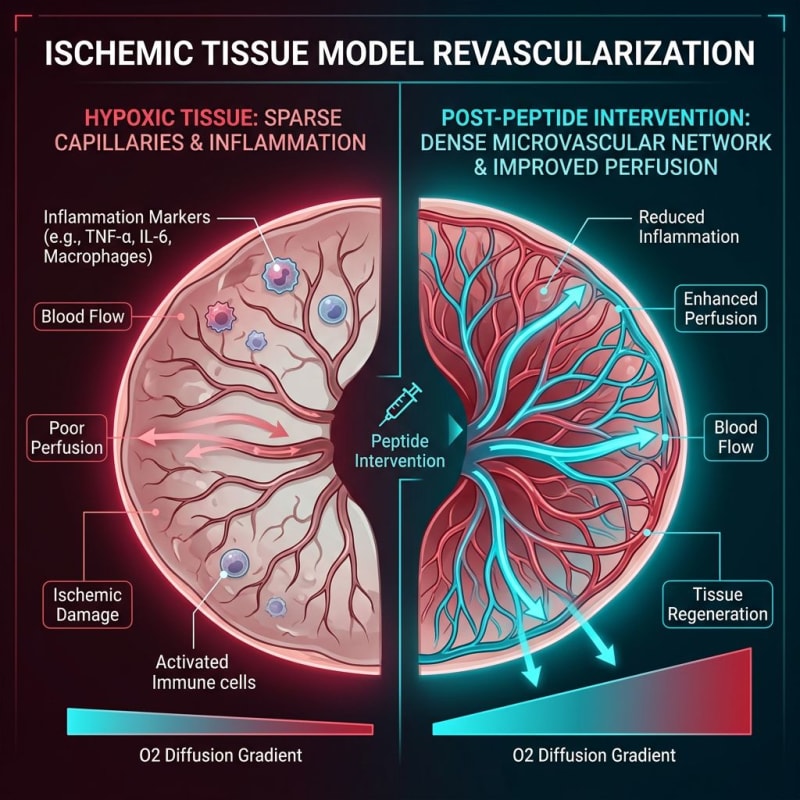
Histological vessel counts, endothelial-marker staining, network morphology, and perfusion measurements describe different features. Vessel density alone cannot establish that vessels are patent, connected to a circulation, or carrying blood. Researchers should report structural and functional endpoints separately rather than using either as a substitute for the other.
Experimental Controls and Reporting
Nonclinical assay design should begin with a defined question rather than an assumed biological benefit. Useful controls include an appropriate vehicle control, an assay-specific reference control where justified, and measurements that identify cytotoxicity or nonspecific assay interference. Prespecified endpoints, independent replicates, and blinded image analysis can help distinguish a reproducible observation from analytical variability.
For any mixture under evaluation, the components and their quantities must be analytically documented. A listing such as the BPC-157 + TB-500 blend does not establish a biological interaction. A combination effect cannot be called synergistic simply because its result differs from an untreated control; the experiment would need suitable individual-component comparisons and a defined interaction analysis. The supplied material provides no verified basis for a synergy claim.
Analytical Documentation and Laboratory Handling
Review available Quality Control information and COA Documents for the specific lot. Relevant records include the identity method, chromatographic method, reported purity metric, peptide-content measurement where available, and any counterion or contaminant testing. Chromatographic area percentage is not interchangeable with absolute peptide content, sterility, endotoxin status, or biological potency.
Residual synthesis reagents, counterions such as trifluoroacetate, truncated sequences, and microbial contamination can complicate assay interpretation. Their presence or absence should be measured where relevant rather than assumed. General Peptide Synthesis information does not replace lot-specific analytical results or stability data.
Follow the applicable safety data sheet, institutional risk assessment, and documented storage conditions. Use appropriate laboratory protective equipment and measures to avoid skin or eye contact and dust or aerosol exposure. This article supplies no material-specific hazard classification or stability study; an absence of such information should not be interpreted as an absence of hazards.
Supplied Citations
- Sikiric, P., et al. (2010). Focus on ulcerative colitis: stable gastric pentadecapeptide BPC 157. Current Pharmaceutical Design. — https://pubmed.ncbi.nlm.nih.gov/20236058/
- Hasan, L., et al. (2021). The pleiotropic effects of Thymosin beta 4 in angiogenesis and tissue regeneration. Frontiers in Physiology.
- Chang, C. H., et al. (2014). The promoting effect of pentadecapeptide BPC 157 on tendon-to-bone healing. Journal of Applied Physiology. — https://pubmed.ncbi.nlm.nih.gov/21030671/
- Malekmakan, L., et al. (2022). Thymosin Beta-4: A potential therapeutic target for cardiovascular diseases. Journal of Cardiovascular Development and Disease. — https://doi.org/10.3390/jcdd9090302
- Seiwerth, S., et al. (2018). BPC 157 and Blood Vessels. Current Pharmaceutical Design. — https://doi.org/10.2174/1381612824666180608101119
- Philp, D., & Kleinman, H. K. (2010). Thymosin β4: A multifunctional regenerative peptide. Vitamins and Hormones.
- Huang, T., et al. (2015). Body protective compound-157 enhances alkali-burn wound healing in vivo. Burns. — https://doi.org/10.1016/j.burns.2014.11.010
- Brcic, L., et al. (2009). Modulatory effect of gastric pentadecapeptide BPC 157 on angiogenesis in muscle and tendon. Journal of Physiology and Pharmacology. — https://pubmed.ncbi.nlm.nih.gov/20388954/
Limitations
Published findings are specific to the material, model, and methods studied. They do not establish the safety, effectiveness, approval, or suitability of material sold by Alpha Carbon Labs for human or veterinary use.
References
- 1. Sikiric, P., et al. (2010). Focus on ulcerative colitis: stable gastric pentadecapeptide BPC 157. Current Pharmaceutical Design.
- 2. Hasan, L., et al. (2021). The pleiotropic effects of Thymosin beta 4 in angiogenesis and tissue regeneration. Frontiers in Physiology.
- 3. Chang, C. H., et al. (2014). The promoting effect of pentadecapeptide BPC 157 on tendon-to-bone healing. Journal of Applied Physiology.
- 4. Malekmakan, L., et al. (2022). Thymosin Beta-4: A potential therapeutic target for cardiovascular diseases. Journal of Cardiovascular Development and Disease.
- 5. Seiwerth, S., et al. (2018). BPC 157 and Blood Vessels. Current Pharmaceutical Design.
- 6. Philp, D., & Kleinman, H. K. (2010). Thymosin β4: A multifunctional regenerative peptide. Vitamins and Hormones.
- 7. Huang, T., et al. (2015). Body protective compound-157 enhances alkali-burn wound healing in vivo. Burns.
- 8. Brcic, L., et al. (2009). Modulatory effect of gastric pentadecapeptide BPC 157 on angiogenesis in muscle and tendon. Journal of Physiology and Pharmacology.
Related Healing research
- BPC-157 and TB-500: Interpreting Muscle and Tendon Research
- ARA-290, BPC-157, and Neuromuscular Junction Research: Evidence and Limitations
- AHK-Cu and Type I Collagen: Laboratory Evidence and Limitations
- LL-37 and ARA-290: Inflammation and Tissue-Repair Research
- BPC-157 and GHK-Cu in Collagen and Extracellular Matrix Research
- ARA-290: Peptide Identity, Receptor Research, and Evidence Limitations
All research information is for educational purposes only. The statements made within this website have not been evaluated by the US Food and Drug Administration. The statements and the products of this company are not intended to diagnose, treat, cure or prevent any disease.