Semaglutide and Ibutamoren (MK-677): Body-Composition Research and Evidence Limits
Semaglutide and ibutamoren act at different receptor systems and have been studied separately in metabolic and endocrine research. Their appearance in the same discussion does not establish a combined effect on skeletal muscle. This article examines the distinction between receptor activity, endocrine measurements, body-composition measurements, and direct evidence about muscle tissue.
Alpha Carbon Labs supplies materials solely for nonclinical laboratory research. The published human studies discussed below provide literature context, not evidence about the identity, activity, or suitability of materials sold by Alpha Carbon Labs.
Chemical Identity and Receptor Targets
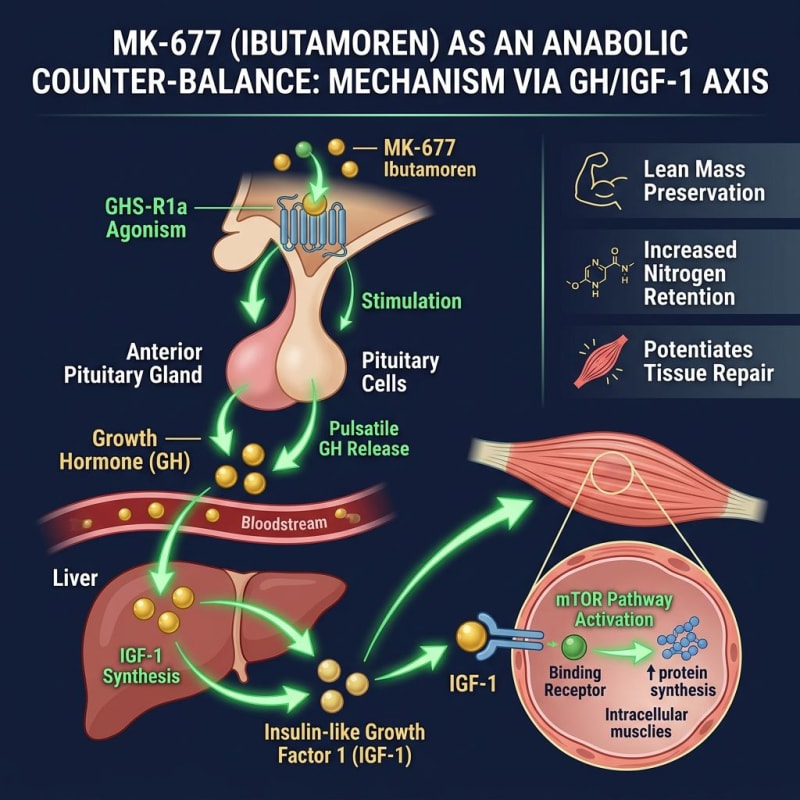
Semaglutide is a modified peptide analog of glucagon-like peptide-1 and an agonist at the GLP-1 receptor. Ibutamoren, also called MK-677, is a non-peptide small molecule and an agonist at the growth hormone secretagogue receptor, GHS-R1a. Describing both compounds as peptides is incorrect.
Receptor identity is a starting point for experimental characterization, not a prediction of whole-organism outcomes. Activity at GLP-1R or GHS-R1a does not by itself establish changes in muscle protein turnover, tissue size, or function.
| Feature | Semaglutide | Ibutamoren (MK-677) |
|---|---|---|
| Molecular class | Modified peptide | Non-peptide small molecule |
| Receptor target | GLP-1 receptor | GHS-R1a |
| Laboratory characterization question | Is the measured response dependent on GLP-1 receptor expression? | Is the measured response dependent on GHS-R1a expression? |
| Interpretive boundary | Receptor signaling is not a direct measure of muscle loss. | Receptor signaling is not a direct measure of muscle preservation. |
What the Cited Human Studies Address
Semaglutide: Clinical Measurements Are Not Muscle Mechanisms
Wilding et al. (2021) studied semaglutide in human adults with overweight or obesity [2]. Blundell et al. (2017) examined appetite, energy intake, eating-related measurements, and body weight in human participants with obesity [5]. Neither study establishes that ibutamoren preserves skeletal muscle during semaglutide exposure. Measurements of body weight or food intake also do not identify a cellular protein-degradation mechanism.
The original article's numerical estimate of the proportion of weight change attributable to lean tissue is not retained because it was not tied to a specific analysis and measurement definition. Lean mass, skeletal muscle mass, and bone mineral measurements must not be treated as interchangeable endpoints.
Ibutamoren: Endocrine and Body-Composition Endpoints
Svensson et al. (1998) studied MK-677 in human participants with obesity and reported changes in GH secretion, fat-free mass, and energy expenditure [3]. This was not a study of semaglutide plus ibutamoren. Its fat-free-mass measurements do not independently establish an increase in contractile muscle tissue or an interaction between the two compounds.
In a randomized controlled trial in healthy older human adults, Nass et al. (2008) reported an increase in fat-free mass with MK-677, without corresponding improvement in strength or function [4]. The study also reported decreased insulin sensitivity and adverse effects including edema. These observations make it inappropriate to equate a fat-free-mass change with a functional muscle benefit or to describe the compound as having an assured safety profile.
Copinschi et al. (1996) examined GH profiles, IGF-I, and adrenocortical measurements in normal young human men [6]. Chapman et al. (1996) examined the GH–IGF-I axis in healthy elderly human participants [10]. These population-specific endocrine studies do not establish muscle preservation, results in cultured muscle cells, or effects of a semaglutide–ibutamoren combination.
No Established Combined Outcome
The supplied references do not establish that the semaglutide–ibutamoren combination preserves muscle, offsets changes in glucose regulation, or balances fluid retention. Results from separate human populations cannot be assembled into a predicted combination outcome. The cited human findings likewise cannot be relabeled as animal, in-vitro, or in-silico evidence.
Distinguishing Body Composition from Muscle Tissue
Fat-free mass includes water and non-muscle tissues. Depending on the measurement method, lean soft tissue and fat-free mass are also distinct quantities. A change in either is not sufficient evidence of myofibrillar protein accretion, fiber atrophy, or altered muscle function.
For laboratory interpretation, each endpoint should be defined before analysis. Tissue morphology, protein abundance, protein synthesis, protein degradation, and functional measurements answer different questions. GH or IGF-I measurements do not substitute for these endpoints.
Mechanistic Claims Require Direct Measurements
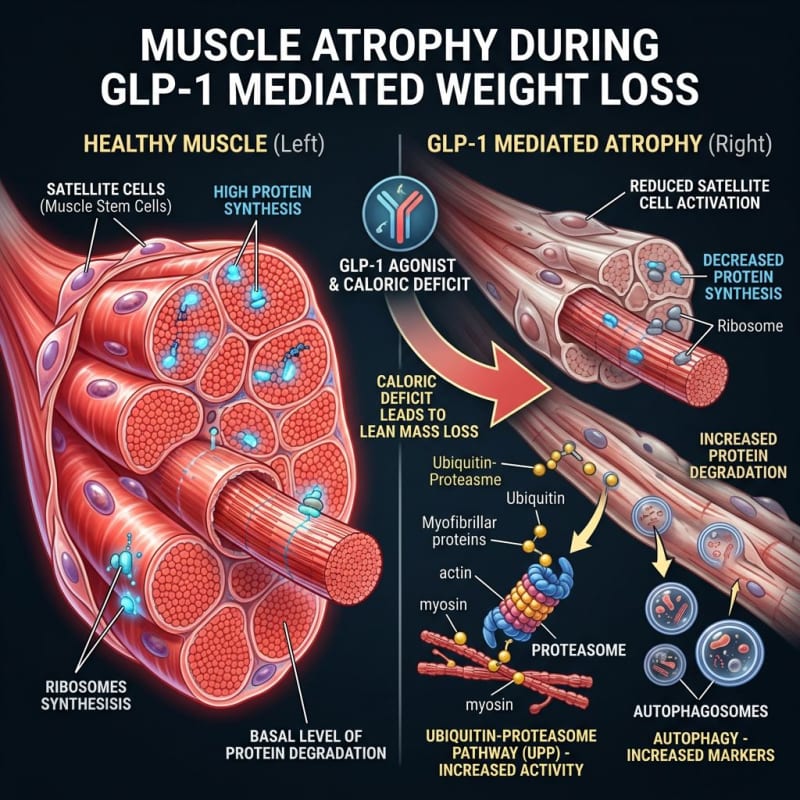
The original article attributed muscle changes to ubiquitin–proteasome activity, autophagy, myostatin, and PI3K/Akt/mTOR signaling without identifying supporting experiments for the proposed combination. These pathways should not be presented as demonstrated consequences of combining semaglutide and ibutamoren. A pathway marker alone also does not establish the rate of protein turnover.
Nonclinical Experimental Design and Interpretation
The following are methodological considerations, not reported experimental findings or a validated protocol for combining these materials.
- Define the model: Identify the cell type, receptor-expression system, isolated tissue, or computational framework. Explain which biological components the model lacks.
- Verify target dependence: Use appropriate negative controls and independent checks of receptor expression or function. A response in a reporter system should not be assumed to occur in muscle tissue.
- Separate specific activity from assay interference: Include vehicle controls, viability measurements where applicable, and checks for interference with the analytical readout.
- Measure the claimed endpoint: If the question concerns muscle protein turnover, distinguish synthesis from degradation rather than relying solely on signaling markers.
- Test interactions rather than assuming them: A laboratory interaction analysis requires measurements for each material separately and together, appropriate controls, and a prespecified analysis. Different receptor targets do not establish synergy.
- Report uncertainty: Document independent replicates, variability, normalization procedures, and model-specific limitations.
A cultured-cell system does not reproduce an intact hypothalamic–pituitary–hepatic endocrine system. Conversely, whole-organism body-composition findings do not identify a direct action on muscle cells. Any animal evidence would need its own species, model, and endpoint attribution; no animal combination result is established here. In-silico predictions would require experimental validation and are not presented as observed biological effects.
Material Characterization and Laboratory Handling
Reproducibility depends on more than a stated purity percentage. Researchers should document the supplied chemical form, lot identifier, analytical methods, and any available measurements relevant to the assay. No lot-specific identity, purity, stability, or potency results were provided for this article.
Chromatographic results can describe a sample under the stated separation and detection conditions; mass spectrometry can provide evidence relevant to molecular identity. Neither method alone establishes biological potency, sterility, absence of all contaminants, or suitability for an intended experiment. Acceptance criteria should be matched to the assay rather than inferred from a general product description.
Researchers can consult the available COA Documents and Quality Control information when reviewing material documentation. The peptide synthesis page provides related process context, but peptide-manufacturing information should not be applied to non-peptide ibutamoren. These links do not establish equivalence between a supplied material and a preparation used in a published study.
For laboratory handling, consult the material-specific safety data sheet and institutional procedures for protective equipment, containment, storage, spills, and waste disposal. The supplied article does not provide validated storage conditions, compatibility data, or a complete laboratory hazard assessment. Human-study observations are not substitutes for a chemical risk assessment.
References
- Murphy, K. G., & Bloom, S. R. (2006). Gut hormones and the regulation of energy homeostasis. Nature, 444(7121), 854-859. — https://doi.org/10.1038/nature05484
- Wilding, J. P. H., et al. (2021). Once-Weekly Semaglutide in Adults with Overweight or Obesity. The New England Journal of Medicine, 384, 989-1002. — https://www.nejm.org/doi/full/10.1056/NEJMoa2032183
- Svensson, J., et al. (1998). Two-month treatment of obese subjects with the oral growth hormone (GH) secretagogue MK-677 increases GH secretion, fat-free mass, and energy expenditure. The Journal of Clinical Endocrinology & Metabolism, 83(2), 362-369. — https://doi.org/10.1210/jcem.83.2.4551
- Nass, R., et al. (2008). Effects of an oral ghrelin mimetic on body composition and clinical outcomes in healthy older adults: a randomized, controlled trial. Annals of Internal Medicine, 149(9), 601-611. — https://doi.org/10.7326/0003-4819-149-9-200811040-00005
- Blundell, J., et al. (2017). Effects of once-weekly semaglutide on appetite, energy intake, control of eating, food preference and body weight in subjects with obesity. Diabetes, Obesity and Metabolism, 19(9), 1242-1251. — https://doi.org/10.1111/dom.12932
- Copinschi, G., et al. (1996). Effects of a 7-day treatment with a novel, orally active, growth hormone (GH) secretagogue, MK-677, on 24-hour GH profiles, insulin-like growth factor I, and adrenocortical function in normal young men. The Journal of Clinical Endocrinology & Metabolism, 81(7), 2376-2381. — https://doi.org/10.1210/jcem.81.7.8675562
- Sardh, E., et al. (2010). Safety, pharmacokinetics and pharmacodynamics of the oral growth hormone secretagogue MK-677 in healthy older adults. Growth Hormone & IGF Research, 20(2), 160-165. — https://doi.org/10.1016/j.ghir.2009.12.002
- Caron, A., et al. (2018). GLP-1 receptor agonists for the treatment of obesity: Role of central and peripheral mechanisms. Diabetes & Metabolism, 44(2), 111-122. — https://doi.org/10.1016/j.diabet.2017.09.006
- Clemmensen, C., et al. (2019). Emerging hormonal-based combination pharmacotherapies for the treatment of metabolic diseases. Nature Reviews Endocrinology, 15(2), 90-104. — https://doi.org/10.1038/s41574-018-0118-x
- Chapman, I. M., et al. (1996). Stimulation of the growth hormone (GH)-insulin-like growth factor I axis by daily oral administration of a GH secretagogue (MK-677) in healthy elderly subjects. The Journal of Clinical Endocrinology & Metabolism, 81(12), 4249-4257. — https://doi.org/10.1210/jcem.81.12.8954023
- Papadopoulou-Marketou, N., et al. (2020). Ghrelin and the Growth Hormone Secretagogue Receptor 1a (GHS-R1a) in the Central Regulation of Energy Balance. Current Medicinal Chemistry, 27(34), 5707-5722.
- McCarthy, D., et al. (2023). Muscle loss with glucagon-like peptide-1 receptor agonists: mechanisms and implications for older adults. Journal of Cachexia, Sarcopenia and Muscle, 14(6), 2820-2826. — https://onlinelibrary.wiley.com/doi/full/10.1002/jcsm.13327
Limitations
The supplied literature does not establish muscle preservation from combining semaglutide and ibutamoren. Published findings do not establish safety, effectiveness, approval, or suitability of materials sold by Alpha Carbon Labs for human or veterinary use.