Ipamorelin, BPC-157 and TB-500: Preclinical Evidence and Limits
A model-specific review of ipamorelin, BPC-157 and TB-500, covering material identity, preclinical evidence, unsupported interaction claims and laboratory documentation.
Scope: Separate Research Subjects, Not an Established Combination
Ipamorelin, BPC-157 and materials labeled TB-500 appear in discussions of endocrine signaling and tissue biology. The informal term “Wolverine Stack” is not a standardized chemical identity or a validated experimental method. The supplied references do not establish a synergistic interaction between these three materials.
This article separates the evidence relevant to each subject, identifies important model and material distinctions, and outlines considerations for nonclinical laboratory evaluation. Findings from separate experiments cannot be combined into a conclusion about a mixture, and published observations cannot be attributed to Alpha Carbon Labs materials without direct evidence.
Chemical Identity and Source-Material Distinctions
Ipamorelin
Ipamorelin is a synthetic pentapeptide growth hormone secretagogue. Its endocrine pharmacology is distinct from that of a directly supplied growth factor. A material record should identify the peptide sequence, chemical form and lot rather than rely on the compound name alone.
BPC-157
BPC-157 is a synthetic pentadecapeptide investigated in preclinical tissue-biology experiments. Its name does not establish a particular distribution within an experimental system, nor does it justify describing its effects as exclusively local. Such conclusions require measurements in the model under study.
TB-500 and Thymosin Beta-4
The supplied Philp and Kleinman reference concerns thymosin beta4 [4]. A product labeled TB-500 should not automatically be treated as identical to the material discussed in that literature. Sequence, molecular mass, chemical modifications and analytical identity must be checked before deciding whether a publication is relevant. Findings about thymosin beta4 do not, by themselves, establish properties of a TB-500-labeled material.
What the Supplied Literature Can Support
Ipamorelin: Endocrine and Bone Research in Animals
Raun and colleagues investigated ipamorelin's growth hormone secretagogue activity and selectivity in preclinical experiments involving rats and pigs [2]. Selectivity reported in those animal experiments is specific to the hormones measured and the experimental conditions. It is not evidence of an absence of off-target activity in every model, a clinical safety assurance, or a specification for a commercial lot.
The supplied Sibilia reference concerns glucocorticoid-associated bone resorption in rats [1], while the supplied Svensson reference concerns bone formation in adult rats [5]. These animal studies address bone-related endpoints under particular experimental conditions. They do not establish outcomes in human participants, generalize to tendon or muscle endpoints, or demonstrate an interaction with BPC-157 or TB-500.
BPC-157: Tissue and Cell-Based Evidence
Chang and colleagues examined BPC-157 using rat tendon explants and cultured rat tendon fibroblasts, reporting tendon outgrowth and cell-survival findings in those ex-vivo and in-vitro systems [7]. These observations should be distinguished from whole-animal structural or mechanical outcomes. They do not establish a response to an ipamorelin-containing mixture.
The supplied Sikiric review addresses preclinical muscle and bone wound research involving BPC-157 [3]. A review should be used to locate and evaluate its underlying experiments, not treated as one uniform model or an independent combination experiment. Individual species, tissue preparations, controls and endpoints must remain attached to any finding drawn from those primary studies.
Thymosin Beta4, GHK-Cu and IGF-Related Literature
The Philp and Kleinman thymosin beta4 review [4] and the Mawer musculoskeletal IGF-related reference [8] provide topics for further source evaluation. This article does not assign their broad discussions to a single species or preparation, or use them as evidence for a TB-500 product or a multi-material interaction.
The supplied He citation identifies human fibroblasts as its experimental subject [6]. Human-derived fibroblast research is in-vitro evidence, not a study of human participants. It does not establish a whole-organism response or an interaction between GHK-Cu and ipamorelin, BPC-157 or TB-500. The full publication and bibliographic record should be checked before extracting specific methods or conclusions.
| Research subject | Evidence context | Key limitation |
|---|---|---|
| Ipamorelin endocrine activity | Rat and pig experiments [2] | Measured selectivity is model- and endpoint-dependent. |
| Ipamorelin and bone endpoints | Rat studies [1, 5] | Bone observations do not establish effects in other tissues or combinations. |
| BPC-157 tendon observations | Rat tendon explants and cultured rat tendon fibroblasts [7] | Outgrowth and survival measurements are not whole-organism outcomes. |
| Thymosin beta4 literature | Review literature [4] | Material identity and each underlying model require verification. |
| GHK-Cu fibroblast literature | Human fibroblasts identified in the supplied citation [6] | Human-derived cells are not human participants. |
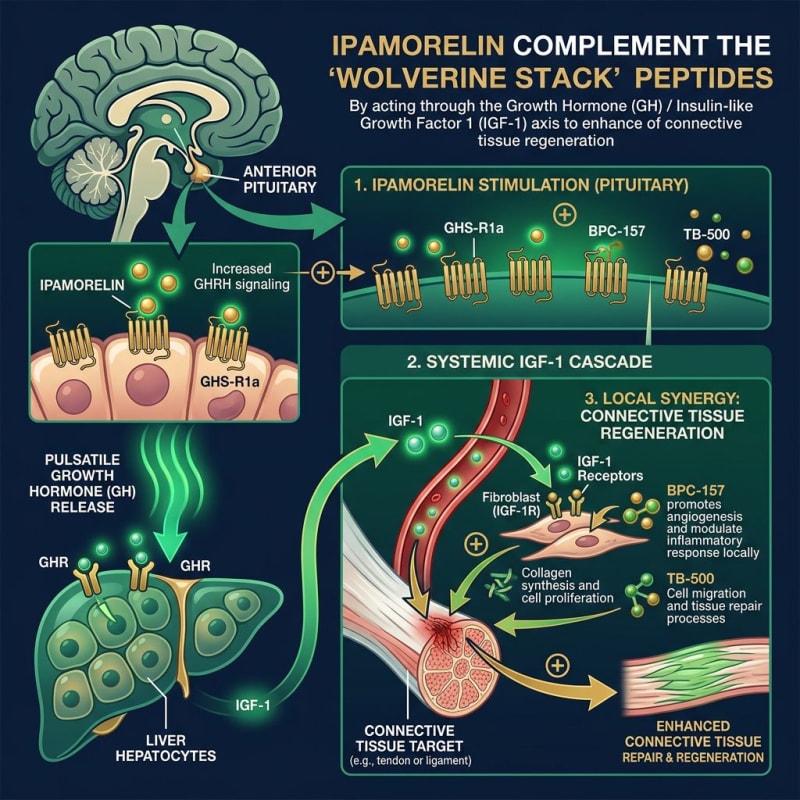
Why Separate Pathways Do Not Establish Synergy
Evidence that different materials affect different biological measurements does not establish that they work together. “Synergy” requires a defined interaction model, appropriate comparisons and quantitative analysis. Neither pathway overlap nor a diagram supplies that evidence.
The supplied references do not substantiate the original article's claims of a systemic amplifier for local repair, coordinated satellite-cell recruitment, improved nutrient allocation, or superior structural outcomes from the named combination. Those claims are therefore not retained. No human-participant or in-silico evidence for the proposed interaction is established here.
Nonclinical Experimental Interpretation
For laboratory researchers evaluating this literature, the central task is to align each conclusion with the preparation and measurement that produced it.
- Define the model: Record species, tissue source, cell identity and culture or experimental conditions. Distinguish cell culture, tissue explants and intact-animal experiments.
- Separate endpoints: Hormone measurements, cell migration, viability, matrix measurements and tissue mechanics answer different questions. A change in one does not establish a change in the others.
- Document controls: Interpret results against appropriate vehicle, baseline and assay controls, including potential interference with the analytical readout.
- Evaluate interaction claims explicitly: Any claimed interaction requires comparisons that distinguish the individual materials from the combined condition and a prespecified analytical approach.
- Preserve uncertainty: Report variability, negative results and model limitations rather than ranking materials by broad claims of potency or safety.
These are general principles of experimental interpretation, not a protocol for administration or a recommendation to combine materials.
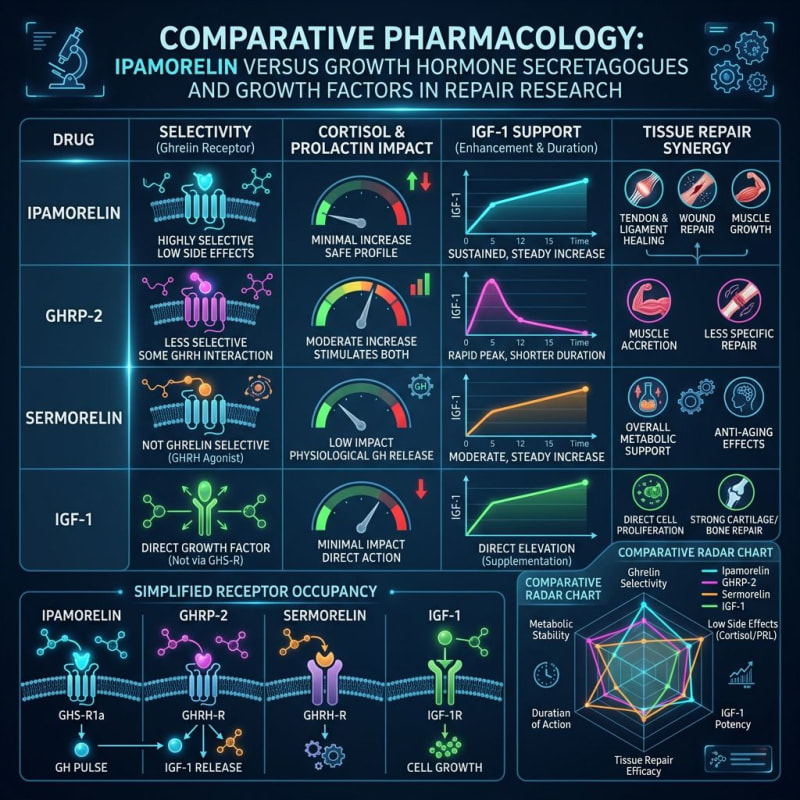
Analytical Documentation and Laboratory Handling
Review the relevant lot-specific COA documents and available quality-control documentation before interpreting experimental results. Check which methods were used, what was actually measured and whether the record applies to the lot being evaluated. Peptide identity, chromatographic purity and peptide content are different analytical attributes; one does not automatically establish the others.
For a listed BPC-157 + TB-500 blend, documentation should identify the constituents and their amounts rather than rely on a blend name. A listing or certificate does not demonstrate a biological interaction, equivalence to published study material, or suitability for a particular assay.
The supplied article provides no lot-specific analytical results, validated storage conditions or material-specific hazard assessment. Consult current safety data and technical documentation, apply institutional laboratory risk assessments, and follow appropriate handling and waste procedures. An absence of reported hazards must not be interpreted as an absence of risk. General information on peptide synthesis does not substitute for characterization of the material actually used.
References
- Sibilia, V., et al. (2006). Ipamorelin, a selective growth hormone secretagogue, prevents glucocorticoid-induced bone resorption in rats. British Journal of Pharmacology. — https://doi.org/10.1038/sj.bjp.0706782
- Raun, K., et al. (1998). Ipamorelin, the first selective growth hormone secretagogue. European Journal of Endocrinology. — https://doi.org/10.1530/eje.0.1390552
- Sikiric, P., et al. (2010). Gastric pentadecapeptide BPC 157: effective treatment for muscle and bone wounds. Frontiers in Bioscience. — https://doi.org/10.2741/3639
- Philp, D., & Kleinman, H. K. (2004). Thymosin beta4: a multifunctional regenerative peptide. Expert Opinion on Biological Therapy.
- Svensson, J., et al. (1998). The GH secretagogue hexarelin and ipamorelin stimulate bone formation in adult rats. Journal of Endocrinology. — https://doi.org/10.1677/joe.0.1590307
- He, X., et al. (2012). Copper-peptide (GHK-Cu) stimulates collagen and glycosaminoglycan synthesis in human fibroblasts. Journal of Peptide Science. — https://doi.org/10.1111/j.1365-2133.2012.11025.x
- Chang, C. H., et al. (2011). The promoting effect of pentadecapeptide BPC 157 on tendon healing involves tendon outgrowth and cell survival. Journal of Applied Physiology. — https://doi.org/10.1152/japplphysiol.00942.2010
- Mawer, E. B., et al. (2001). Insulin-like growth factor-I and its binding proteins in the musculoskeletal system. Growth Hormone & IGF Research.
Limitations
The cited work involves distinct materials and experimental systems and does not establish the proposed combination or the properties of Alpha Carbon Labs products. Published findings do not establish safety, effectiveness, approval or suitability of the material sold for human or veterinary use. Alpha Carbon Labs materials are intended solely for nonclinical laboratory research.
References
- 1. Sibilia, V., et al. (2006). Ipamorelin, a selective growth hormone secretagogue, prevents glucocorticoid-induced bone resorption in rats. British Journal of Pharmacology.
- 2. Raun, K., et al. (1998). Ipamorelin, the first selective growth hormone secretagogue. European Journal of Endocrinology.
- 3. Sikiric, P., et al. (2010). Gastric pentadecapeptide BPC 157: effective treatment for muscle and bone wounds. Frontiers in Bioscience.
- 4. Philp, D., & Kleinman, H. K. (2004). Thymosin beta4: a multifunctional regenerative peptide. Expert Opinion on Biological Therapy.
- 5. Svensson, J., et al. (1998). The GH secretagogue hexarelin and ipamorelin stimulate bone formation in adult rats. Journal of Endocrinology.
- 6. He, X., et al. (2012). Copper-peptide (GHK-Cu) stimulates collagen and glycosaminoglycan synthesis in human fibroblasts. Journal of Peptide Science.
- 7. Chang, C. H., et al. (2011). The promoting effect of pentadecapeptide BPC 157 on tendon healing involves tendon outgrowth and cell survival. Journal of Applied Physiology.
- 8. Mawer, E. B., et al. (2001). Insulin-like growth factor-I and its binding proteins in the musculoskeletal system. Growth Hormone & IGF Research.
Related Growth Hormone research
- GHRP-6 and Ipamorelin: Nitrogen Balance and Experimental Evidence
- Ipamorelin vs GHRP-6: Cortisol, Prolactin, and Research Selectivity
- Sermorelin and GHRP-6: Receptor Signaling and Research Evidence
- Hexarelin Research Models and Extrapituitary Cardiovascular Signaling
- Ipamorelin and CJC-1295: Research on GH Signaling and Pulsatility
- CJC-1295, Ipamorelin, and Satellite Cell Proliferation: Evidence and Research Limits
All research information is for educational purposes only. The statements made within this website have not been evaluated by the US Food and Drug Administration. The statements and the products of this company are not intended to diagnose, treat, cure or prevent any disease.