Scope: Matrix Biology and Cellular Metabolism
The extracellular matrix (ECM) is a network of proteins and polysaccharides that contributes to tissue structure and cell–matrix interactions. Laboratory investigations of ECM remodeling often examine matrix synthesis, deposition, organization, and degradation alongside the metabolic state of the cells producing it. These are related but distinct experimental endpoints: increased collagen synthesis alone does not establish greater matrix stability.
GHK-Cu, a copper(II) complex of glycyl-L-histidyl-L-lysine, and NAD+, the oxidized form of nicotinamide adenine dinucleotide, offer separate subjects for biochemical and cell-culture investigation. Their respective connections to copper coordination and cellular metabolism do not establish that combining them produces synergistic effects on the ECM. This article distinguishes those research questions from demonstrated outcomes and outlines analytical considerations for nonclinical laboratory work.

Defining Extracellular Matrix Stability
Collagens, elastin, proteoglycans, and hyaluronan contribute different structural and biochemical properties to the ECM. Fibroblast cultures can be used to examine selected aspects of matrix production, but a culture system does not reproduce the full cellular diversity, mechanical environment, or architecture of intact tissue.
For an experiment, “stability” should be defined operationally rather than treated as a single biological property. Relevant measurements can include:
- Synthesis: production of matrix proteins, distinguished from changes in their transcript abundance.
- Deposition: matrix-associated protein remaining after an appropriately validated separation or processing method.
- Turnover: degradation products and proteolytic activity, including measurements relevant to matrix metalloproteinases (MMPs) and their tissue inhibitors (TIMPs).
- Organization: spatial distribution and architecture assessed by suitable imaging methods.
- Material properties: mechanical measurements appropriate to the culture-derived matrix or engineered construct.
A collagen type I/III ratio, an MMP measurement, or a proliferation result should not be treated as a universal marker of matrix integrity or cellular senescence. Interpretation depends on the model, sampling interval, normalization method, and accompanying measurements.
Chemical Identity and Biochemical Context
GHK-Cu and Copper Coordination
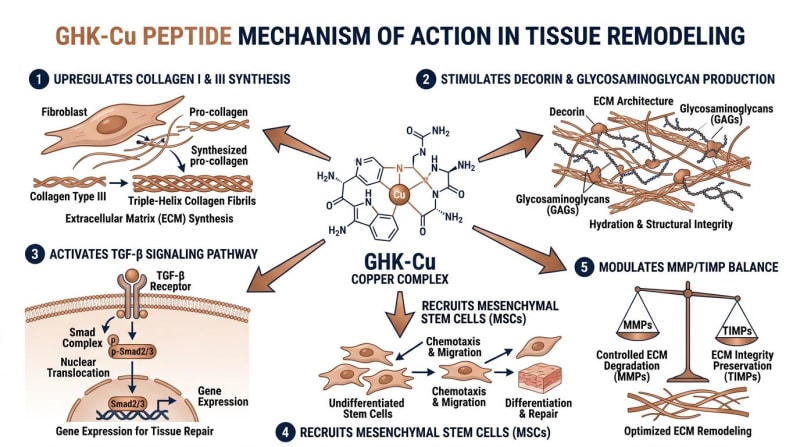
GHK is the tripeptide glycyl-L-histidyl-L-lysine. GHK-Cu denotes a complex with copper(II); it is not interchangeable with uncomplexed GHK or a copper salt. Solution composition, pH, and competing ligands can affect metal coordination. Experiments therefore need to distinguish peptide identity, total copper content, and the chemical species present under assay conditions.
The review by Pickart and Margolina [1] discusses GHK-Cu literature spanning cell-based and animal experimental work as well as human-related observations. Those evidence types must be evaluated separately. A review-level discussion does not establish a single mechanism across models or demonstrate the behavior of an Alpha Carbon Labs material.
Reference 5 is listed as a study of collagen synthesis in fibroblast cultures, an in-vitro experimental setting. The supplied entry does not establish the cells’ species, donor characteristics, or culture conditions. Those details and the bibliographic record should be checked against the original publication before using it to support a model-specific conclusion or an experimental protocol. A fibroblast-culture endpoint cannot by itself establish matrix organization, mechanical integrity, or an outcome in an intact organism.
NAD+ and Metabolic Measurements
NAD+ participates in oxidation–reduction reactions through the NAD+/NADH couple. It also serves as a substrate for enzymes including sirtuins and poly(ADP-ribose) polymerases (PARPs). NAD+ is not ATP, and its presence in culture medium is not a measurement of intracellular energy availability.
The review by Covarrubias and colleagues [2] synthesizes NAD+ metabolism research across experimental systems, including cell-based, animal, and human evidence. Its broad scope does not justify assigning a uniform age-related decline to every tissue or culture model. The review by Kane and Sinclair [4] likewise provides context on sirtuins and NAD+, rather than direct evidence for a combined NAD+/GHK-Cu ECM experiment.
Extracellular NAD+ exposure must be distinguished from intracellular NAD+ abundance, the NAD+/NADH ratio, and compartment-specific pools. None of these measurements alone establishes ATP production, sirtuin activity, or PARP activity. If those processes are central to a hypothesis, they require appropriate independent readouts.
What Would Establish an Interaction?
The supplied material does not establish that NAD+ potentiates GHK-Cu, rescues collagen synthesis in metabolically stressed fibroblasts, or prevents cellular senescence during matrix production. Such conclusions require identifiable experiments with defined models, controls, endpoints, and statistical analyses. They should not be inferred by combining separate literature discussions about the two compounds.
For a nonclinical cell-culture investigation, an interaction can be framed as a testable question: does a measured response to the two experimental factors differ from a predefined expectation based on their separate responses? A combined condition producing a larger signal than either single condition is not, by itself, proof of synergy.
Design Considerations for In-Vitro Studies
- Document the model: record species, tissue source, donor information where available, passage number, culture format, medium composition, and cell-quality checks.
- Separate the factors: include matched control conditions and each factor separately, alongside the combined experimental condition. Where relevant to the question, distinguish effects associated with GHK, copper, and the copper–peptide complex.
- Measure cell abundance and viability: distinguish an apparent increase in matrix-associated signal from differences in cell number or loss of viable cells.
- Define the interaction analysis: specify the endpoint, expected non-interacting response, and statistical approach before interpreting a combined response.
- Use independent replication: distinguish technical repeats from independent cultures or donors, and report variability and uncertainty.
- Check assay interference: use reagent-only blanks and suitable controls to identify optical, chemical, or enzymatic interference from the test materials.
These are design considerations, not a validated protocol or a prediction that an interaction will occur. If metabolic stress is introduced into a culture model, its effects on viability, pH, nutrient availability, and assay performance must also be characterized.
Readouts and Their Interpretive Limits
| Research question | Potential measurements | Key limitation |
|---|---|---|
| Does matrix production change? | Collagen transcripts, protein synthesis, and deposited matrix protein | Transcript abundance does not establish protein deposition or matrix architecture. |
| Does matrix turnover change? | MMP activity, TIMP abundance, and matrix degradation products | Enzyme abundance is not equivalent to catalytic activity or net matrix turnover. |
| Does metabolic state change? | NAD+, NADH, ATP, and suitable metabolic flux measurements | A bulk metabolite measurement does not resolve all intracellular compartments or pathways. |
| Does matrix structure change? | Microscopy and appropriate mechanical characterization | More matrix protein does not necessarily mean greater structural stability. |
| Are responses affected by cell state? | Cell counts, viability, proliferation, and a justified panel of cell-state markers | A single marker does not establish senescence or explain the mechanism of a response. |
Analytical Characterization and Material Documentation
The source article supplies no lot-specific analytical results, numerical purity specifications, copper-content measurements, or stability data. Consequently, it does not support a claim about the identity, purity, or performance of any particular Alpha Carbon Labs lot. Researchers should review available COA documents and quality-control information for the material actually used.
GHK-Cu Characterization
Chromatographic methods can assess a defined impurity profile, and mass spectrometry can support molecular identity within the limits of the method. Neither an HPLC peak-area percentage nor a peptide mass alone establishes copper occupancy, solution speciation, or the absence of unbound copper. Copper analysis and coordination-sensitive characterization may be needed when those properties are relevant to the experiment. Report the method, sample conditions, and acceptance criteria rather than relying on an unspecified purity label.
NAD+ Characterization and Stability
Analytical work should distinguish NAD+ from NADH and relevant degradation products. Stability should be assessed under the actual storage and assay conditions, including the experimental matrix and duration. A generic storage statement cannot substitute for material-specific documentation or a stability-indicating method.
Record lot identifiers, handling history, sampling intervals, and analytical checks. The laboratory record should make it possible to separate a biological response from changes in test-material composition during the experiment.
Laboratory Handling and Hazard Assessment
Consult the current safety data sheet and institutional procedures for each material and formulation. Use task-appropriate protective equipment and containment, avoid unnecessary dust or aerosol generation, and manage copper-containing waste according to local chemical-waste requirements.
Unbound copper can participate in redox chemistry and can confound oxidation-sensitive assays. Its contribution should be considered in both chemical characterization and cell-culture controls. The occurrence of related molecules in biological systems does not establish that a supplied preparation is harmless to handle or non-cytotoxic under experimental conditions.
No compound-specific exposure limits, validated shelf life, or experimental cytotoxicity thresholds are supplied here. These should not be inferred from the article or from the general biochemical roles of NAD+ and GHK.
Interpreting the Evidence
Cell-free assays address chemical or enzymatic behavior; in-vitro cultures address responses within a defined cellular system; animal studies address a particular species and experimental model; human studies address their enrolled population and measured endpoints. In-silico analyses generate computational results that require appropriate validation. Findings from these categories are not interchangeable, and this article makes no in-silico or combined-exposure outcome claim.
The most useful next step for an ECM investigation is to define a measurable endpoint and establish material identity, assay validity, and model provenance. Published findings about other preparations do not characterize Alpha Carbon Labs products.
References
The supplied citation list is reproduced unchanged below. Bibliographic accuracy and original methods should be verified before relying on an entry; inclusion does not validate the unsupported claims removed from the source article.
- Pickart, L., & Margolina, A. (2018). Regenerative and Protective Actions of the GHK-Cu Peptide in the Light of the New Gene Data. International Journal of Molecular Sciences, 19(7), 1987. — https://doi.org/10.3390/ijms19071987
- Covarrubias, A. J., Perrone, R., Grozio, A., & Verdin, E. (2021). NAD+ metabolism and its roles in cellular processes during ageing. Nature Reviews Molecular Cell Biology, 22(2), 119–141. — https://doi.org/10.1038/s41580-020-00313-x
- Gorbunov, N. V., et al. (2015). High-Affinity Copper Binding by GHK Peptide and Its Role in Tissue Repair. Biometals, 28(5), 843–853.
- Kane, A. E., & Sinclair, D. A. (2018). Sirtuins and NAD+ in the Development and Treatment of Metabolic and Cardiovascular Diseases. Circulation Research, 123(7), 868–885. — https://doi.org/10.1161/CIRCRESAHA.118.312498
- Maquart, F. X., et al. (1993). Stimulation of Collagen Synthesis in Fibroblast Cultures by the Tripeptide-Copper Complex Glycyl-L-Histidyl-L-Lysine-Cu2+. FEBS Letters, 332(1-2), 125–128. — https://doi.org/10.1016/0014-5793(88)80509-x
- Massip, L., et al. (2010). E2F1-Sirt1 interaction involves disruption of the E2F1/Rb complex. The EMBO Journal, 29(1), 176–188. — https://doi.org/10.1038/emboj.2009.308
- Pollard, C. L., et al. (2005). Modulation of Sirtuin Activity by NAD+: Implications for Aging and Longevity. Aging Cell, 4(1), 14–22.
- Simiele, L., et al. (2022). GHK-Cu: A Novel Approach for Dermal Remodeling. Journal of Controlled Release, 345, 122-136. — https://doi.org/10.1016/j.jconrel.2022.03.012
Limitations
Alpha Carbon Labs materials are intended solely for nonclinical laboratory research. Published findings do not establish the safety, effectiveness, approval, or suitability of the material sold for human or veterinary use.