Analytical Characterization for Nonclinical Laboratory Research
Retatrutide, also known as LY3437943, is a modified 39-amino-acid peptide associated with GIP, GLP-1, and glucagon receptor research. Its laboratory characterization requires more than a single purity percentage. Chromatographic purity, molecular identity, peptide content, and residual components describe different properties of a material and require distinct analytical evidence.
This guide explains how to evaluate HPLC and mass spectrometry data, review a batch-specific Certificate of Analysis (CoA), and identify limitations relevant to nonclinical experiments. It does not establish specifications or test results for any Alpha Carbon Labs batch.
Peptide Structure and Synthesis-Related Impurities
Retatrutide contains a peptide backbone and a lipid modification attached through a linker. Characterization should address both the peptide sequence and its modifications. A name on a label is not sufficient to establish that the expected molecular structure is present.
During peptide synthesis, incomplete coupling or deprotection can generate related species. Other possible impurities include truncated sequences, stereochemical variants, and products of chemical degradation. These are general analytical considerations for synthetic peptides, not findings about a particular retatrutide batch. The actual impurity profile must be measured.
The number of purification steps does not establish purity. Likewise, terms such as “research grade” do not define a universal analytical specification. Acceptance criteria should specify the measured attribute, analytical method, reporting basis, and limits appropriate to the experiment.
HPLC: What a Purity Percentage Measures
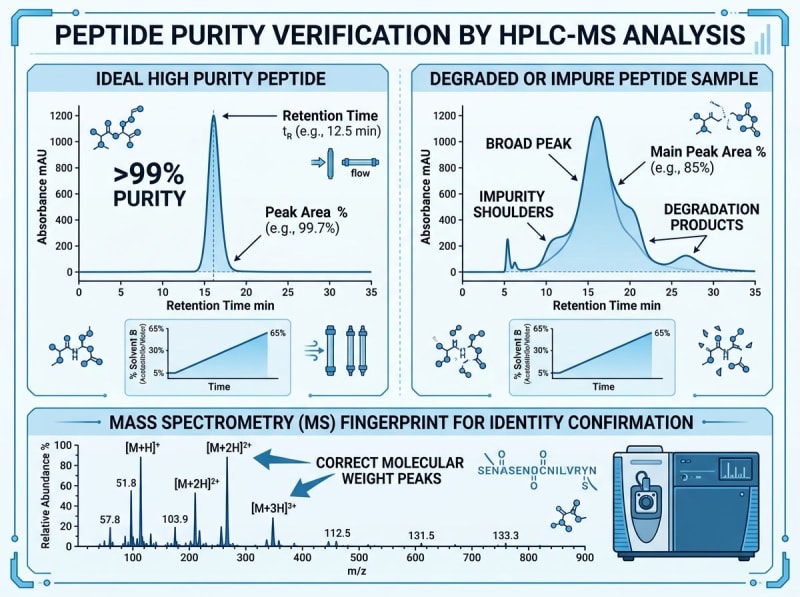
High-performance liquid chromatography separates components under defined analytical conditions. In peptide analysis, reversed-phase HPLC with ultraviolet detection is commonly used to report the area of a designated target peak relative to the sum of integrated peak areas. That result is a method-dependent chromatographic area percentage, not necessarily the peptide mass fraction of the powder.
Components can co-elute, respond differently at the selected detection wavelength, or remain undetected. Water, counterions, and residual solvents are not necessarily represented in a peptide HPLC area calculation. A dominant peak therefore cannot establish complete chemical purity.
Parameters to Review
- Column and operating conditions: Review stationary phase, column dimensions, temperature, flow rate, and sample loading. Changes in these conditions can affect separation and peak shape.
- Mobile phases and gradient: Record solvent composition, additives, and the full gradient program. Water and acetonitrile with an acidic additive are common examples, not a validated method for every sample.
- Detection: Confirm the detector type and, for ultraviolet detection, the wavelength. The reported area percentage depends on what the detector measures.
- Retention time: Compare results only under appropriately controlled conditions. Retention time can support a comparison with a characterized reference material, but does not independently establish identity.
- Integration: Examine the full chromatogram, baseline selection, integration boundaries, and any excluded peaks. Request clarification when processing choices are not documented.
- Method performance: Look for evidence that the method can separate relevant impurities and produce repeatable results for its stated purpose.
A broad peak or shoulder warrants investigation, but it does not identify a specific impurity. Peak broadening can arise from sample loading, solvent mismatch, column performance, or unresolved components. Conversely, a sharp peak can contain co-eluting species.
No universal HPLC threshold follows from the number of receptors associated with a peptide. A reported value above 99% does not, by itself, establish that an experimental signal is attributable solely to the target molecule.
Mass Spectrometry: Evidence for Molecular Identity
Mass spectrometry measures mass-to-charge ratios. Electrospray ionization can produce multiple charge states of a peptide, which may be used to determine its neutral mass through deconvolution. Interpretation should account for charge assignment, isotope patterns, adducts, instrument calibration, and the mass convention used in the calculation.
Compare the observed mass with a theoretical value calculated from the explicitly defined sequence and modifications. Monoisotopic and average molecular masses are different quantities and should not be compared interchangeably. The mass assigned to the peptide must also be distinguished from the composition of the bulk salt or hydrated powder.
Interpreting Unexpected Signals
- Lower-mass species: These can prompt investigation of truncation or deletion products, but an assignment requires sequence-specific calculations and supporting evidence.
- Higher-mass species: Consider possible chemical modifications, retained protecting groups, or adducts rather than assigning an identity from mass direction alone.
- Sodium and potassium adducts: These can occur during ionization and complicate interpretation. Their presence alone does not establish altered solubility or receptor binding.
- Same-mass impurities: Some structural or stereochemical variants cannot be distinguished by intact mass alone.
An expected intact mass supports an identity assessment, but does not establish complete sequence, stereochemistry, modification position, or purity. Depending on the analytical question, tandem MS, peptide mapping, or another orthogonal method may be needed. None of these results should be inferred for an Alpha Carbon Labs product without direct, batch-specific evidence.
Counterions, Residual Solvents, and Water
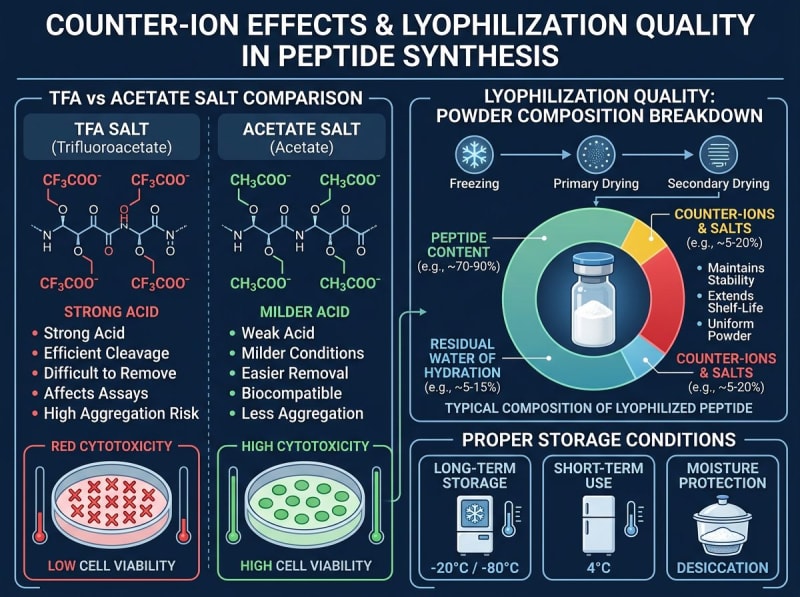
Peptide preparations can contain counterions, water, and residual processing solvents. Trifluoroacetic acid may be used in peptide purification, but the final counterion identity and amount require documentation. An acetate designation does not demonstrate the absence of residual trifluoroacetate or other components.
For an in-vitro experiment, matrix composition should be considered alongside the peptide itself. Where relevant, use appropriate matrix controls and assess compatibility in the actual assay rather than assuming that a particular counterion is preferable. General discussion of counterions does not establish an effect in a specified cell model.
Water content, residual solvents, and counterions require suitable measurements beyond routine peptide HPLC area reporting. Karl Fischer analysis, gas chromatography, and ion chromatography are examples of methods used for these respective attributes; their suitability must be established for the sample and purpose. These examples are not statements that such tests were performed on any product.
Chromatographic Purity Versus Peptide Content
A powder with a high HPLC area percentage can still contain appreciable non-peptide material. Chromatographic purity describes the integrated signals under a specified method. Peptide content describes the measured amount of peptide relative to a defined sample quantity. These values should not be substituted for each other.
For quantitative analytical work, use an appropriately measured peptide content and a clearly defined molecular-mass basis when assigning sample concentration. If only gross powder mass and HPLC area purity are available, document the resulting concentration uncertainty. Do not assign an assumed peptide content from powder appearance or a generic percentage.
A Practical CoA Review Checklist
Review available quality-control documentation against the intended laboratory measurement. A useful CoA review asks:
- Does the batch identifier match the material received?
- Are the sequence or structural specification, modifications, and salt designation unambiguous?
- Are HPLC methods, chromatograms, integration details, and numerical results available?
- Does the MS report distinguish observed and theoretical mass and explain the calculation basis?
- Are peptide content, water, counterions, and residual solvents reported separately where relevant?
- Are acceptance criteria stated, and is the analytical evidence sufficient to evaluate them?
- Are test dates, storage conditions, and any retest period supported by appropriate documentation?
A CoA should be evaluated for what it actually reports. Missing results should not be treated as evidence of absence, and a chromatographic purity result does not establish sterility, endotoxin status, or biological activity.
Laboratory Handling and Stability
Follow the applicable safety data sheet, institutional risk assessment, and documented batch-specific storage requirements. Use appropriate protective equipment and controls to limit contact with powders and analytical solvents, avoid generating airborne material, and handle waste according to laboratory procedures. Analytical purity is not a hazard assessment.
Do not infer stability from a white powder appearance or select storage temperatures solely by analogy with unrelated peptides. Record storage history and relevant handling excursions. If stability under the experimental conditions is uncertain, evaluate it with suitable analytical methods rather than assuming that the initial CoA remains representative.
References
- Frias JP, et al. (2022). Retatrutide, a GIP, GLP-1, and Glucagon Receptor Agonist, for Glycemic Control and Weight Reduction. New England Journal of Medicine. — https://www.nejm.org/doi/full/10.1056/NEJMoa2301972
- Mumenthaler SM, et al. (2021). Importance of Peptide Purity in Preclinical Research. Journal of Pharmaceutical Sciences. — https://doi.org/10.1016/j.xphs.2021.01.015
- D'Hondt M, et al. (2014). Related impurities in peptide medicines. Journal of Pharmaceutical and Biomedical Analysis. — https://doi.org/10.1016/j.jpba.2014.08.011
- Andersson L, et al. (2000). Large-scale synthesis of peptides. Biopolymers (Peptide Science).
- Erak M, et al. (2018). Peptide chemistry and the next wave of peptide drugs. Expert Opinion on Drug Discovery.
- Coskun T, et al. (2022). LY3437943 (Retatrutide), a novel triple GIP, GLP-1, and glucagon receptor agonist. Cell Metabolism. — https://doi.org/10.1016/j.cmet.2022.07.001
Limitations
This guide concerns nonclinical laboratory characterization. Published findings do not establish the safety, effectiveness, approval, or suitability of material sold by Alpha Carbon Labs for human or veterinary use.