Tirzepatide and Retatrutide: Receptor Activity and Occupancy Evidence
A laboratory-focused comparison of tirzepatide and retatrutide receptor profiles, distinguishing occupancy, binding affinity, functional potency, and the limits of the supplied evidence.
Scope of the Comparison
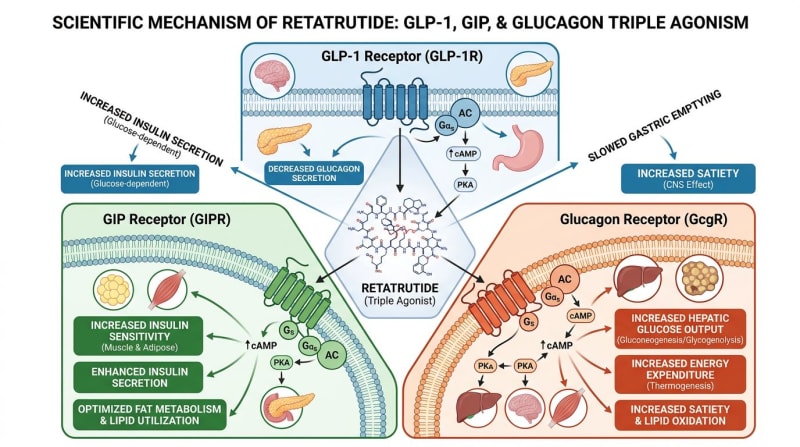
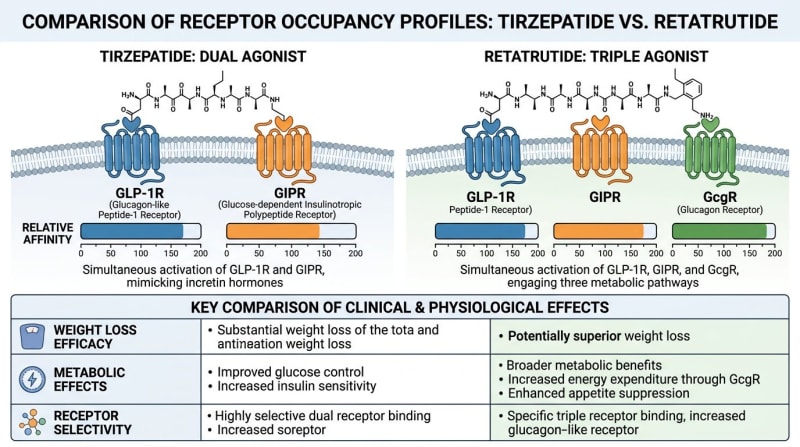
Tirzepatide and retatrutide differ in their receptor target profiles: tirzepatide is characterized as a dual glucose-dependent insulinotropic polypeptide receptor (GIPR) and glucagon-like peptide-1 receptor (GLP-1R) agonist, whereas retatrutide is characterized as a triple GIPR, GLP-1R, and glucagon receptor (GCGR) agonist. These classifications describe receptor activity, not the fraction of receptors occupied in a particular experiment.
For laboratory researchers, a useful comparison separates chemical identity, binding affinity, functional potency, and signaling behavior. The supplied references do not establish a matched, quantitative receptor-occupancy comparison between the two compounds. This article therefore examines what the available evidence supports and what would require direct measurement.
Chemical Identity and Receptor Classification
Tirzepatide
Tirzepatide is a 39-amino-acid peptide based on a modified GIP sequence, with a C20 fatty diacid attached through a linker. Structural identity and lipid modification should be distinguished from functional performance: a sequence description alone cannot establish the binding or signaling properties of a particular laboratory sample.
In the in-vitro receptor assays reported by Coskun et al. [3] and Willard et al. [7], tirzepatide was characterized at GIPR and GLP-1R. Willard et al. reported GIPR binding affinity comparable to native GIP and lower GLP-1R binding affinity than native GLP-1 under their assay conditions. These findings concern the tested experimental materials and receptor systems; they do not establish occupancy in another assay or characterize material supplied by Alpha Carbon Labs.
Retatrutide
Jastreboff et al. [2] describe retatrutide as a GIPR, GLP-1R, and GCGR agonist in a phase 2 study involving human adults with obesity. That human trial is not a matched receptor-binding experiment against tirzepatide. Its designation of retatrutide as a triple agonist should not be interpreted as proof of equal affinity, potency, or occupancy across the three receptors.
Occupancy, Affinity, and Potency Are Different Measurements
- Receptor occupancy
- The fraction of an available receptor population bound by a ligand under specified conditions.
- Binding affinity
- A measure of ligand–receptor binding, commonly expressed using an equilibrium dissociation constant, Kd, or an appropriately derived inhibition constant, Ki.
- Functional potency
- The concentration associated with a specified functional response. EC50 is the concentration producing half of the fitted maximal response in the assay.
- Maximal response
- The largest measured or fitted response within the experimental system, often expressed relative to a reference agonist.
- Signaling bias
- Preferential activation of one measured signaling pathway relative to another, assessed against a reference ligand within a defined experimental framework.
EC50 is not an occupancy measurement. Receptor expression, signal amplification, receptor reserve, incubation time, and assay format can change a functional concentration–response curve without a corresponding change in binding affinity. Similarly, occupancy alone does not specify which downstream response occurs.
For a simple, single-site equilibrium binding model, fractional occupancy is expressed as [L]free / (Kd + [L]free). This relationship assumes a suitable binding model and a known free ligand concentration. It should not be applied uncritically to dynamic cellular assays, heterogeneous receptor populations, or conditions with substantial ligand depletion or nonspecific binding.
What Can Be Compared from the Supplied Evidence?
| Question | Tirzepatide | Retatrutide |
|---|---|---|
| Receptor classification | Dual GIPR/GLP-1R activity characterized in published in-vitro receptor assays [3,7]. | Described as a GIPR/GLP-1R/GCGR agonist in the human phase 2 report [2]; that trial does not provide a matched occupancy comparison. |
| Signaling bias | Pathway-dependent behavior reported in in-vitro assays by Willard et al. [7]. | No matched bias comparison with tirzepatide is established by the supplied evidence. |
| Quantitative occupancy ranking | Not established. A ranking requires appropriate binding measurements under comparable experimental conditions. | |
| Properties of supplier material | Not established by these publications. Lot-specific analytical and functional evidence would be required. | |
Intracellular Signaling and Experimental Context
GIPR, GLP-1R, and GCGR are G-protein-coupled receptors for which cAMP accumulation is a useful functional readout. A cAMP assay measures a downstream response rather than direct ligand binding. Beta-arrestin recruitment and receptor internalization provide additional, distinct readouts; they should not be treated as interchangeable measures of receptor activation.
In the in-vitro GLP-1R experiments reported by Willard et al. [7], tirzepatide showed signaling biased toward cAMP relative to beta-arrestin recruitment, together with reduced receptor internalization relative to the reference agonist under the tested conditions. These cellular observations do not establish persistent signaling in every model or explain long-term human outcomes on their own.
A laboratory comparison should specify the receptor species and construct, cell background, receptor expression, reference agonist, exposure duration, and analytical method. Claims of bias require an explicit reference and comparable pathway measurements; differences between isolated EC50 values are not sufficient by themselves.
Separate Evidence by Model
Human Studies
The studies by Jastreboff et al. [1,2] involved human adults with obesity and evaluated tirzepatide and retatrutide in separate trials. They were not a head-to-head receptor-occupancy study. Differences between their trial outcomes cannot establish which compound binds more tightly to a receptor or produces a larger response in a laboratory assay.
Adverse events, including gastrointestinal events, were reported in the human trial populations studied by Jastreboff et al. [1,2]. Those observations do not constitute a safety assessment of laboratory-supply material or replace a laboratory hazard assessment.
Animal Studies and Related Peptides
Finan et al. [4] studied a monomeric peptide triagonist in rodent models. That paper should not be treated as a retatrutide-specific receptor-occupancy study or used to assign its findings to retatrutide solely because both are described as triple agonists. Evidence about a related peptide remains evidence about that peptide and the model tested.
In-Vitro and In-Silico Evidence
The in-vitro receptor findings from Coskun et al. [3] and Willard et al. [7] support assay-specific characterization of tirzepatide. They do not provide a complete, matched in-vitro comparison with retatrutide. No in-silico occupancy finding is presented here; computational predictions would need to remain distinct from measured binding and cellular responses.
Planning a Nonclinical Laboratory Comparison
- Define the endpoint. Decide whether the experiment measures binding, cAMP accumulation, beta-arrestin recruitment, internalization, or another specified response.
- Match experimental conditions. Use comparable receptor systems and document incubation times, media composition, plate format, and detection methods.
- Include appropriate controls. Reference agonists, vehicle controls, and receptor-negative controls can help distinguish receptor-dependent responses from assay interference.
- Account for free concentration. Protein binding, adsorption to laboratory surfaces, and sample degradation can affect the relationship between nominal concentration and available ligand.
- Report uncertainty. Include replicate structure, curve-fitting methods, response normalization, and uncertainty estimates rather than unsupported high, moderate, or low potency labels.
- Avoid tissue-level extrapolation. A receptor assay does not by itself establish adipose remodeling, hepatic lipid changes, or energy expenditure.
For related catalog context, see the semaglutide research-material listing. A catalog link is not evidence of a validated experimental comparator or equivalence between materials.
Analytical Documentation and Laboratory Handling
Review lot-specific documentation for identity, chromatographic purity, peptide content, and the methods used to obtain those results. Mass spectrometry and chromatography address different analytical questions: a purity percentage alone does not establish sequence identity, concentration, receptor potency, or absence of all contaminants. No lot-specific analytical specifications or functional results were supplied for this article.
Potential synthesis-related impurities, including truncated sequences or incompletely modified peptides, are relevant to interpreting peptide assays. Their presence and abundance require measurement; they should not be presumed from a product name or excluded solely by a general quality claim.
Use the material-specific safety data sheet, documented storage instructions, and institutional chemical-hygiene procedures. Select containment and personal protective equipment through a laboratory risk assessment, minimize unintended exposure, and follow local waste-disposal requirements. Published receptor pharmacology does not establish laboratory handling safety.
References
- Jastreboff AM, et al. Tirzepatide Once Weekly for the Treatment of Obesity. N Engl J Med. 2022;387:205-216. — https://doi.org/10.1056/NEJMoa2206038
- Jastreboff AM, et al. Triple-Hormone-Receptor Agonist Retatrutide for Obesity — A Phase 2 Trial. N Engl J Med. 2023;389:514-526. — https://doi.org/10.1056/NEJMoa2301972
- Coskun T, et al. Ly3298176, a novel dual GIP and GLP-1 receptor agonist for the treatment of type 2 diabetes mellitus: From discovery to clinical proof of concept. Mol Metab. 2018;18:3-14. — https://doi.org/10.1016/j.molmet.2018.09.009
- Finan B, et al. A rationally designed monomeric peptide triagonist corrects obesity and diabetes in rodents. Nat Med. 2015;21:27-36. — https://doi.org/10.1038/nm.3761
- Knerr PJ, et al. Next generation GLP-1/glucagon receptor co-agonists with improved therapeutic potential. Mol Metab. 2022;63:101531. — https://doi.org/10.1016/j.molmet.2022.101531
- Müller TD, et al. The New Biology and Pharmacology of Glucagon. Physiol Rev. 2017;97(2):721-766. — https://doi.org/10.1152/physrev.00025.2016
- Willard, F.S., et al. Tirzepatide is an imbalanced and biased dual GIP and GLP-1 receptor agonist. JCI Insight. 2020;5(17):e140532. — https://doi.org/10.1172/jci.insight.140532
- Gribble FM, Reimann F. Metabolic Messengers: Glucagon-like peptide 1. Nat Metab. 2021;3:142–143. — https://doi.org/10.1038/s42255-020-00327-x
- Nauck MA, et al. The broad clinical potential of receptor agonists for glucagon-like peptide-1 and glucose-dependent insulinotropic polypeptide. Nat Rev Endocrinol. 2024.
- Samms RJ, et al. GIPR signaling in immune cells and adipose tissue. Peptides. 2020;125:170252.
- Capozzi ME, et al. Glucagon lowers glycemia when β-cells are active. JCI Insight. 2019;5:e129954. — https://doi.org/10.1172/jci.insight.129954
Limitations
The supplied literature does not establish a matched receptor-occupancy comparison or characterize Alpha Carbon Labs materials. Published findings do not establish safety, effectiveness, approval, or suitability of the material sold for human or veterinary use. Alpha Carbon Labs materials are intended solely for nonclinical laboratory research.
References
- 1. Jastreboff AM, et al. Tirzepatide Once Weekly for the Treatment of Obesity. N Engl J Med. 2022;387:205-216.
- 2. Jastreboff AM, et al. Triple-Hormone-Receptor Agonist Retatrutide for Obesity — A Phase 2 Trial. N Engl J Med. 2023;389:514-526.
- 3. Coskun T, et al. Ly3298176, a novel dual GIP and GLP-1 receptor agonist for the treatment of type 2 diabetes mellitus: From discovery to clinical proof of concept. Mol Metab. 2018;18:3-14.
- 4. Finan B, et al. A rationally designed monomeric peptide triagonist corrects obesity and diabetes in rodents. Nat Med. 2015;21:27-36.
- 5. Knerr PJ, et al. Next generation GLP-1/glucagon receptor co-agonists with improved therapeutic potential. Mol Metab. 2022;63:101531.
- 6. Müller TD, et al. The New Biology and Pharmacology of Glucagon. Physiol Rev. 2017;97(2):721-766.
- 7. Willard, F.S., et al. Tirzepatide is an imbalanced and biased dual GIP and GLP-1 receptor agonist. JCI Insight. 2020;5(17):e140532.
- 8. Gribble FM, Reimann F. Metabolic Messengers: Glucagon-like peptide 1. Nat Metab. 2021;3:142–143.
- 9. Nauck MA, et al. The broad clinical potential of receptor agonists for glucagon-like peptide-1 and glucose-dependent insulinotropic polypeptide. Nat Rev Endocrinol. 2024.
- 10. Samms RJ, et al. GIPR signaling in immune cells and adipose tissue. Peptides. 2020;125:170252.
- 11. Capozzi ME, et al. Glucagon lowers glycemia when β-cells are active. JCI Insight. 2019;5:e129954.
Related Comparison research
- Peptide Sterility vs Purity: Separate Quality Checks
- US-Shipped vs US-Made Peptides: What Is Different?
- Retatrutide vs Orforglipron: Molecular Identity and Research Evidence
- Melanotan 1 vs Melanotan 2: Structure and Laboratory Evidence
- Semaglutide vs AOD9604: Mechanisms and Body-Composition Research
- MK-677 Powder vs Liquid: Laboratory Stability Considerations
All research information is for educational purposes only. The statements made within this website have not been evaluated by the US Food and Drug Administration. The statements and the products of this company are not intended to diagnose, treat, cure or prevent any disease.