Retatrutide and Hepatic Lipid Regulation in Triple Agonist Research
A research-focused review of retatrutide receptor pharmacology, hepatic lipid measurements, evidence types, and analytical limitations in nonclinical studies.
Retatrutide as a Multi-Receptor Research Subject
Retatrutide, also designated LY3437943, is a peptide studied for agonist activity at the glucose-dependent insulinotropic polypeptide receptor (GIPR), glucagon-like peptide-1 receptor (GLP-1R), and glucagon receptor (GCGR). Its relevance to hepatic lipid research lies in the experimental challenge of distinguishing receptor-specific signaling from the effects of interacting pathways.
This article focuses on chemical identity, evidence interpretation, and nonclinical experimental measurements. Published work on a named compound does not characterize an Alpha Carbon Labs lot or establish that a supplied material reproduces the activity of a study preparation.
Chemical Identity and Receptor Pharmacology
Retatrutide is a 39-amino-acid, GIP-based peptide with structural modifications that include fatty-acid acylation. Coskun and colleagues describe LY3437943 and report its activity at GIPR, GLP-1R, and GCGR in in-vitro receptor assays [6]. These assays support its classification as a triple receptor agonist; they do not independently establish a mechanism of hepatic lipid regulation in intact organisms.
Receptor potency should be interpreted within the assay in which it was measured. Receptor species, expression level, cell background, reference agonist, incubation conditions, and signaling readout can affect the result. A potency ranking is not a fixed ratio of receptor contributions in liver tissue, and receptor activation alone does not demonstrate synergistic action.
For laboratory procurement, distinguish the stated chemical structure from evidence of lot identity and composition. Relevant documentation may be available through the retatrutide material listing, peptide synthesis information, and certificate-of-analysis documents. These resources should be evaluated for the specific material and lot under consideration rather than treated as proof of equivalence to a published study preparation.
Separating the Evidence Types
In-vitro receptor evidence
The in-vitro receptor assays reported by Coskun and colleagues concern the pharmacological activity of LY3437943 [6]. Receptor signaling measurements are distinct from hepatocyte lipid measurements: a receptor assay does not directly measure fatty-acid oxidation, lipid synthesis, or lipid export.
Animal evidence
Finan and colleagues investigated a monomeric peptide triagonist in rodent models [3]. That work provides animal-model context for multi-receptor agonist research, but it should not be presented as a study of an Alpha Carbon Labs product or assumed to characterize retatrutide. Compound identity, species, and experimental conditions must remain attached to any interpretation of those findings.
Human evidence
Jastreboff and colleagues studied retatrutide in a phase 2 trial involving adults with obesity or overweight with a weight-related condition [1]. This is human clinical evidence, not a nonclinical laboratory experiment. The trial does not isolate the contribution of GCGR to hepatic lipid metabolism or establish the properties of commercially supplied research material.
The supplied Sanyal citation concerns phase 2 hepatic-fat data in a human NAFLD study context [2]. Quantitative findings are not reproduced here because the supplied citation alone does not provide the participant characteristics, measurement protocol, or analysis details needed for a qualified account. A hepatic-fat measurement should not be interpreted as direct evidence of a particular intracellular pathway.
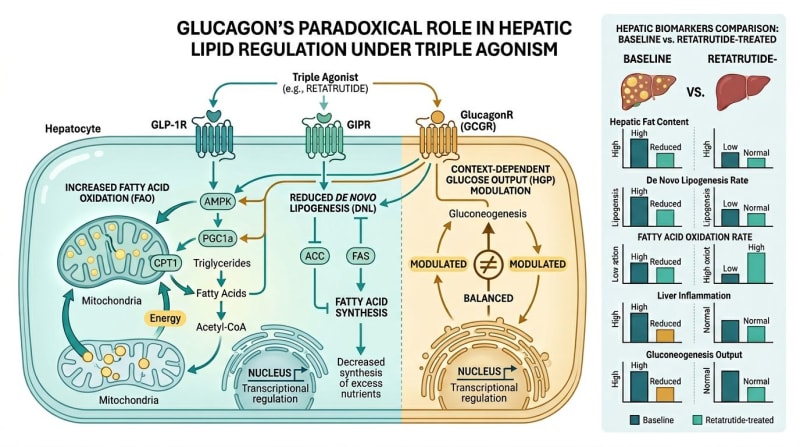
Hepatic Lipid Content Is Not a Mechanism
Hepatic lipid content reflects several processes, including fatty-acid uptake, lipid synthesis, oxidation, and export. A change in net lipid content cannot, on its own, identify which process changed. Likewise, an observation in an intact animal or human population cannot establish that the compound acted directly on hepatocytes.
Claims about GCGR-dependent lipid regulation therefore require experiments that distinguish receptor engagement from downstream metabolic flux. Terms such as “reciprocal activation,” “metabolic acceleration,” and “targeted fat clearance” are not substitutes for defined endpoints and causal controls.
Comparing Receptor Target Profiles
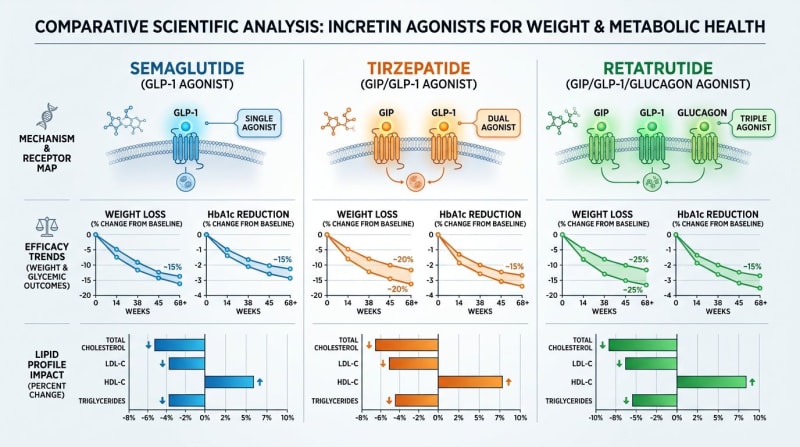
Semaglutide, tirzepatide, and retatrutide have different receptor target profiles. The table below describes those profiles only; it is not a ranking of hepatic effects, metabolic outcomes, or material quality.
| Compound | Receptor targets |
|---|---|
| Semaglutide | GLP-1R |
| Tirzepatide | GIPR and GLP-1R |
| Retatrutide | GIPR, GLP-1R, and GCGR |
Adding a receptor target does not by itself demonstrate synergy or identify the source of an observed endpoint. Cross-study percentages should not be used as head-to-head comparisons when study populations, preparations, conditions, and analytical methods differ.
Nonclinical Measurements and Their Limits
The following are experimental considerations, not claims that a supplied material has been validated for these applications. Each method requires an appropriate model, controls, and a defined analytical question.
- Receptor signaling: In-vitro receptor assays can assess activity under specified conditions. Matched controls are needed to distinguish target-dependent responses from assay interference or nonspecific effects.
- Cellular lipid content: In-vitro hepatocyte or other liver-model measurements can quantify lipid accumulation. Model identity, receptor expression, viability, and normalization should be documented.
- Lipid flux: Measurements designed to resolve synthesis, oxidation, uptake, or export are needed before attributing a change in lipid content to one of these processes.
- Mitochondrial oxygen consumption: In-vitro respirometry measures oxygen consumption in the selected preparation. It does not, by itself, establish fatty-acid-specific oxidation, thermogenesis, or improved mitochondrial function.
- Indirect calorimetry: In animal research, whole-body gas-exchange measurements provide a different level of evidence from isolated-cell assays. They do not localize an effect to the liver or a specific receptor.
- MRI-PDFF: Magnetic resonance imaging proton density fat fraction provides a fat-fraction measurement. It is not a direct measurement of intracellular lipid flux and does not establish reversal of tissue injury.
A claim of synergy requires a defined comparison and an appropriate model of additivity. Merely observing activity at three receptors, or an endpoint after exposure to a triple agonist, is insufficient. This article does not recommend combinations with other peptides or metabolic agents.
Analytical Documentation and Laboratory Handling
High-performance liquid chromatography (HPLC) and mass spectrometry (MS) address different analytical questions. HPLC can characterize the chromatographic profile under the reported conditions; MS can assess mass-related identity. Neither an isolated purity percentage nor an intact-mass result establishes complete structural identity, receptor selectivity, or biological activity.
Review the lot identifier, analytical method, chromatogram, mass data, and any documented limitations. Do not infer sequence verification, modification-site confirmation, sterility, endotoxin status, or stability from an assay that did not evaluate that attribute. The quality-control information and lot documentation should be read for the tests actually reported. No batch-specific analytical results or validated storage conditions were supplied for this article.
Laboratory handling should follow the applicable safety data sheet, documented storage requirements, and institutional risk assessment. Select containment, personal protective equipment, spill procedures, and disposal practices for the actual material and work performed. A research-use designation does not establish that exposure is harmless.
In the human phase 2 trial reported by Jastreboff and colleagues, gastrointestinal adverse events and increases in heart rate were reported [1]. These human observations are not laboratory exposure limits and do not establish a handling-risk threshold. They also do not support attributing those effects to sequence deviations or a particular receptor without additional evidence.
Research Interpretation
Retatrutide's distinct research subject is the interaction of GIPR, GLP-1R, and GCGR pharmacology. For hepatic lipid studies, the central task is to connect a defined compound and preparation to receptor engagement, then to a measured metabolic process in a specified model. Receptor activity, cellular lipid content, animal physiology, and human clinical endpoints should remain separate evidence categories unless a study directly connects them.
References
- Jastreboff AM, et al. Triple-Hormone-Receptor Agonist Retatrutide for Obesity - A Phase 2 Trial. New England Journal of Medicine. 2023;389(6):514-526. — https://pubmed.ncbi.nlm.nih.gov/37366315/
- Sanyal AJ, et al. Retatrutide Phase 2 Data in NAFLD: Significant Reductions in Hepatic Fat Content. Journal of Hepatology. 2023;78(1):S23-S24.
- Finan B, et al. A rationally designed monomeric peptide triagonist corrects obesity and diabetes in rodents. Nature Medicine. 2015;21(1):27-36. — https://www.nature.com/articles/nm.3761
- Müller TD, et al. Glucagon-like peptide 1 (GLP-1). Molecular Metabolism. 2019;30:72-130. — https://doi.org/10.1016/j.molmet.2019.09.010
- Campbell JE, Drucker DJ. Islet α cells and glucagon—critical regulators of energy homeostasis. Nature Reviews Endocrinology. 2015;11(6):329-338. — https://www.nature.com/articles/nrendo.2015.51
- Coskun T, et al. LY3437943, a novel triple glucagon, GIP, and GLP-1 receptor agonist for glycemic control and weight loss. Cell Metabolism. 2022;34(9):1234-1245.e9. — https://doi.org/10.1016/j.cmet.2022.07.013
- Evers A, et al. Design of dual and triple agonists of GLP-1, GIP, and glucagon receptors for the treatment of obesity and type 2 diabetes. Journal of Peptide Science. 2017;23(7-8):470-474. — https://doi.org/10.1002/psc.3013
- Lynch L, et al. Glucagon-like Peptide-1 Controls Tumor Necrosis Factor α Expression and Astrogliosis in the Kidney. Journal of the American Society of Nephrology. 2014;25(7):1455-1467. — https://doi.org/10.1681/ASN.2013060601
- Heppner KM, et al. Glucagon regulation of energy expenditure. Physiology & Behavior. 2010;100(5):545-548. — https://doi.org/10.1016/j.physbeh.2010.03.018
- Rossi MC, et al. Triple agonists in the management of metabolic dysfunction-associated steatotic liver disease (MASLD). Trends in Endocrinology & Metabolism. 2024;35(2):112-125. — https://doi.org/10.1016/j.tem.2023.10.005
Limitations
Alpha Carbon Labs materials are intended solely for nonclinical laboratory research. Published findings do not establish the safety, effectiveness, approval, or suitability of the material sold for human or veterinary use.
References
- 1. Jastreboff AM, et al. Triple-Hormone-Receptor Agonist Retatrutide for Obesity - A Phase 2 Trial. New England Journal of Medicine. 2023;389(6):514-526.
- 2. Sanyal AJ, et al. Retatrutide Phase 2 Data in NAFLD: Significant Reductions in Hepatic Fat Content. Journal of Hepatology. 2023;78(1):S23-S24.
- 3. Finan B, et al. A rationally designed monomeric peptide triagonist corrects obesity and diabetes in rodents. Nature Medicine. 2015;21(1):27-36.
- 4. Müller TD, et al. Glucagon-like peptide 1 (GLP-1). Molecular Metabolism. 2019;30:72-130.
- 5. Campbell JE, Drucker DJ. Islet α cells and glucagon—critical regulators of energy homeostasis. Nature Reviews Endocrinology. 2015;11(6):329-338.
- 6. Coskun T, et al. LY3437943, a novel triple glucagon, GIP, and GLP-1 receptor agonist for glycemic control and weight loss. Cell Metabolism. 2022;34(9):1234-1245.e9.
- 7. Evers A, et al. Design of dual and triple agonists of GLP-1, GIP, and glucagon receptors for the treatment of obesity and type 2 diabetes. Journal of Peptide Science. 2017;23(7-8):470-474.
- 8. Lynch L, et al. Glucagon-like Peptide-1 Controls Tumor Necrosis Factor α Expression and Astrogliosis in the Kidney. Journal of the American Society of Nephrology. 2014;25(7):1455-1467.
- 9. Heppner KM, et al. Glucagon regulation of energy expenditure. Physiology & Behavior. 2010;100(5):545-548.
- 10. Rossi MC, et al. Triple agonists in the management of metabolic dysfunction-associated steatotic liver disease (MASLD). Trends in Endocrinology & Metabolism. 2024;35(2):112-125.
Related Weight Loss research
- Pair-Fed Controls in Peptide Weight Loss Studies
- Survodutide and Adipotide: Receptor Signaling and Adipose Vascular Research
- Adipotide and Retatrutide: Vascular Targeting and Receptor Agonism in Research
- Mazdutide and Retatrutide Mechanisms in Research Models
- 5-Amino-1MQ and AICAR: NNMT and AMPK in Metabolic Research
- SLU-PP-332 and 5-Amino-1MQ: Research Context for Lean-Mass Endpoints
All research information is for educational purposes only. The statements made within this website have not been evaluated by the US Food and Drug Administration. The statements and the products of this company are not intended to diagnose, treat, cure or prevent any disease.