Scope of the Comparison
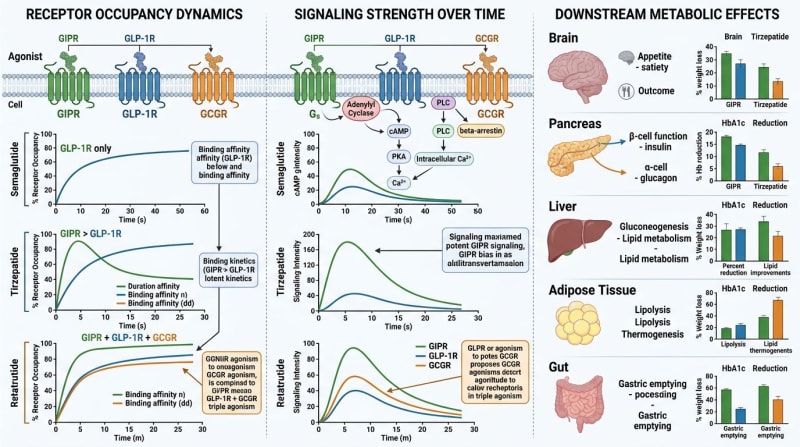
Retatrutide and tirzepatide are synthetic peptide ligands with different receptor-target profiles. Tirzepatide is classified as a dual agonist at the glucose-dependent insulinotropic polypeptide receptor (GIPR) and glucagon-like peptide-1 receptor (GLP-1R). Retatrutide, also designated LY3437943, is classified as a triple agonist at GIPR, GLP-1R, and the glucagon receptor (GCGR). For nonclinical laboratory work, the central distinction is the inclusion of GCGR activity, not a general ranking of one compound above the other.
This article focuses on molecular identity, receptor-assay interpretation, and the limits of comparisons across experimental systems. Alpha Carbon Labs lists tirzepatide and retatrutide as materials intended solely for nonclinical laboratory research. Published results concern the materials and conditions used in the cited studies; they do not establish the properties of a supplier's individual lot.
Molecular Architecture and Receptor Targets
Tirzepatide: A Dual-Receptor Peptide
Tirzepatide, also designated LY3298176, is a 39-amino-acid synthetic peptide based on the GIP sequence. Its structure includes a C20 fatty diacid attached through a linker to the lysine at position 20. Coskun and colleagues describe its molecular design and report activity at GIPR and GLP-1R in in-vitro receptor assays [5]. Those receptor-assay findings should be distinguished from the animal and human portions of the same discovery program.
Calling tirzepatide an “unbiased” or “balanced” agonist without specifying an assay is not informative. Binding affinity, functional potency, maximal response, and signaling bias are different measurements. A ligand can produce different relative responses depending on receptor expression, the signaling endpoint, and the reference agonist. A numerical affinity or potency comparison therefore requires the original assay conditions rather than a compound-wide label.
Retatrutide: A Three-Receptor Peptide
Retatrutide is a 39-amino-acid synthetic peptide with a fatty-acid modification and a GIPR/GLP-1R/GCGR target profile. The supplied human phase 2 trial publication describes it as a triple-hormone-receptor agonist [2]. That human study is not a substitute for a matched in-vitro comparison of receptor binding or signaling.
The additional GCGR target creates a distinct receptor-level question for laboratory experiments. It does not, by itself, establish stronger signaling at the other two receptors or a particular downstream response in a mixed-cell or tissue preparation. Descriptions such as “high,” “moderate,” or “significant” potency should be replaced by endpoint-specific measurements with an identified reference ligand.
Comparing Receptor Pharmacology
| Feature | Tirzepatide | Retatrutide |
|---|---|---|
| Development identifier | LY3298176 | LY3437943 |
| Peptide length | 39 amino acids | 39 amino acids |
| Receptor-target classification | GIPR and GLP-1R agonist | GIPR, GLP-1R, and GCGR agonist |
| Structural feature relevant to assay conditions | Fatty-diacid modification | Fatty-acid modification |
| Comparative laboratory question | How are responses distributed between GIPR and GLP-1R in the selected assay? | How does GCGR activity differ from GIPR and GLP-1R activity in the selected assay? |
Separate Binding from Functional Response
A binding experiment evaluates ligand–receptor interaction under defined conditions. A functional experiment measures a response downstream of receptor activation. An EC50 from a signaling assay is not a binding-affinity constant, and a maximal response is not a measure of receptor occupancy. These quantities should not be substituted for one another when comparing the peptides.
For a prospective in-vitro comparison, receptor-defined cell systems can help separate GIPR, GLP-1R, and GCGR responses. A cAMP readout is one possible functional endpoint, but it does not characterize every signaling pathway. Report the cell background, receptor species, expression system, assay duration, reference ligand, response normalization, and replicate structure. These are experimental-design considerations, not claims that a particular supplier lot has been tested in those systems.
Control the Experimental Context
Matched conditions are important when comparing functional concentration–response curves. Document medium composition, protein content, vehicle controls, and the tested concentration range. For lipid-modified peptides, protein binding and nonspecific adsorption are relevant variables to evaluate rather than assume away. Include suitable background and receptor-specific controls before assigning a response to an individual receptor.
Results from separate laboratories or assay formats should not be combined into a potency ranking without establishing comparability. Likewise, a response in a cell population expressing multiple receptors does not identify each receptor's contribution unless the experiment can distinguish those contributions.
Evidence Types and Their Limits
In-vitro evidence: The receptor experiments reported by Coskun and colleagues support the dual-receptor characterization of tirzepatide in the tested systems [5]. They do not establish identical responses in other cell backgrounds, with other assay endpoints, or with Alpha Carbon Labs materials.
Human evidence: Jastreboff and colleagues studied tirzepatide in adults with obesity or overweight and a weight-related complication [1], and studied retatrutide in a separate phase 2 population of adults with obesity or overweight and a weight-related condition [2]. These were separate human studies, not a direct comparison of the two compounds. Their results cannot establish a laboratory receptor-potency ranking.
Animal and in-silico evidence: No animal-model outcome or computational prediction is used here to rank the compounds. Animal findings require attribution to the species and experimental model; computational predictions require identification of the modeled system and independent experimental validation. Neither evidence type should be presented as a measured human or in-vitro result.
Pharmacokinetics Is Not an In-Vitro Exposure Schedule
Organism-level pharmacokinetics and cell-assay exposure are different experimental domains. A circulating half-life does not specify peptide stability in culture medium, the duration of receptor signaling, or an appropriate incubation period. Laboratory exposure conditions should be justified by the assay and supported by stability or recovery measurements where needed. Human administration schedules are outside the scope of this article.
Analytical Documentation and Laboratory Handling
Before interpreting an experiment, review the specific lot's available identity and analytical documentation. The quality-control information and certificate-of-analysis documents are relevant starting points, but their scope must be checked. A reported chromatographic purity value does not by itself establish peptide identity, content, receptor activity, sterility, or endotoxin status.
- Record the lot identifier, stated material form, analytical methods, and acceptance criteria relevant to the experiment.
- Distinguish identity testing and chromatographic purity from functional receptor testing.
- Evaluate stability and recovery under the actual assay conditions when these could affect interpretation.
- Follow the available safety data sheet, product-specific storage instructions, and institutional procedures for protective equipment, exposure prevention, and waste disposal.
The supplied article does not provide lot-specific hazard classifications or validated storage and handling conditions. These should not be inferred from peptide identity or from clinical publications.
Human Adverse Events Are Not Laboratory Hazard Assessments
In the human populations studied by Jastreboff and colleagues, gastrointestinal adverse events were reported in both the tirzepatide trial [1] and the separate retatrutide trial [2]; the retatrutide trial also reported increases in heart rate. These observations do not establish comparable safety between the compounds, identify a specific cardiac receptor mechanism, or define the occupational hazards of handling laboratory material.
Conclusion
The useful laboratory distinction is dual GIPR/GLP-1R activity versus triple GIPR/GLP-1R/GCGR activity. A defensible comparison requires defined receptor systems, matched analytical endpoints, appropriate controls, and lot-specific documentation. It should not rely on clinical outcome rankings, unsupported pathway claims, or assumptions that published study material and commercially supplied research material are equivalent.
References
- Jastreboff AM, et al. Tirzepatide Once Weekly for the Treatment of Obesity. N Engl J Med. 2022;387(3):205-217. — https://pubmed.ncbi.nlm.nih.gov/35658024/
- Jastreboff AM, et al. Triple-Hormone-Receptor Agonist Retatrutide for Obesity - A Phase 2 Trial. N Engl J Med. 2023;389(6):514-526. — https://pubmed.ncbi.nlm.nih.gov/37366315/
- Frias JP, et al. Efficacy and safety of retatrutide, a GIP, GLP-1, and glucagon receptor agonist, in adults with type 2 diabetes: a randomised, double-blind, placebo-controlled and active-controlled, parallel-group, phase 2 trial. Lancet. 2023;402(10401):529-544. — https://www.thelancet.com/journals/lancet/article/PIIS0140-6736(23)01053-X/fulltext
- Müller TD, et al. The evolution of incretin hormones for the treatment of metabolic diseases. Gut. 2023;72:1335-1351.
- Coskun T, et al. LY3298176, a novel dual GIP and GLP-1 receptor agonist for the treatment of type 2 diabetes mellitus: From discovery to clinical proof of concept. Mol Metab. 2018;18:3-14. — https://pubmed.ncbi.nlm.nih.gov/30293777/
- Nauck MA, et al. Incretin hormones: Their role in health and disease. Diabetes Obes Metab. 2018;20(S1):5-21. — https://pubmed.ncbi.nlm.nih.gov/29364588/
- Rosenstock J, et al. Retatrutide, a GIP, GLP-1 and glucagon receptor agonist, for people with type 2 diabetes: a 36-week, double-blind, randomised, phase 2 trial. Lancet. 2023;402(10401):529-544. — https://pubmed.ncbi.nlm.nih.gov/37385280/
- Baggio LL, Drucker DJ. Biology of Incretins: GLP-1 and GIP. Gastroenterology. 2007;132(6):2131-2157. — https://pubmed.ncbi.nlm.nih.gov/17498508/
- Heise T, et al. Tirzepatide: Pharmacokinetics and pharmacodynamics. Clin Pharmacokinet. 2022;61(12):1245-1259. — https://pubmed.ncbi.nlm.nih.gov/36029471/
- Knerr PJ, et al. Next-generation multi-receptor agonists for the treatment of obesity and type 2 diabetes. Nat Rev Endocrinol. 2024;20:12-28.
Limitations: Published findings are specific to their study materials, models, and conditions. They do not establish safety, effectiveness, approval, or suitability of material sold by Alpha Carbon Labs for human or veterinary use.