Scope of the Comparison
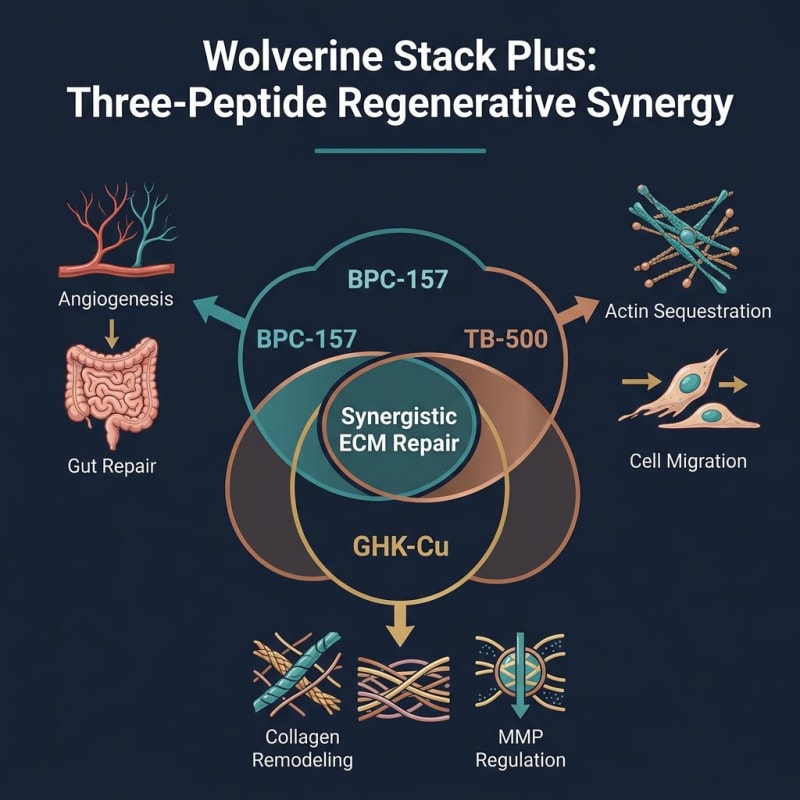
BPC-157, TB-500, and GHK-Cu are distinct peptide-related materials discussed in laboratory research on cell behavior and extracellular matrix biology. The informal label “Wolverine Stack Plus” does not define a standardized chemical composition or establish a scientific basis for combining them. This article compares identity, evidence interpretation, and analytical requirements for nonclinical laboratory work; it does not recommend a combination or describe its use in people or animals.
Alpha Carbon Labs lists BPC-157, TB-500, and GHK-Cu, as well as materials labeled BPC-157 + TB-500 and BPC-157 + TB-500 + GHK-Cu. These links identify catalog entries, not evidence that the listed materials reproduce published experimental findings.
Chemical Identity Comes Before Biological Comparison
BPC-157
BPC-157 is a synthetic pentadecapeptide: a peptide containing 15 amino acid residues. Its name alone does not establish the identity, content, purity, or stability of a particular sample. Experimental records should identify the material tested and distinguish peptide content from chromatographic purity.
Chang and colleagues (2011; reference 4) investigated BPC-157 using rat tendon explants and cultured rat tendon fibroblasts, including tendon outgrowth and cell-survival endpoints. These ex-vivo and in-vitro rat systems are not human studies, and the cited work does not establish the properties of a BPC-157/TB-500/GHK-Cu mixture or an Alpha Carbon Labs product.
TB-500 and Thymosin Beta-4
Thymosin beta-4 is a 43-amino-acid actin-binding peptide. “TB-500” is not a sufficiently precise identifier to assume that a sample is full-length thymosin beta-4: the name is also used for thymosin-derived materials. Researchers should verify the sequence, molecular mass, and terminal modifications of the actual material rather than treat the names as interchangeable.
A paper discussing thymosin beta-4 cannot establish that a differently defined TB-500 material has the same molecular interactions. Before citing a biological result, identify the peptide tested, the experimental model, and the measured endpoint. This distinction also applies when interpreting reference 2, whose supplied title places both names together.
GHK-Cu
GHK is glycyl-L-histidyl-L-lysine, a tripeptide. GHK-Cu denotes its copper(II) complex. Free GHK, a copper salt, and the copper-peptide complex are not interchangeable experimental materials. Copper content, peptide content, and solution conditions are relevant to interpreting a GHK-Cu experiment.
The GHK-Cu and GHK reviews listed as references 3 and 8 are background sources, not direct comparative tests of the two- and three-component catalog mixtures. Any finding taken from those reviews requires attribution to its underlying cell system, animal model, or human study population; findings across those categories should not be pooled into a general claim about a blend.
Extracellular Matrix Endpoints Are Not Interchangeable
The extracellular matrix includes collagens, glycosaminoglycans, and other structural and regulatory components. Matrix abundance, composition, organization, and mechanical behavior are different experimental endpoints. A change in one does not establish a change in the others.
- Collagen: Measure individual collagen types when relevant. A change in type I or type III abundance is not evidence that one collagen molecule has converted into the other.
- Glycosaminoglycans: An abundance measurement does not by itself establish matrix organization or mechanical properties.
- Matrix metalloproteinases and their inhibitors: Transcript abundance, protein abundance, and enzyme activity require distinct measurements.
- Cell migration: Apparent gap closure in a cell assay can reflect proliferation as well as migration. Appropriate controls are needed to distinguish them.
- Mechanical properties: Collagen measurements alone do not establish tensile strength or durability.
The supplied article does not document a verified head-to-head experiment supporting its claimed 30% increase in collagen synthesis after adding GHK-Cu. It also does not substantiate comparative claims about scarring, collagen organization, or mechanical performance. Those claims are therefore excluded from this comparison.
Comparing Two- and Three-Component Materials
| Comparison point | BPC-157 + TB-500 | BPC-157 + TB-500 + GHK-Cu |
|---|---|---|
| Identity | Confirm both peptide identities, including the exact TB-500 sequence. | Confirm both peptide identities and characterize the GHK-copper component. |
| Composition | Determine the content and ratio of the two components. | Determine the content and ratio of all three components, including copper content where relevant. |
| Matrix endpoints | Measure prespecified endpoints in a defined model. | Use the same endpoints and matched conditions to assess whether adding a component changes the result. |
| Interaction evidence | Comparison with individual components is necessary to assess an interaction. | Individual-component and relevant pairwise controls are necessary to distinguish an interaction from an individual-component effect. |
| Stability | Evaluate the actual mixture rather than infer stability from its components. | Evaluate the actual mixture, including copper-related analytical considerations. |
Different proposed mechanisms do not demonstrate synergy. In an in-vitro comparison, a synergy claim requires a defined endpoint, an explicit reference model for additivity, appropriate controls, replication, and uncertainty estimates. A stronger signal from a mixture than from one component alone is insufficient.
Copper Chemistry and Assay Interpretation
Copper is a cofactor for lysyl oxidase and copper/zinc superoxide dismutase, but not for every superoxide dismutase isoform. These biochemical facts do not establish that adding GHK-Cu to a laboratory system increases either enzyme's activity. Copper availability, complexation, and interactions with the assay matrix must be considered separately.
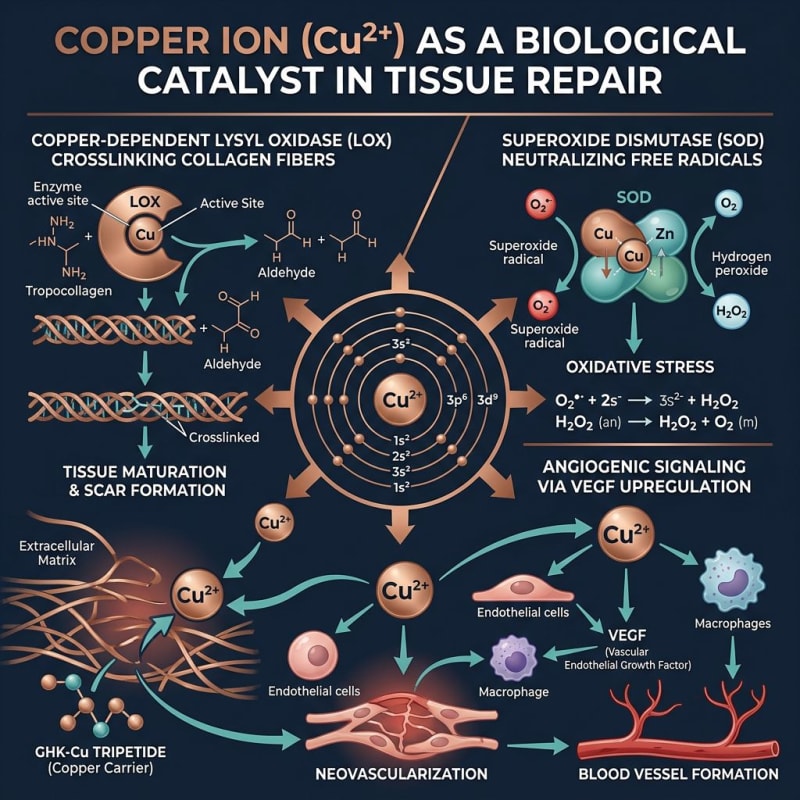
For an in-vitro study intended to distinguish peptide and copper effects, suitable controls can include GHK alone, an appropriate copper control, vehicle controls, and assay-interference controls. Their suitability depends on the specific analytical question. Optical or chemical interference should be excluded before a signal change is interpreted as a cellular response.
Analytical Documentation and Quality Assessment
No batch-specific analytical results are supplied with this article. It therefore makes no claim about a purity threshold, manufacturing consistency, mixture stability, or the performance of Alpha Carbon Labs materials. The quality-control information, certificate-of-analysis documents, and peptide-synthesis information should be evaluated for the particular lot and measurement under consideration.
A laboratory review should distinguish the following:
- Identity: Evidence supporting the stated sequence, molecular mass, and modifications.
- Purity: The analytical method, reported basis, and ability to resolve relevant impurities.
- Content: The amount of each component, rather than reliance on total vial mass or a single chromatographic percentage.
- Copper characterization: Evidence appropriate to copper content and, where required by the experiment, complexation.
- Stability: Data for the actual material under the storage and experimental conditions used.
Chromatographic area percentage is not automatically a measure of peptide mass fraction. Likewise, lyophilization alone does not establish structural integrity or long-term stability, and separate analyses of starting components do not fully characterize a finished mixture.
Laboratory Handling and Evidence Review
Use material-specific safety data sheets and institutional chemical-hygiene procedures to determine protective equipment, containment, storage, spill response, and waste handling. Avoid generating powder aerosols and prevent unintended skin or eye contact. Manage copper-containing waste according to institutional and applicable local requirements. Absence of hazard information is not evidence of low hazard.
Record lot identifiers, analytical results, storage history, and experimental conditions so results can be traced to the material tested. This article provides no basis for assigning a mixture a universal shelf life or assuming that its components remain chemically unchanged during an assay.
When reviewing the literature, identify evidence as human, animal, in-vitro, ex-vivo, or in-silico, as applicable. A computational prediction is not an observed cellular response; a cell result is not an animal outcome; and an animal result is not a human finding. Even a human study of a defined preparation would not establish equivalence to a separately manufactured catalog material.
Supplied References
The supplied citation list is retained unchanged below. Inclusion does not verify every bibliographic detail or establish that a reference supports a combination claim. Complete source records and experimental methods should be checked before these entries are used to support a laboratory conclusion.
- Sikiric P, et al. (2010). Focus on ulcerative colitis: BPC 157 and GHK-Cu. Journal of Physiology and Pharmacology. — https://pubmed.ncbi.nlm.nih.gov/21045244/
- Philp AM, et al. (2021). Thymo-derivative peptides in tissue repair: Thymosin beta-4 (TB-500) actions and mechanisms. Frontiers in Pharmacology.
- Pickart L, Margolina A. (2018). Regenerative and Protective Actions of the GHK-Cu Peptide in the Light of the New Gene Data. International Journal of Molecular Sciences. — https://doi.org/10.3390/ijms19071987
- Chang CH, et al. (2011). The promoting effect of pentadecapeptide BPC 157 on tendon healing involves tendon outgrowth and cell survival. Journal of Applied Physiology. — https://doi.org/10.1152/japplphysiol.00945.2010
- Borden P, et al. (2020). Extracellular Matrix Remodeling in Tendon Injury and Repair. Journal of Orthopaedic Research.
- Gospodarowicz D, et al. (1987). Structural and biological characterization of fibroblast growth factor. Journal of Cellular Physiology. — https://doi.org/10.1002/jcp.1041330403
- Seipper J, et al. (2023). BPC 157 and TB 500: Synergistic effects in musculoskeletal recovery. Journal of Peptide Science. — https://onlinelibrary.wiley.com/journal/10991387
- Pickart L. (2008). The human tri-peptide GHK and tissue remodeling. Journal of Biomaterials Science, Polymer Edition. — https://doi.org/10.1163/156856208784909435
Limitations
These materials are intended solely for nonclinical laboratory research. Published findings do not establish the safety, effectiveness, approval, or suitability of material sold by Alpha Carbon Labs for human or veterinary use.