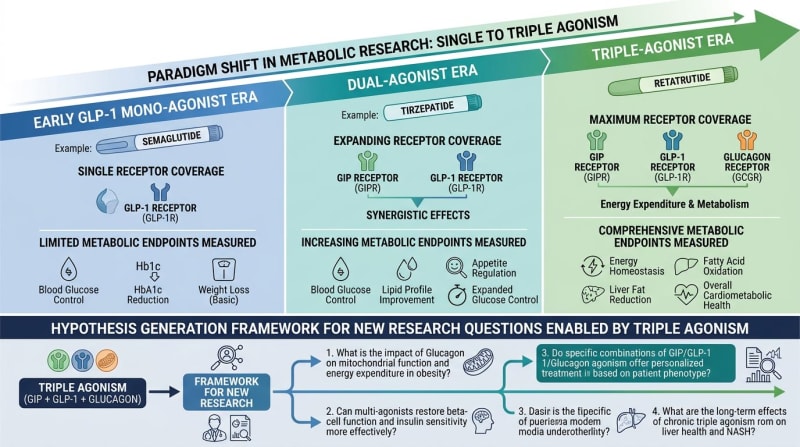
Retatrutide is a peptide agonist targeting the glucose-dependent insulinotropic polypeptide receptor (GIPR), glucagon-like peptide-1 receptor (GLP-1R), and glucagon receptor (GCGR). Its three-receptor profile provides a distinct subject for nonclinical receptor-signaling studies. Comparisons with semaglutide and tirzepatide require defined experimental systems, matched analytical conditions, and endpoints selected before data collection—not assumptions that additional receptor targets confer superior results.
This article addresses laboratory study design, evidence interpretation, and material characterization. Alpha Carbon Labs materials are intended solely for nonclinical laboratory research.
Chemical Identity and Receptor Classification
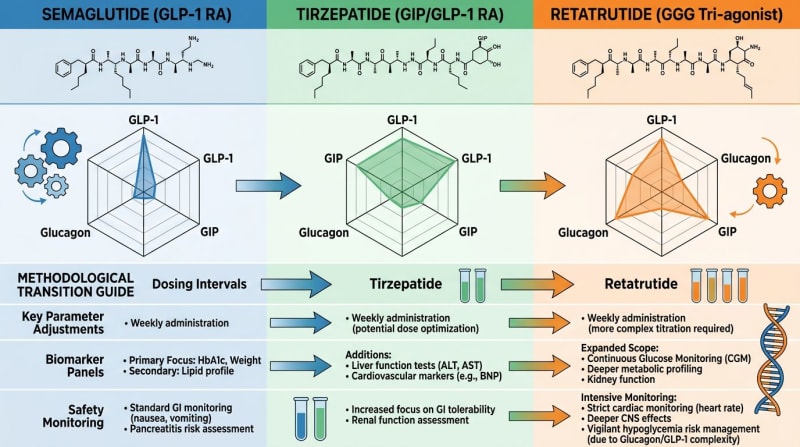
Retatrutide is a 39-amino-acid, lipid-modified peptide. Its molecular identity should be distinguished from the identity, composition, and analytical characteristics of any particular supplied lot. A compound name alone does not establish sequence confirmation, purity, functional activity, or stability.
The receptor classifications below describe the named molecules. They are not measurements of affinity, potency, selectivity, or activity for Alpha Carbon Labs materials.
| Compound | Receptor targets | Classification |
|---|---|---|
| Semaglutide | GLP-1R | Single-receptor agonist |
| Tirzepatide | GIPR and GLP-1R | Dual-receptor agonist |
| Retatrutide | GIPR, GLP-1R, and GCGR | Triple-receptor agonist |
Retatrutide is a single molecular entity, not a mixture of three receptor agonists. Its functional activity at each receptor must be evaluated experimentally; there is no ingredient ratio of GLP-1, GIP, and glucagon to preserve during laboratory handling.
Separate Published Evidence by Study Type
Jastreboff and colleagues studied retatrutide in a phase 2 trial involving human adults with obesity [1]. Rosenstock and colleagues studied retatrutide in a phase 2 trial involving human adults with type 2 diabetes [2]. These human studies are not nonclinical assay validations and do not establish the performance of Alpha Carbon Labs materials. Results from separate human trials should not be assembled into a head-to-head ranking of semaglutide, tirzepatide, and retatrutide.
In the human phase 2 obesity trial reported by Jastreboff and colleagues, adverse-event observations included gastrointestinal events and increases in heart rate [1]. These observations are specific to that human study population and study material. They neither establish laboratory handling hazards nor support safety assurances for another material.
For literature review and experimental reporting, keep the following evidence categories separate:
- In-vitro evidence: Identify the cell system, receptor species, expression conditions, assay endpoint, and exposure conditions. A receptor-signaling result does not by itself establish an organism-level effect.
- Animal evidence: Identify the species, strain, experimental model, and measured endpoint. Do not present animal observations as human findings or as veterinary-use guidance.
- Human evidence: Identify the enrolled population and trial design. Human trial findings do not validate a supplier's nonclinical material.
- In-silico evidence: Label computational outputs as predictions and distinguish them from experimentally measured binding or signaling.
Redesigning a Comparative Laboratory Study
Moving from a single- or dual-receptor assay to a three-receptor investigation is an experimental-design change, not a compound-switching schedule. Define which receptor-specific questions the new study will answer and which measurements can be compared with existing data.
Receptor-Specific Functional Assays
For an in-vitro study, evaluate each receptor in a defined system before interpreting activity in cells that express multiple receptors. Document receptor expression, use appropriate vehicle and reference controls, and include controls for nonspecific signal and cell viability. Establish concentration–response relationships within the assay's validated range rather than inferring activity from the compound's classification.
Keep binding affinity distinct from functional potency and maximal response. Comparisons require attention to receptor abundance, signal amplification, incubation conditions, and data normalization. A difference between assays cannot automatically be assigned to a difference between compounds.
Energy-Expenditure Measurements in Animal Research
If an approved nonclinical animal study includes energy expenditure as an endpoint, indirect calorimetry and metabolic-cage measurements are possible methodological approaches. Prespecify collection of oxygen consumption, carbon dioxide production, food intake, activity, and body-composition data as appropriate to the research question. Document housing conditions, acclimation, and the analysis approach. These are study-design considerations, not evidence that retatrutide increases energy expenditure in a particular model.
Hepatic Lipid Endpoints
For nonclinical hepatic-lipid studies, select validated biochemical, histological, or imaging endpoints suitable for the model. MRI-derived proton-density fat fraction and tissue histology measure different aspects of the sample and should not be treated as interchangeable. Sampling intervals should follow the study question and method validation, not an unsupported expectation of faster lipid changes with one compound.
Physiological Measurements and Interpretation
Where an approved animal research question includes cardiovascular measurements, telemetry or ECG can provide model-specific observations. Such measurements alone do not establish the mechanism underlying a change. Prespecify endpoints, controls, and analysis rather than interpreting a heart-rate change as evidence of a particular metabolic or neural pathway.
Material Characterization and Laboratory Handling
Review available lot-specific COA documents before selecting material for an experiment. Record the lot identifier, reported identity method, purity method, and any available content or stability data. Chromatographic purity, peptide content, sequence identity, and biological activity are different attributes; evidence for one does not establish the others.
Mass spectrometry and chromatography can contribute to material characterization, while receptor-specific functional assays address activity. State which measurements were actually performed and which remain unavailable. Neither a chromatographic result nor the appearance of a lyophilized sample establishes sterility, absence of endotoxin, or functional consistency.
Information about peptide synthesis and quality-control processes provides process context but does not replace lot-specific evidence. No numerical release specifications or validated storage conditions are established by the information supplied with this article.
Use the applicable safety data sheet, documented material-specific handling instructions, and institutional chemical-hygiene procedures. Select protective equipment and containment through a laboratory risk assessment, avoid unnecessary exposure or aerosol generation, and follow institutional waste-disposal procedures. Do not infer low handling risk from a peptide's research classification.
Track storage history and sample handling, and assess stability under the conditions used in the experiment. Human pharmacokinetic observations are not evidence of stability in a vial, assay medium, or laboratory storage environment.
Reporting and Reproducibility
Report material provenance, lot characterization, experimental model, controls, endpoint definitions, replicate structure, and analysis methods. Separate measured results from mechanistic interpretations and untested hypotheses. A useful comparison identifies what the experiment can resolve and what would require additional receptor-specific, analytical, or model-specific evidence.
References
- Jastreboff AM, et al. Triple-Hormone-Receptor Agonist Retatrutide for Obesity — A Phase 2 Trial. New England Journal of Medicine. 2023. — https://www.nejm.org/doi/full/10.1056/NEJMoa2301972
- Rosenstock J, et al. Retatrutide, a GIP, GLP-1, and glucagon receptor agonist, for type 2 diabetes: a 24-week, multicentre, randomised, double-blind, placebo-controlled, phase 2 trial. The Lancet. 2023. — https://www.thelancet.com/journals/lancet/article/PIIS0140-6736(23)01053-X/fulltext
- Finan B, et al. A strategically engineered GIP, GLP-1, and glucagon receptor co-agonist with potent anti-hyperglycemic and insulinotropic properties. Nature Medicine. 2013. — https://www.nature.com/articles/nm.3394
- Müller TD, et al. GLP-1, GIP, and Glucagon Receptor Co-agonism: Next Generation Therapeutics for Obesity and Diabetes. Cell Metabolism. 2022. — https://doi.org/10.1016/j.cmet.2022.02.002
- Knerr PJ, et al. Next-generation multi-receptor agonists for the treatment of metabolic diseases. International Journal of Molecular Sciences. 2022. — https://doi.org/10.3390/ijms23169315
- Heise T, et al. Tirzepatide: A Novel Dual GIP and GLP-1 Receptor Agonist for the Treatment of Type 2 Diabetes Mellitus. Diabetes, Obesity and Metabolism. 2022. — https://dom-pubs.onlinelibrary.wiley.com/doi/10.1111/dom.14652
- Thomas MK, et al. Dual GIP and GLP-1 Receptor Agonist Tirzepatide Improves Beta-Cell Function and Insulin Sensitivity in Type 2 Diabetes. J Clin Invest. 2021.
- Bastin M, et al. Glucagon receptor signaling and its metabolic physiological roles. Frontiers in Endocrinology. 2019. — https://doi.org/10.3389/fendo.2019.00669
Limitations: Published findings are specific to their study materials, models, and populations. They do not establish safety, effectiveness, approval, or suitability of material sold by Alpha Carbon Labs for human or veterinary use.