NAD+ and ACE-031: Metabolic and ActRIIB Signaling in Muscle Research
Skeletal muscle aging involves changes in metabolism, cellular signaling, tissue organization, and neuromuscular function. NAD+ metabolism and activin type IIB receptor (ActRIIB) signaling are distinct subjects within this field. Examining them together can help define experimental questions, but the supplied literature does not establish a combined NAD+ and ACE-031 effect or demonstrate synergy.
Material Identity and Mechanistic Scope
NAD+: A Metabolic Cofactor and Enzyme Substrate
Nicotinamide adenine dinucleotide in its oxidized form, NAD+, is a small-molecule coenzyme, not a peptide. The NAD+/NADH pair participates in oxidation–reduction reactions: NAD+ accepts reducing equivalents during substrate oxidation, and NADH can supply electrons to the mitochondrial respiratory chain. NAD+ is also consumed by enzymes including sirtuins and poly(ADP-ribose) polymerases.
These roles should not be collapsed into a claim that adding NAD+ to an experimental system necessarily increases mitochondrial abundance or cellular ATP. Extracellular NAD+, intracellular NAD+ pools, NAD+ precursors, and interventions affecting NAD+ synthesis or consumption are different experimental variables. Evidence concerning one does not automatically apply to the others.
ACE-031: A Recombinant Receptor-Fc Fusion Protein
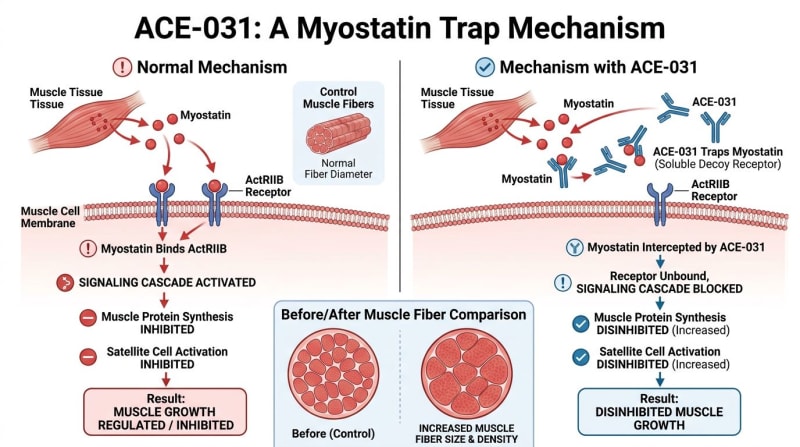
ACE-031 is a recombinant fusion protein containing the extracellular domain of human ActRIIB linked to the Fc region of human IgG1. It is not a short synthetic peptide. Its soluble receptor domain provides a ligand-binding mechanism distinct from that of an antibody directed specifically against myostatin.
ActRIIB-associated signaling involves multiple ligands, including myostatin and activins. A receptor-based ligand trap therefore should not be treated as a myostatin-selective reagent. Ligand binding, downstream signaling, and cellular phenotype are separate properties that require appropriate assays; none can be inferred from the material name alone.
What the Supplied Literature Examines
NAD+ and Nuclear–Mitochondrial Communication
Gomes et al. (2013) investigated age-associated NAD+ changes and nuclear–mitochondrial communication using mouse and cell-based experiments. The study linked declining NAD+ availability to a pseudohypoxic signaling state in those experimental systems [2]. It is not a study of NAD+ combined with ACE-031 and does not characterize Alpha Carbon Labs material.
Cantó et al. (2015) and Imai and Guarente (2014) are reviews synthesizing NAD+ metabolism and sirtuin biology across experimental systems, rather than single-model tests of a defined NAD+ material [5, 7]. They provide biochemical context, but individual claims about a particular species, tissue, or intervention require examination of the underlying primary studies.
ActRIIB Signaling and Muscle Biology
Lee and McPherron (2001) examined myostatin regulation using mouse experiments and biochemical approaches [3]. Cadena et al. (2010) examined a soluble ActRIIB receptor in mouse skeletal muscle, including its relationship to IGF-1 signaling [8]. These are relevant to pathway interpretation, but neither a shared receptor target nor a related construct establishes equivalence to ACE-031 or to a supplier's research material.
Zhou et al. (2010) studied ActRIIB antagonism in mouse models of cancer-associated wasting [6]. That disease-associated animal context must remain separate from normal aging, isolated-cell experiments, and human evidence. It does not establish a combined NAD+ and ACE-031 effect.
Faitg et al. (2020) reviewed mitochondrial biogenesis and muscle-mass regulation in the context of sarcopenia [9]. As a review spanning the literature rather than a direct combination experiment, it supports consideration of multiple biological processes, not a conclusion that manipulating two pathways produces synergy.
Human Studies: Separate Evidence and Important Limitations
Attie et al. (2013) studied ACE-031 in healthy postmenopausal women [1]. That human study population is distinct from cell cultures, aging mice, and other experimental models. The study did not evaluate an NAD+ and ACE-031 combination, and its findings cannot be transferred to commercially supplied research material.
Campbell et al. (2017) studied ACE-031 in boys with Duchenne muscular dystrophy in a randomized, placebo-controlled clinical trial [4]. The trial was stopped early because of safety concerns involving epistaxis and telangiectasias. These observations should not be minimized as evidence of an acceptable safety profile or attributed to an unverified vascular mechanism.
Why Synergy Is Not Established
The supplied references do not report a direct experimental comparison of NAD+ alone, ACE-031 alone, and their combination. Separate evidence concerning NAD+ metabolism and ActRIIB signaling cannot establish an interaction between the materials. The original claims of coordinated mitochondrial expansion, functional hypertrophy, fatigue resistance, and favorable body composition are therefore not supported by this citation set.
For an in-vitro investigation, synergy would require a predefined interaction model and a controlled comparison, rather than an assumption that two mechanistic descriptions are complementary. A combination response exceeding either individual response is not, by itself, proof of synergy.
| Research question | Possible measurement category | Interpretive limitation |
|---|---|---|
| Does the experimental condition change cellular NAD metabolism? | NAD+ and NADH measurements with defined extraction and normalization procedures | Total cellular measurements do not necessarily resolve subcellular pools. |
| Does a receptor-Fc preparation bind a specified ligand? | Ligand-binding assay with appropriate reference and negative controls | Binding alone does not demonstrate a downstream cellular response. |
| Does ligand-dependent signaling change? | A validated signaling readout, such as ligand-stimulated SMAD2/3 phosphorylation | A signaling change does not establish tissue-level function. |
| Do metabolic and morphological endpoints change together? | Separately measured respiration, viability, and cell morphology | Association between endpoints does not establish causation or synergy. |
These are proposed measurement categories, not methods or results reported for an Alpha Carbon Labs product. Cell identity, differentiation state, medium composition, assay timing, biological replication, and normalization should be documented before interpreting a response. In-vitro results should remain identified as in-vitro evidence; computational predictions, if used, should be identified separately as in-silico evidence.
Analytical Documentation and Laboratory Handling
The NAD+ and ACE-031 catalog entries concern materials intended solely for nonclinical laboratory research. The supplied article provides no lot-specific analytical results, numerical purity specifications, storage conditions, or validated activity measurements. Such information should not be invented or inferred from published studies.
Review the applicable certificate of analysis for the methods used, reported results, lot identity, and stated limitations. Chromatographic purity, molecular identity, and biological activity answer different questions. A chromatographic purity value alone does not establish correct folding, ligand binding, absence of aggregates, sterility, or low endotoxin content.
For NAD+, analytical review should distinguish the oxidized coenzyme from NADH and any relevant degradation products. For a receptor-Fc protein, identity, integrity, aggregation, and assay-specific activity require consideration. These are analytical review priorities, not claims that any particular supplier test has been performed.
General information about peptide synthesis should not be mistaken for evidence of how a recombinant receptor-Fc protein was manufactured. Obtain material-specific manufacturing and characterization information where it is necessary for experimental interpretation.
Use the current material-specific safety data sheet, documented storage instructions, and institutional chemical or biological risk assessment to determine handling, protective equipment, spill response, and waste procedures. Human adverse-event reports are not substitutes for laboratory hazard documentation, and a research-use designation does not establish that handling is risk-free.
References
- Attie, K. M., et al. (2013). A single ascending-dose study of muscle growth factor trap ACE-031 in healthy postmenopausal women. Muscle & Nerve, 47(3), 416–423. — https://pubmed.ncbi.nlm.nih.gov/23169607/
- Gomes, A. P., et al. (2013). Declining NAD(+) induces a pseudohypoxic state disrupting nuclear-mitochondrial communication during aging. Cell, 155(7), 1624–1638. — https://doi.org/10.1016/j.cell.2013.11.037
- Lee, S. J., & McPherron, A. C. (2001). Regulation of myostatin activity and muscle growth. Proceedings of the National Academy of Sciences, 98(16), 9306–9311. — https://doi.org/10.1073/pnas.151270098
- Campbell, C., et al. (2017). Myostatin inhibition with ACE-031 in boys with Duchenne muscular dystrophy: Results of a randomized, placebo-controlled clinical trial. Muscle & Nerve, 55(4), 458-464. — https://pubmed.ncbi.nlm.nih.gov/27462804/
- Cantó, C., et al. (2015). NAD+ metabolism and the control of energy homeostasis: a balancing act between mitochondria and the nucleus. Cell Metabolism, 22(1), 31-53. — https://doi.org/10.1016/j.cmet.2015.05.023
- Zhou, X., et al. (2010). Reversal of cancer cachexia and muscle wasting by ActRIIB antagonism leads to prolonged survival. Cell, 142(4), 531-543. — https://doi.org/10.1016/j.cell.2010.07.011
- Imai, S., & Guarente, L. (2014). NAD+ and sirtuins in aging and disease. Trends in Cell Biology, 24(8), 464-471. — https://doi.org/10.1016/j.tcb.2014.04.002
- Cadena, S. M., et al. (2010). Administration of a soluble activin type IIB receptor promotes skeletal muscle growth independent of IGF-1 signaling. Journal of Applied Physiology, 109(3), 635-642. — https://doi.org/10.1152/japplphysiol.00866.2009
- Faitg, J., et al. (2020). Crosstalk between mitochondrial biogenesis and control of muscle mass in sarcopenia. Cells, 9(5), 1251. — https://doi.org/10.3390/cells9051251
- Latres, E., et al. (2017). Myostatin blockade with a fully human monoclonal antibody induces muscle hypertrophy and reverses muscle atrophy in young and aged mice. Skeletal Muscle, 5, 34.
Limitations
The supplied literature does not establish NAD+–ACE-031 synergy or characterize Alpha Carbon Labs products. Published findings do not establish safety, effectiveness, approval, or suitability of the material sold for human or veterinary use.