Retatrutide Structural Biochemistry and Triple Agonist Receptor Binding
A laboratory-focused overview of retatrutide's peptide architecture, three receptor targets, binding-versus-signaling measurements, and analytical characterization limits.
Retatrutide as a Multi-Receptor Research Subject
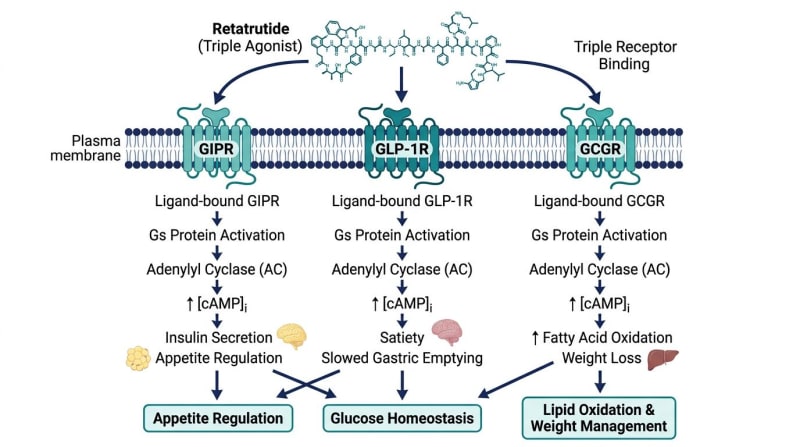
Retatrutide, also designated LY3437943, is a synthetic 39-amino-acid peptide studied for agonist activity at the glucose-dependent insulinotropic polypeptide receptor (GIPR), glucagon-like peptide-1 receptor (GLP-1R), and glucagon receptor (GCGR). These are class B1 G-protein-coupled receptors. In the in-vitro receptor assays reported by Coskun et al., LY3437943 exhibited functional agonist activity at all three receptors [2]. This finding describes the experimental compound in the reported assay systems; it does not establish the activity of material supplied by Alpha Carbon Labs.
The structural question is how one modified peptide can interact with three related but distinct receptor environments. Addressing that question requires separating chemical identity, receptor binding, functional signaling, and assay conditions. Activity at three receptors does not mean that one peptide molecule binds all three receptors at once, nor does it establish equal affinity or equal signaling potency.
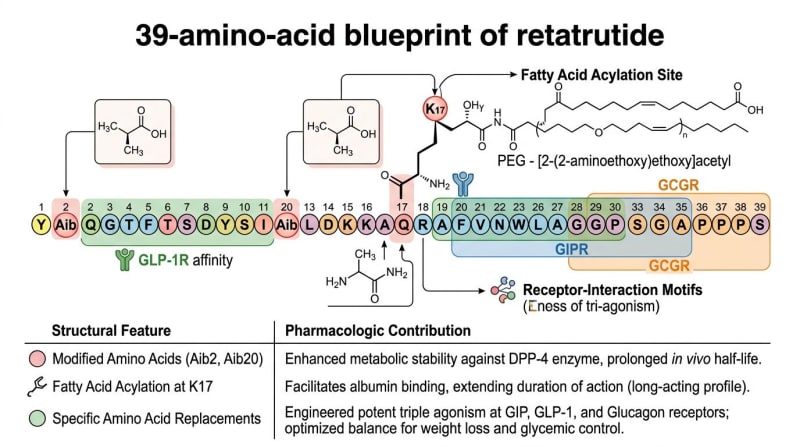
Molecular Architecture: Peptide Backbone and Acylation
Retatrutide has a GIP-based peptide backbone with sequence modifications and a lipid-containing side chain. Its chemical identity includes a C20 fatty diacid moiety attached through a linker at Lys17. The peptide sequence, nonstandard residues, linker, and site of modification are all relevant to identity; describing a material only as a “39-amino-acid peptide” is insufficient to distinguish it from related molecules.
A residue-by-residue explanation of receptor selectivity requires direct evidence. Sequence similarity alone cannot establish which side chains determine affinity, stabilize a receptor-bound conformation, or contribute to signaling. Likewise, a nonstandard residue should not automatically be assigned a particular helix geometry or a universal protective effect against proteolysis.
Questions for Structure–Activity Studies
- Does a sequence substitution change receptor binding, functional potency, maximal response, or more than one of these measurements?
- Does a proposed contact have support from an experimentally determined receptor complex, mutagenesis, or another direct method?
- Are comparisons made under matched conditions, including receptor expression, incubation time, and medium composition?
- Could altered peptide integrity, adsorption, or protein binding explain an apparent activity difference?
These questions help distinguish a demonstrated structure–activity relationship from an interpretation based only on a molecular diagram.
Receptor Binding Is Not the Same as Receptor Activation
Binding assays measure ligand–receptor interaction, whereas functional assays measure a downstream response. An affinity estimate, such as a dissociation constant, is not interchangeable with an EC50 from a signaling assay. EC50 values depend on the experimental system and can be influenced by receptor abundance, signal amplification, and assay duration.
In the in-vitro receptor assays described by Coskun et al., the evidence for retatrutide's triple-agonist classification comes from functional activity at GIPR, GLP-1R, and GCGR [2]. Such results should not be restated as a universal ranking of binding affinities. A “full agonist” designation also requires a stated reference agonist and an assay-specific comparison of maximal responses.
| Receptor | Experimental focus | Interpretive limitation |
|---|---|---|
| GIPR | Binding and concentration–response measurements in a defined GIPR assay system. | High functional potency does not independently demonstrate the highest binding affinity. |
| GLP-1R | Binding and signaling measurements with a defined reference agonist. | A difference in EC50 does not by itself establish signaling bias. |
| GCGR | Receptor-dependent signaling and testing of proposed ligand–receptor contacts. | Activity in an isolated receptor system does not establish responses in tissues or whole organisms. |
Controls for Functional Assays
For nonclinical in-vitro work, useful controls include a receptor-appropriate reference ligand, a vehicle control, and a receptor-negative or otherwise suitable background control. Report the cell system, receptor species, expression context, endpoint, incubation time, and normalization method. If cAMP is the endpoint, describe it as a cAMP response rather than as a direct measurement of binding.
A mixed-receptor system introduces additional attribution problems. A response in cells expressing multiple receptors cannot be assigned to one receptor without appropriate controls. Similarly, observing responses at three receptors in separate experiments does not demonstrate synergy; that requires a defined interaction model and an experimental design capable of testing it.
C20 Fatty Diacid Modification and Assay Conditions
The C20 fatty diacid modification is an important part of retatrutide's molecular architecture. For laboratory interpretation, lipid modification makes protein binding and the distinction between nominal and unbound peptide concentration relevant experimental variables. Albumin content, other medium components, and contact surfaces should therefore be documented when comparing assays.
The presence of an acyl group does not establish a binding constant, a particular storage lifetime, or a duration of receptor activation. Those properties require measurements under specified conditions. A half-life measured in human participants or animals is not an in-vitro stability specification and cannot be used as a shelf-life claim for a supplied research material.
Evidence Boundaries and Comparator Selection
In-vitro receptor experiments can characterize responses in a defined assay system. Animal experiments address questions in the stated species and model. Human studies concern their enrolled populations and measured endpoints. In-silico docking or modeling generates structural hypotheses rather than independently confirming binding or activation. These evidence types are not interchangeable.
A comparator should be selected for the experimental question, not for an assumed similarity in whole-organism effects. Related internal catalog entries include semaglutide, tirzepatide, and retatrutide. Catalog listings are not evidence that materials are equivalent to published study compounds or that any listed material has validated receptor activity. Differences between peptide structures also do not establish a hierarchy of laboratory utility.
Synthesis, Identity, and Analytical Characterization
Laboratory preparation of a modified peptide involves both assembly of the peptide chain and control of the lipid-linker modification. General information on peptide synthesis provides process context, but it does not establish how a particular lot was produced or characterized.
Chromatography and mass spectrometry provide complementary evidence. HPLC can describe a sample's chromatographic profile under the reported method. Mass spectrometry can assess whether an observed mass is consistent with the proposed molecule. Neither a single chromatographic purity value nor an intact-mass match alone proves the complete sequence, stereochemistry, modification site, or biological activity.
- Identity: Review the stated structure, molecular form, and supporting analytical results.
- Chromatographic purity: Check the method, detection conditions, integration approach, and available chromatogram. Peak-area percentage is not automatically peptide content by mass.
- Modification: Determine whether the evidence supports the intended lipid-linker attachment rather than only a compatible total mass.
- Content and formulation: Distinguish peptide content from water, counterions, and other constituents when preparing quantitative laboratory calculations.
- Functional characterization: Treat receptor activity as a separate measurement rather than inferring it from chemical purity.
Review available certificate-of-analysis documents alongside the stated quality-control methods. Interpret each result within its method and lot scope. No batch-specific analytical data are presented in this article.
Laboratory Handling and Documentation
Use the applicable safety data sheet and lot-specific handling instructions, together with an institutional risk assessment. Apply appropriate laboratory protective measures and waste procedures. Incomplete hazard information should not be interpreted as evidence that a peptide material is harmless.
Document storage conditions, container type, preparation history, and any repeated temperature changes relevant to the experiment. Use validated stability information where available; neither lyophilization nor cold storage alone proves preservation of chemical integrity or receptor activity. If degradation is suspected, reassess the material analytically rather than assuming that an observed assay change reflects receptor biology.
References
- Jastreboff AM, et al. Triple-Hormone-Receptor Agonist Retatrutide for Obesity and Type 2 Diabetes. N Engl J Med. 2023. — https://pubmed.ncbi.nlm.nih.gov/37366315/
- Coskun T, et al. LY3437943, a novel triple glucagon, GIP, and GLP-1 receptor agonist for efficiencies in treatment of type 2 diabetes and obesity. Cell Metab. 2022.
- Knerr PJ, et al. Next generation of tirzepatide-based incretin mimetics: Retatrutide and beyond. Journal of Peptide Science. 2023.
- Sun B, et al. Structural insights into the activation of the glucagon receptor by retatrutide. Nature Communications. 2024.
- Müller TD, et al. Glucagon-like peptide 1 (GLP-1). Molecular Metabolism. 2019.
- Willard FS, et al. Tirzepatide is an imbalanced and biased dual GIP and GLP-1 receptor agonist. JCI Insight. 2020.
- Bossart M, et al. Effects of an Oxyntomodulin-Derived Triple Agonist on Weight Loss and Glycemic Control. Diabetes. 2021.
- Finan B, et al. A novel chimerical peptide with potent dual GLP-1 and glucagon receptor agonism. Nature Medicine. 2013.
Limitations
Alpha Carbon Labs materials are intended solely for nonclinical laboratory research. Published findings do not establish the safety, effectiveness, approval, or suitability of the material sold for human or veterinary use.
References
- 1. Jastreboff AM, et al. Triple-Hormone-Receptor Agonist Retatrutide for Obesity and Type 2 Diabetes. N Engl J Med. 2023.
- 2. Coskun T, et al. LY3437943, a novel triple glucagon, GIP, and GLP-1 receptor agonist for efficiencies in treatment of type 2 diabetes and obesity. Cell Metab. 2022.
- 3. Knerr PJ, et al. Next generation of tirzepatide-based incretin mimetics: Retatrutide and beyond. Journal of Peptide Science. 2023.
- 4. Sun B, et al. Structural insights into the activation of the glucagon receptor by retatrutide. Nature Communications. 2024.
- 5. Müller TD, et al. Glucagon-like peptide 1 (GLP-1). Molecular Metabolism. 2019.
- 6. Willard FS, et al. Tirzepatide is an imbalanced and biased dual GIP and GLP-1 receptor agonist. JCI Insight. 2020.
- 7. Bossart M, et al. Effects of an Oxyntomodulin-Derived Triple Agonist on Weight Loss and Glycemic Control. Diabetes. 2021.
- 8. Finan B, et al. A novel chimerical peptide with potent dual GLP-1 and glucagon receptor agonism. Nature Medicine. 2013.
Related GLP-1 Agonists research
- Retatrutide Research and the Science of Triple Agonism
- Cagrilintide and Tirzepatide: Receptor Mechanisms in Satiety Research
- Retatrutide, Tirzepatide, and Semaglutide: Receptor Profiles and Research Limitations
- Survodutide and Mazdutide: Comparing Dual-Receptor Pharmacology
- Cagrilintide and Amylin Analogs in Satiety Research
- Survodutide Molecular Structure and Dual-Receptor Assay Interpretation
All research information is for educational purposes only. The statements made within this website have not been evaluated by the US Food and Drug Administration. The statements and the products of this company are not intended to diagnose, treat, cure or prevent any disease.