GHRP-6 and Ipamorelin: Nitrogen Balance and Experimental Evidence
GHRP-6 and ipamorelin are synthetic peptide growth hormone secretagogues studied in experimental endocrine systems. Their literature is relevant to questions about hormone secretion, but a change in growth hormone (GH) is not itself evidence of nitrogen retention or muscle protein preservation. Evaluating these questions requires separating the compound studied, the experimental model, and the endpoint actually measured.
This article examines those distinctions for nonclinical laboratory research. Links to GHRP-6 and ipamorelin identify related catalog materials; they do not establish that those materials reproduce results reported in published studies.
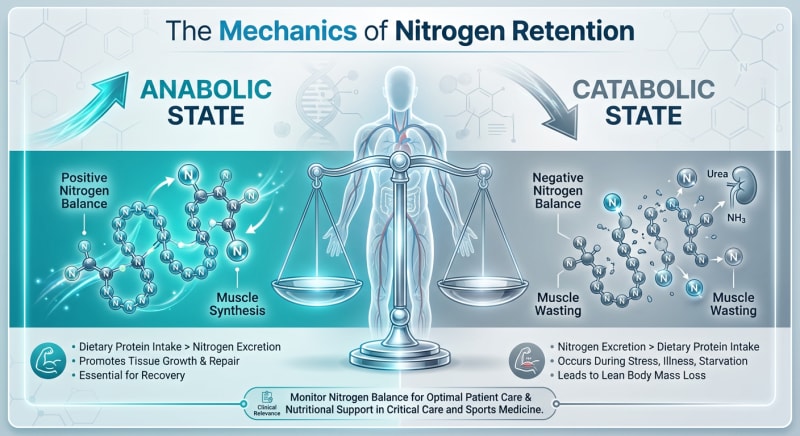
What Nitrogen Balance Measures
Nitrogen balance is the difference between nitrogen entering and leaving a defined biological system over a specified interval. In whole-organism studies, its estimation requires accounting for nitrogen intake and losses. Positive balance indicates net nitrogen retention within that accounting framework; it does not identify which tissues retained nitrogen. Negative balance likewise does not, on its own, quantify skeletal-muscle protein loss.
Whole-organism nitrogen balance, muscle protein turnover, and circulating hormone concentrations are different measurements. A study that measures GH secretion cannot establish muscle protein synthesis, muscle repair, or nitrogen retention unless those endpoints are also assessed with appropriate methods.
Compound Identity and Experimental Context
GHRP-6 is a synthetic hexapeptide; ipamorelin is a synthetic pentapeptide. Both belong to the peptide growth hormone secretagogue class associated with ghrelin-receptor signaling. They are chemically distinct from GH and from growth hormone-releasing hormone (GHRH). These distinctions matter when selecting analytical methods and interpreting receptor or secretion assays.
GHRH-related materials, including CJC-1295, represent a separate experimental category. Findings involving GHRH cannot automatically be assigned to a different molecule or used to infer the behavior of a combination of catalog materials.
What the Cited Studies Actually Address
Ipamorelin: Preclinical Endocrine and Growth Endpoints
Raun et al. (1998) investigated ipamorelin in preclinical systems, including rat and swine experiments, and reported GH-secretagogue activity and endocrine selectivity under the conditions examined [1]. These animal findings do not establish an absence of other biological effects across models or exposure conditions. They also do not establish nitrogen retention or muscle recovery.
Johansen et al. (1999) reported longitudinal bone growth in rats studied with ipamorelin [5]. This is an animal skeletal-growth endpoint, not a direct measurement of muscle protein turnover or nitrogen balance. It should not be presented as evidence of muscle preservation.
GHRP-6: Human Secretion Data Are Not Nonclinical Muscle Data
Penalva et al. (1993) studied GHRP-6-induced GH secretion in human participants and examined its relationship to GHRH and other experimental conditions [4]. This is human endocrine evidence, not an in-vitro muscle experiment. Its secretion endpoint does not establish a nitrogen-retention or muscle-repair effect and is not a laboratory protocol for the materials sold here.
Ex-Vivo Tissue Findings and Evidence From Other Compounds
Korbonits et al. (1999) examined hypothalamic hormone release from acute rat hypothalamic explants [6]. This ex-vivo animal-tissue model addresses local hormone release outside the intact organism. It does not directly measure whole-organism nitrogen balance or skeletal-muscle recovery.
Copinschi et al. (1996) studied MK-0677 in normal young men, measuring GH profiles, insulin-like growth factor I, and adrenocortical function [7]. These are human findings involving a different compound. They cannot be assigned to GHRP-6, ipamorelin, or Alpha Carbon Labs products.
The cited literature therefore spans distinct compounds, models, and endpoints. It does not provide a basis for ranking GHRP-6 and ipamorelin by nitrogen retention or muscle recovery.
Comparing Evidence Without Inferring Unmeasured Effects
| Material or study | Model or population | Endpoint and interpretation boundary |
|---|---|---|
| Ipamorelin, Raun et al. [1] | Preclinical experiments including rats and swine | GH secretion and endocrine selectivity; not a direct muscle nitrogen-balance measurement. |
| Ipamorelin, Johansen et al. [5] | Rats | Longitudinal bone growth; not evidence of muscle recovery. |
| GHRP-6, Penalva et al. [4] | Human participants | GH secretion; not a nonclinical muscle-protein experiment. |
| Secretagogue experiments, Korbonits et al. [6] | Acute rat hypothalamic explants | Hypothalamic hormone release; not whole-organism nitrogen balance. |
Designing a Nonclinical Nitrogen-Metabolism Study
A laboratory study should define its primary endpoint before interpreting endocrine measurements. In a cell-based experiment, changes in protein synthesis or degradation require direct, validated measurements. Cellular protein content alone may also reflect changes in cell number or viability. It should not be described as whole-organism nitrogen retention.
- Identify the model: Record species, tissue or cell source, and relevant receptor-expression characteristics.
- Separate endpoints: Distinguish receptor signaling, hormone secretion, protein turnover, and nitrogen accounting.
- Control alternative explanations: Include appropriate vehicle and assay controls, and evaluate viability where applicable.
- Document experimental conditions: Record material identity, lot, exposure conditions, sampling intervals, and analytical methods.
- Limit the conclusion: Report the measured result in the tested model without extrapolating to other tissues, organisms, or catalog products.
These are general experimental-design considerations, not a validated protocol for either peptide. The supplied article provides no direct comparative nitrogen-balance dataset or validated myocellular recovery method.
Analytical Documentation and Laboratory Handling
Material characterization is necessary for interpretable experiments. High-performance liquid chromatography (HPLC) can characterize chromatographic purity under a specified method, while mass spectrometry (MS) can assess molecular mass and support identity testing. Neither measurement alone establishes the absence of every impurity, biological activity, sterility, or suitability for a particular assay.
Review the available certificates of analysis for the specific lot rather than assuming a universal purity threshold. Relevant documentation may include identity results, chromatographic methods, reported purity, and storage information. The peptide synthesis and quality-control pages provide related internal information, but do not substitute for lot-specific evidence.
The supplied source contains no verified lot-specific analytical results or detailed hazard assessment. Before laboratory work, consult the applicable safety data sheet, material documentation, and institutional risk assessment. Use appropriate laboratory protective equipment and exposure controls, and follow documented storage and disposal requirements. Missing hazard information should not be interpreted as evidence that a material is harmless.
References
- Raun, K., et al. (1998). Ipamorelin, the first selective growth hormone secretagogue. European Journal of Endocrinology, 139(5), 552-561. — https://doi.org/10.1530/eje.0.1390552
- Bowers, C. Y. (2001). Unnatural growth hormone-releasing peptide begets natural ghrelin. Journal of Clinical Endocrinology & Metabolism, 86(4), 1464-1469. — https://doi.org/10.1210/jcem.86.4.7431
- Sigalos, J. T., & Pastuszak, A. W. (2018). The Safety and Efficacy of Growth Hormone Secretagogues. Sexual Medicine Reviews, 6(1), 45-53. — https://doi.org/10.1016/j.sxmr.2017.02.004
- Penalva, A., et al. (1993). Effect of growth hormone (GH)-releasing hormone (GHRH), atropine, pyridostigmine, or hypoglycemia on GHRP-6-induced GH secretion in man. Journal of Clinical Endocrinology & Metabolism, 76(1), 168-171. — https://doi.org/10.1210/jcem.76.1.8421081
- Johansen, P. B., et al. (1999). Ipamorelin, a new growth-hormone-releasing peptide, induces longitudinal bone growth in rats. Growth Hormone & IGF Research, 9(2), 106-113. — https://doi.org/10.1054/ghir.1999.0103
- Korbonits, M., et al. (1999). The effect of growth hormone secretagogues and neuropeptide Y on hypothalamic hormone release from acute rat hypothalamic explants. Journal of Endocrinology, 160(2), 195-204.
- Copinschi, G., et al. (1996). Effects of a 7-day treatment with a novel, orally active, growth hormone (GH) secretagogue, MK-0677, on 24-hour GH profiles, insulin-like growth factor I, and adrenocortical function in normal young men. Journal of Clinical Endocrinology & Metabolism, 81(8), 2776-2782. — https://doi.org/10.1210/jcem.81.8.8768828
- Garcia, J. M., et al. (2007). Macimorelin (AEZS-130), an oral ghrelin receptor agonist, for the diagnosis of adult growth hormone deficiency. Endocrine Reviews, 28(7), 800-804. — https://doi.org/10.1210/er.2007-0010