Defining the Receptor Comparison
Retatrutide, also designated LY3437943, is a modified 39-amino-acid peptide investigated for activity at the glucose-dependent insulinotropic polypeptide receptor (GIPR), glucagon-like peptide-1 receptor (GLP-1R), and glucagon receptor (GCGR). In the in-vitro receptor assays reported by Coskun and colleagues, LY3437943 exhibited agonist activity at all three receptors [2]. This receptor profile provides a basis for laboratory comparisons with single- and dual-receptor agonists; it does not establish that one receptor is the dominant contributor to every measured endpoint.
This article focuses on how to interpret GIPR activity within a multi-receptor experimental system. Receptor activation, downstream signaling, and whole-organism observations are different levels of evidence and should not be treated as interchangeable.
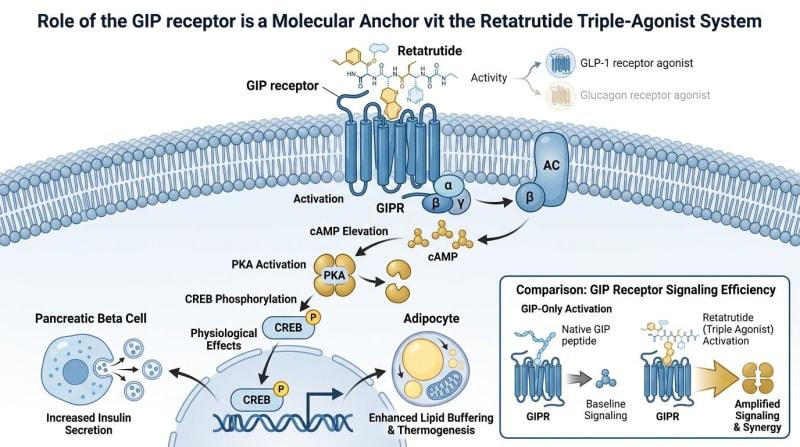
GIPR Activity Within a Triple-Agonist System
Retatrutide uses a modified GIP-based peptide scaffold. In the in-vitro characterization reported by Coskun and colleagues, functional activity was evaluated at GIPR, GLP-1R, and GCGR [2]. Scaffold identity alone does not determine receptor selectivity, signaling kinetics, or the contribution of each receptor in a mixed biological system.
Relative potency requires an explicit assay context. An EC50 measures the concentration associated with a half-maximal assay response; it is not a direct measurement of binding affinity or an organism-level effect. Comparisons should identify the receptor species, expression system, endpoint, reference ligand, incubation conditions, and curve-fitting method. A ratio normalized to one endogenous ligand is not automatically comparable with a ratio normalized to a different ligand at another receptor.
Comparing Single-, Dual-, and Triple-Receptor Experimental Designs
The in-vitro work by Willard and colleagues characterized tirzepatide at GIPR and GLP-1R and examined signaling bias [8]. The in-vitro work by Coskun and colleagues characterized LY3437943 across GIPR, GLP-1R, and GCGR [2]. These separate publications support receptor-level distinctions, but they are not a matched head-to-head experiment. Findings cannot be combined into a quantitative ranking without accounting for differences in assay design.
| Experimental configuration | Primary question | Interpretive limitation |
|---|---|---|
| GLP-1R-only system | What response occurs when GLP-1R is the receptor under study? | Does not evaluate GIPR or GCGR contributions. |
| GIPR-only system | What response occurs when GIPR is the receptor under study? | Does not reproduce a multi-receptor environment. |
| GIPR and GLP-1R system | How does the measured response depend on each receptor? | Requires controls that distinguish the two receptor contributions. |
| GIPR, GLP-1R, and GCGR system | How do three receptor pathways contribute to the selected endpoint? | An aggregate response alone cannot identify receptor-specific causality. |
Relevant internal catalog entries include semaglutide, tirzepatide, and retatrutide. These links identify catalog materials only; they do not demonstrate equivalence to the preparations used in published studies or establish their activity in a particular assay.
Evaluating the Proposed GIP–Adipose Connection
“Lipid buffering” is a mechanistic hypothesis, not a single analytical endpoint. A laboratory investigation must distinguish lipid uptake, intracellular storage, release, and oxidation rather than treating them as one process. Changes in extracellular lipid concentration alone do not establish which process occurred.
For an in-vitro adipocyte experiment, useful design considerations include verifying receptor expression, documenting the cell model and differentiation state, specifying the nutrient conditions, and measuring cell viability alongside the endpoint of interest. Receptor-selective controls are needed to distinguish a direct GIPR-dependent response from effects mediated by other receptors or experimental conditions. These are experimental design considerations, not reported findings for Alpha Carbon Labs materials.
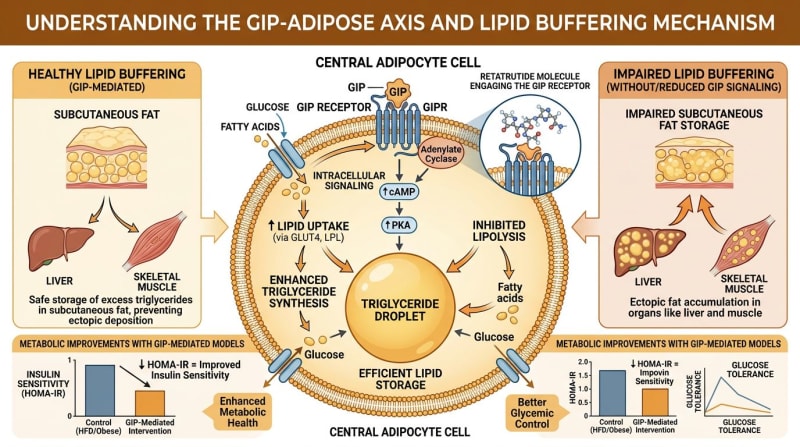
A claim that GIPR activity counterbalances GCGR activity would require experiments that manipulate those receptor contributions and directly measure the proposed interaction. A change observed with a triple agonist does not, by itself, demonstrate a GIP-mediated protective mechanism.
Separating Evidence by Model
In-vitro evidence: The receptor studies described by Coskun and colleagues [2] and Willard and colleagues [8] concern defined experimental assay systems. Their receptor-level findings should be interpreted within those systems, rather than extrapolated directly to tissue behavior or clinical outcomes.
Human evidence: Jastreboff and colleagues studied retatrutide in adults with obesity [1]. That human trial was not a receptor-isolation experiment and does not establish that GIPR activity independently explains an observed whole-organism endpoint. It also does not validate the identity, activity, or suitability of a separately supplied laboratory material.
Animal and in-silico evidence: No animal-specific or computational result is summarized here without a specified model and endpoint. Neither category should be used as an unstated bridge between a cell assay and a human study. Any subsequent comparison should identify the species or computational system in the same discussion as the finding.
The supplied references also include reviews. A review can provide background, but a model-specific mechanistic assertion should be traced to the underlying experiment rather than attributed to an unspecified collection of “research models.”
Analytical Documentation and Laboratory Handling
Chemical identity, chromatographic purity, peptide content, and functional receptor activity are separate characteristics. A chromatographic purity result does not establish the expected sequence, quantify biological potency, or demonstrate activity at all three receptors. Functional claims require an appropriate functional assay.
Researchers can consult available COA Documents, Quality Control information, and peptide synthesis information when evaluating documentation. Review the actual lot-specific methods and results rather than assuming that a linked page establishes a particular specification. The supplied article contains no lot-specific analytical results supporting the original claims about batch testing or receptor potency.
For nonclinical laboratory work, follow applicable material-specific safety documentation and institutional procedures for storage, exposure control, protective equipment, spill response, and disposal. No validated storage conditions or material-specific hazard classification are supplied here; these should not be inferred from publications about a different preparation.
Research Interpretation
The central comparison is between receptor configurations and the experiments needed to distinguish their contributions. Establishing GIPR activity is not the same as establishing synergy, tissue protection, or a dominant mechanism. A defensible laboratory report should state the material tested, biological system, endpoint, controls, and analytical limitations without extending its conclusions beyond those data.
References
- Jastreboff AM, et al. Triple-Hormone-Receptor Agonist Retatrutide for Obesity. New England Journal of Medicine. 2023. — https://pubmed.ncbi.nlm.nih.gov/37366315/
- Coskun T, et al. LY3437943, a novel triple glucagon, GIP, and GLP-1 receptor agonist for glycemic control and weight loss. Cell Metabolism. 2022.
- Finan B, et al. A strategically designed dual-agonist of GIP and GLP-1 receptors for treatement of obesity and diabetes. Science Translational Medicine. 2013. — https://pubmed.ncbi.nlm.nih.gov/24174327/
- Nauck MA, Meier JJ. The incretin effect: challenges and opportunities. The Lancet Diabetes & Endocrinology. 2016.
- Knop FK, et al. The Glucose-Dependent Insulinotropic Polypeptide (GIP) Receptor as a Therapeutic Target. Endocrine Reviews. 2023.
- Müller TD, et al. The Glucose-Dependent Insulinotropic Polypeptide (GIP) Receptor: Anatomy of a New Therapeutic Strategy. Cell Metabolism. 2019.
- Samms RJ, et al. GIP receptor agonism improves dyslipidemia and skeletal muscle insulin sensitivity. JCI Insight. 2021.
- Willard FS, et al. Tirzepatide is an imbalanced and biased dual GIP and GLP-1 receptor agonist. JCI Insight. 2020.
- Bastin M, Andreelli F. GIP receptor agonists: the new frontier in obesity and diabetes? Review of Physiology, Biochemistry and Pharmacology. 2019.
- Thomas MK, et al. Dual GIP and GLP-1 Receptor Agonist Tirzepatide in Type 2 Diabetes. New England Journal of Medicine. 2021. — https://pubmed.ncbi.nlm.nih.gov/34170647/
Limitations
Alpha Carbon Labs materials are intended solely for nonclinical laboratory research. Published findings do not establish the safety, effectiveness, approval, or suitability of the material sold for human or veterinary use.