Semaglutide Chemical Identity, Purity, and Analytical Validation
Characterizing semaglutide for nonclinical laboratory research requires separate assessments of chemical identity, chromatographic purity, peptide content, and sample stability. No single analytical result establishes all four. This guide explains how to interpret those measurements and identify gaps in batch documentation.
The semaglutide material listed by Alpha Carbon Labs is intended solely for nonclinical laboratory research. The methods discussed below are analytical considerations, not evidence that any particular supplier batch has undergone or passed these tests.
Molecular Architecture of Semaglutide
Semaglutide is a modified 31-amino-acid analogue of human GLP-1 (7–37). Using GLP-1 sequence numbering, its defining structural features include:
- Aib at position 8: Alanine is replaced by alpha-aminoisobutyric acid.
- Modification at Lys26: A C18 fatty diacid is attached through a spacer containing gamma-glutamyl and two oligoethylene glycol units.
- Arg at position 34: Arginine replaces lysine, leaving Lys26 as the lysine side-chain attachment site.
These features matter analytically because backbone composition, linker structure, and attachment position must be evaluated separately. Errors during peptide synthesis can generate truncated sequences, incompletely modified material, or structural isomers. Some isomers have the same elemental composition and cannot be distinguished by intact mass alone.

Establishing Chemical Identity
A label, powder appearance, or chromatographic retention time alone cannot establish semaglutide identity. An identity assessment should combine complementary measurements and state what each measurement can and cannot resolve.
High-Resolution Mass Spectrometry
The theoretical neutral monoisotopic mass of the covalent semaglutide molecule is approximately 4111.12 Da, excluding counterions, water, and other sample constituents. This value is not the average molecular mass. When reviewing a certificate of analysis (COA), check whether the reported result is a measured mass-to-charge ratio, a deconvoluted neutral mass, or an average mass.
An interpretable HRMS report should identify the ionization method, charge assignments, calculated and observed masses, and mass error. The isotope pattern and possible adducts should also be considered. Intact-mass measurements can support the expected composition and reveal mass-changing variants, but they do not independently establish the complete sequence, stereochemistry, or lipid attachment site.
Tandem Mass Spectrometry and Structural Confirmation
MS/MS fragmentation or an appropriate peptide-mapping method can provide sequence and modification-site information. Interpretation depends on fragment coverage: observing the expected intact mass is not equivalent to observing site-localizing fragments. Unresolved structural questions may require an orthogonal chromatographic or spectroscopic method.
Amino Acid Analysis
Amino acid analysis (AAA) measures composition after hydrolysis and can support peptide-content determination when the method is appropriately calibrated. It does not establish residue order or the position of the lipid modification.
Hydrolysis conditions, residue-specific recovery, conversion of glutamine to glutamate, and measurement of the nonstandard residue Aib affect interpretation. The spacer must also be considered when calculating expected composition. A single amino-acid ratio is not sufficient to identify semaglutide or distinguish it from another analogue.
Interpreting HPLC Purity
Reversed-phase HPLC or UHPLC can separate semaglutide from some related substances. A reported area percentage describes the integrated detector response assigned to a peak under a specific method. It is not automatically a mass fraction, a measure of total peptide content, or proof that every impurity has been detected.
Chromatographic interpretation depends on the column, mobile phases, gradient, temperature, detection wavelength, sample loading, and integration rules. Co-eluting impurities may be included in the main peak, while water, counterions, and some residual solvents may not be represented adequately in a peptide UV chromatogram.
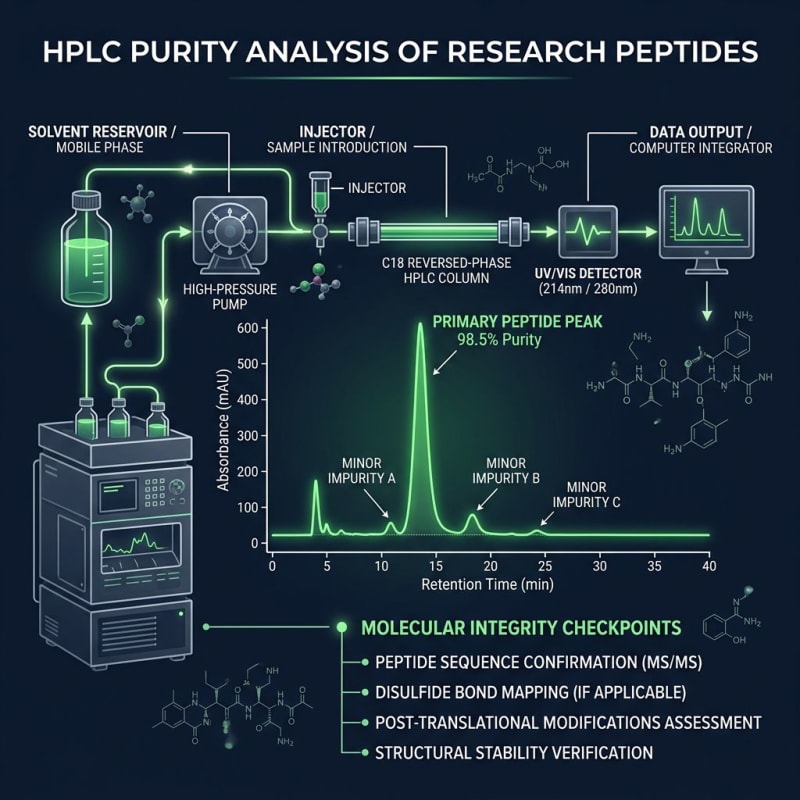
Related Substances and Method Selectivity
- Deletion or truncated sequences: Incomplete synthesis products may differ in both mass and retention.
- Incompletely or incorrectly modified material: Missing or altered side-chain components require suitable chromatographic and structural assessment.
- Stereochemical variants: Epimerization can produce impurities with the same intact mass as the target peptide.
- Degradation products: Oxidation or other chemical changes require characterization rather than assignment from retention time alone. Semaglutide contains no methionine, so methionine oxidation is not a semaglutide-specific impurity marker.
Gradient optimization can improve separation, but a particular gradient does not guarantee resolution of all related substances. Method selectivity should be evaluated using appropriate standards or characterized samples where available. Review the actual supporting records rather than inferring performance from a general quality-control description.
Measurements Beyond Chromatographic Area Purity
| Attribute | Potential analytical approach | Interpretive limitation |
|---|---|---|
| Peptide content | Calibrated AAA or another suitable quantitative assay | Requires defined calibration and recovery; cannot be inferred from HPLC area percentage. |
| Counterion content, including TFA where present | Ion chromatography or an appropriately validated quantitative method; fluorine NMR can assess fluorinated species | Counterions contribute to sample mass and may affect assay conditions. |
| Residual solvents | Suitable gas chromatography methods, including headspace analysis where appropriate | The method must be suitable for the solvents being assessed. |
| Water content | Karl Fischer analysis where compatible with the sample | Powder appearance does not quantify residual water. |
| Mass-changing degradation products | LC-MS with a stability-indicating separation | A mass shift alone may not establish the product structure. |
| Endotoxin, when relevant to an in-vitro assay | A suitable endotoxin assay with interference controls | HPLC purity and mass confirmation do not establish endotoxin status or sterility. |
For in-vitro experiments, residual solvents, counterions, and contaminants can confound assay interpretation. Their significance depends on the experimental system and measured levels; this guide does not provide universal acceptance limits. Specifications should be established for the intended nonclinical experiment.
Documentation and Sample Traceability
Assess the supplied lot rather than relying on marketing labels such as “research grade” or “high purity.” These labels do not by themselves define a complete analytical specification. A useful review includes:
- Lot traceability: Matching identifiers on the container, COA, and underlying analytical records.
- Identity evidence: Mass spectra and, where required, additional sequence or modification-site evidence.
- Chromatographic records: The full chromatogram, method conditions, integration approach, and stated reporting limits.
- Quantitative basis: Clear separation of net sample mass, peptide content, and chromatographic area purity.
- Material composition: Declared counterion form and available water and residual-solvent measurements.
- Dates and conditions: Test dates, storage instructions, and the evidence supporting any stability or retest period.
Visual inspection can identify damaged packaging or changes that warrant investigation, but a uniform lyophilized cake does not prove identity, low moisture, sterility, or absence of fillers. Likewise, an analytical mismatch establishes a discrepancy requiring investigation, not necessarily intentional substitution.
Laboratory Handling and Stability
Use the current safety data sheet, documented batch storage conditions, and the laboratory’s chemical risk assessment. Wear appropriate laboratory protective equipment, minimize dust generation and exposure, and manage spills and waste under institutional procedures. Missing toxicological information should not be interpreted as evidence of low hazard.
Stability depends on material form, moisture, temperature, light exposure, container closure, and handling history. A universal storage temperature or shelf life cannot be established from identity and purity results alone. Record storage excursions and sample transfers, and avoid unnecessary repeated exposure to ambient conditions.
Where an experiment depends on stability, compare samples over the relevant interval using a method capable of detecting degradation. A stable-looking main chromatographic peak does not exclude changes that the method cannot resolve. Analytical purity also does not establish a particular conformation or functional response in an in-vitro assay.
References
- Mahapatra MK, Karuppasamy M, Sahoo BM. Semaglutide, a glucagon-like peptide-1 receptor agonist with cardiovascular benefits for management of type 2 diabetes. Rev Endocr Metab Disord. 2022. — https://pubmed.ncbi.nlm.nih.gov/35165840/
- Albericio F, Kruger HG. The Most Amazing De Novo Peptides of 2021. International Journal of Molecular Sciences. 2022. — https://doi.org/10.3390/ijms23094595
- Swarbrick J. Encyclopedia of Pharmaceutical Technology. CRC Press. (Peptide Synthesis and Validation).
- World Health Organization (WHO). Alert No. 6/2023: Falsified semaglutide products. 2023.
- Prasad-Reddy L, Isaacs D. A Review of Semaglutide: A Once-Weekly Glucagon-Like Peptide-1 Receptor Agonist. Annals of Pharmacotherapy. 2017. — https://journals.sagepub.com/doi/10.1177/1060028017717480
- Lau J, Bloch P, Schäffer L, et al. Discovery of the Once-Weekly Glucagon-Like Peptide-1 (GLP-1) Analogue Semaglutide. Journal of Medicinal Chemistry. 2015. — https://pubs.acs.org/doi/10.1021/acs.jmedchem.5b00726
- D'Hondt M, Bracke N, Taevernier L, et al. Quality control of peptides: Analytical challenges and strategies. Journal of Pharmaceutical Analysis. 2014. — https://doi.org/10.1016/j.jpha.2014.03.001
- Evrard AF, et al. Analytical validation of therapeutic peptides by UHPLC-MS/MS. Journal of Chromatography B. 2021. — https://doi.org/10.1016/j.jchromb.2021.122822
Limitations
Analytical conclusions are limited to the tested sample and the methods used. Published findings do not establish the safety, effectiveness, approval, or suitability of material sold by Alpha Carbon Labs for human or veterinary use.