Introduction: Analytical Verification of Peptide Blends
A blend labeled TB-500 and BPC-157 requires separate evaluation of component identity, chromatographic purity, peptide content, and composition. These measurements answer different questions. A dominant chromatographic peak does not establish sequence identity, and a high chromatographic area percentage does not establish the amount of peptide in a weighed powder.
Compared with individual peptide samples, blends introduce additional opportunities for co-elution, unequal detector responses, matrix effects, and ambiguous impurity assignments. This guide addresses analytical method development and interpretation for nonclinical laboratory research. It does not report testing of any Alpha Carbon Labs product or establish product-specific specifications.
Define the Analytes Before Selecting a Method
TB-500, Thymosin β4, and Sequence Identification
The name TB-500 alone is not a sufficient chemical specification. Documentation should identify whether the material is a full-length thymosin β4 sequence or a defined fragment, including its terminal modifications and counterion form. Full-length thymosin β4 is a 43-amino-acid peptide. The N-acetylated fragment Ac-LKKTETQ corresponds to residues 17–23 of thymosin β4; it is chemically distinct from both the full-length peptide and Ac-SDKP.
Do not assign these materials a shared theoretical mass or assume that a fragment has the biochemical properties of its parent sequence. Calculate the expected mass from the documented sequence and modifications, stating whether the value is monoisotopic or average mass. Chromatography separates analytes according to their interactions with the stationary and mobile phases, not simply their molecular weights.
BPC-157 Identity
BPC-157 is a 15-residue peptide with the sequence GEPPPGKPADDAGLV: Gly-Glu-Pro-Pro-Pro-Gly-Lys-Pro-Ala-Asp-Asp-Ala-Gly-Leu-Val. The specification should also state terminal chemistry and counterion form. Sequence identity, relative abundance in the blend, and impurity content require distinct analytical evidence.
Composition and Stability Considerations
Ac-LKKTETQ contains neither cysteine nor methionine. Full-length thymosin β4 contains methionine, making oxidation a relevant analytical consideration for that sequence. Absence of cysteine eliminates a route to disulfide formation but does not rule out aggregation, adsorption, precipitation, or other degradation processes. Solubility and stability must be assessed for the actual composition, pH, solvent, container, and storage conditions rather than inferred from a product name.
Chromatographic Resolution in a Two-Peptide Matrix
Reversed-phase high-performance liquid chromatography (RP-HPLC) can separate intact components from some synthesis-related impurities and degradation products. A C18 stationary phase is a common starting point, but column chemistry, pore size, temperature, gradient, and mobile-phase additives all influence selectivity.
Co-elution can make multiple substances appear as one peak. Conversely, extra peaks do not automatically identify degradation products: blanks, carryover, adduct-related behavior, and sample contaminants need consideration. Analyze an appropriate blank and characterized individual components alongside the blend where available. Retention-time agreement supports an assignment only under comparable chromatographic conditions.
Evaluate resolution for the target components and relevant neighboring impurities. A visible return to baseline is useful but does not, by itself, establish the absence of unresolved contaminants. Orthogonal methods may be necessary when a separation cannot distinguish critical species.
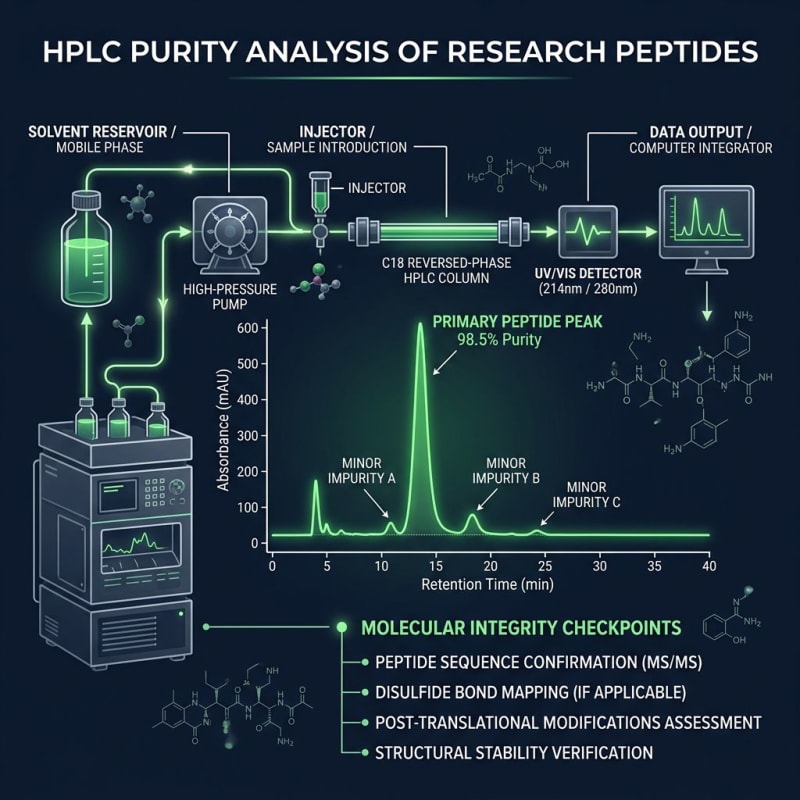
HPLC Method Development: Starting Conditions, Not Validated Specifications
The following conditions are illustrative starting points retained from the original guide. They are not a validated TB-500/BPC-157 blend method and do not establish that the components or their impurities will separate.
| Parameter | Example condition | What to evaluate |
|---|---|---|
| Column | C18, 5 μm particles, 4.6 × 250 mm | Retention, recovery, peak shape, and selectivity for the specified sequences and impurities. |
| Mobile phase | A: water with 0.1% trifluoroacetic acid (TFA); B: acetonitrile with 0.1% TFA | TFA can influence retention and peak shape through ion pairing, but can also suppress electrospray response. Document the percentage convention used. |
| UV detection | 214 or 220 nm | Peptide-bond absorbance supports detection of peptides without aromatic residues. Solvent background and component-specific responses still matter. |
| Gradient | 10% to 60% B over 30 minutes | Early-eluting material, critical-pair resolution, late-eluting impurities, and adequate column re-equilibration. |
A reproducible method also needs a defined flow rate, column temperature, sample loading, acquisition settings, integration rules, and system-suitability criteria. These parameters are not established by the example above. For LC-MS, evaluate compatible volatile additives rather than assuming that a UV-HPLC mobile phase will provide adequate mass-spectrometric sensitivity.
What Chromatographic Area Percentage Measures
An area-normalized result expresses selected peak area relative to the integrated area detected under the stated method. It is not automatically a mass fraction. Water, counterions, residual solvents, undetected contaminants, and unequal UV responses can make chromatographic area percentage differ from peptide content by weight.
For a blend, specify whether the reported percentage refers to one component, the combined target-component areas, or a separately calibrated assay. Report the wavelength, integration window, excluded peaks, and treatment of unresolved material. There is no universal chromatographic purity threshold that establishes suitability for all research applications.
Peptide Content and Blend Ratio
Quantifying each component requires suitable reference materials, calibration, and recovery assessment. Do not infer a mass or molar ratio directly from uncorrected UV or MS peak areas. Component-specific assay results, water measurements, counterion measurements, and other relevant tests may be needed to distinguish peptide content from total powder mass. Report the measurement basis and uncertainty where available.
Mass Spectrometry: Identity Evidence and Matrix Effects
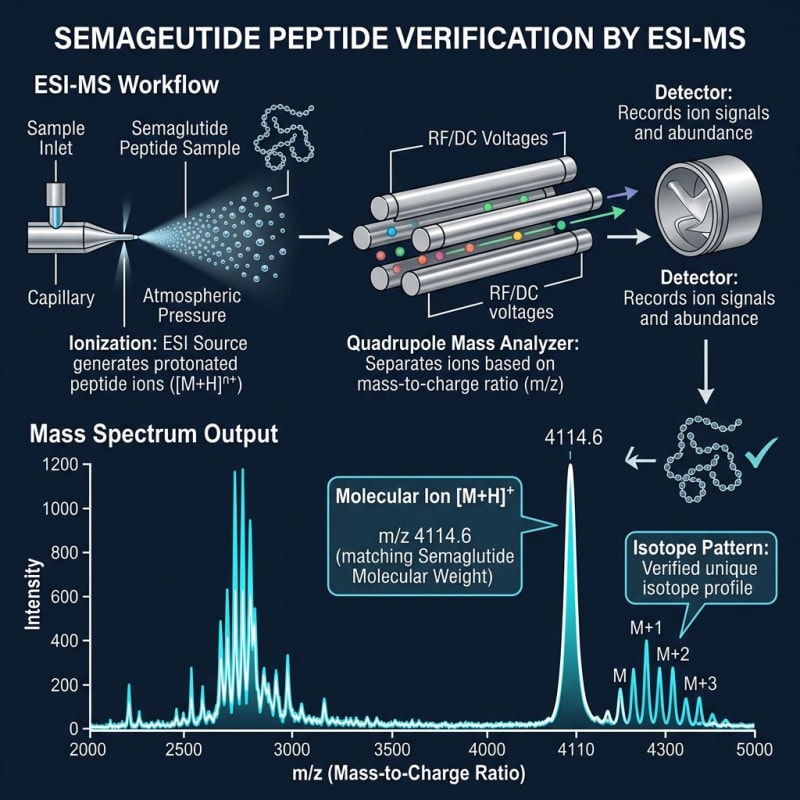
Liquid chromatography coupled to electrospray mass spectrometry (LC-ESI-MS) can provide mass information for separated components. Signals may include singly or multiply charged ions, isotope envelopes, and adducts. Observed mass-to-charge ratios must be interpreted using the correct charge state before comparison with a theoretical neutral mass.
Define an appropriate mass tolerance for the instrument and method rather than using a universal tolerance of less than one dalton. Accurate intact mass supports a composition assignment but does not uniquely establish sequence, stereochemistry, or modification position. Tandem MS and complementary methods may be needed; some isomeric species remain difficult to distinguish.
Ion Suppression and Missing Signals
Co-eluting peptides, salts, additives, and other matrix components can change electrospray response. A weak or absent signal does not, by itself, prove that a component is missing or degraded. Investigate retention, acquisition range, charge-state assignments, recovery, detection limits, and matrix effects before drawing a compositional conclusion.
Possible analytical checks include comparison of individual-component and blend responses, dilution studies, spike-recovery experiments, and matrix-effect assessments using appropriate controls. Assess these checks under the method actually used. Raw MS signal intensity is not a reliable measure of blend composition without calibration and response characterization.
Additional Components and Fragment Comparisons
When GHK-Cu Is Present
A sample that also contains GHK-Cu, a copper complex of glycyl-L-histidyl-L-lysine, presents a different analytical problem from a two-peptide blend. pH and mobile-phase composition can alter metal–ligand speciation, while sample processing and ionization can affect which species are observed. A peptide signal alone does not establish the amount or integrity of the original copper complex.
Define whether the analytical objective is peptide quantification, total copper measurement, or characterization of the intact complex. Conditions appropriate for one objective may not be appropriate for another. Do not infer metal speciation, stability, or oxidation behavior from a single chromatogram.
Other Peptide Fragments
The same identity-documentation principle applies to materials such as HGH Fragment 176-191: a fragment must be characterized by its own sequence and modifications rather than by its parent protein's properties. This comparison does not establish shared function or justify transferring an HPLC method between fragments. Column selection and solvent conditions require analyte-specific evaluation.
Certificate of Analysis Review Checklist
- Lot traceability: Confirm the lot identifier, sample description, test dates, laboratory, and methods used.
- Chemical identity: Look for the sequence, terminal modifications, counterion information, theoretical mass convention, and measured mass for each component.
- Complete chromatographic context: Review the full trace, method conditions, integration rules, and peak assignments. One peak in a blend is inconclusive: it may reflect co-elution rather than a missing ingredient.
- Quantitative basis: Distinguish chromatographic area percentage from calibrated component content and blend ratio.
- Impurity interpretation: Additional MS signals may represent charge states, isotopes, adducts, contaminants, or distinct peptides. Intensity alone cannot identify a deletion sequence or establish its mass fraction.
- Method performance: Review specificity, precision, accuracy or recovery, reportable range, and relevant detection or quantification limits.
- Stability evidence: Check whether storage conditions and retest periods are supported for the actual blend rather than borrowed from an individual component.
Changes in retention time can arise from method differences, column condition, temperature, or sample matrix. They are not specific evidence of an interaction between peptides. Likewise, a clear analytical sample does not establish purity, and visible particles do not identify their own cause.
Laboratory Storage, Handling, and Hazards
Use documented storage conditions supported by stability data for the specified material. No universal multiyear frozen shelf life or refrigerated holding period can be assigned to a TB-500/BPC-157 blend from its name alone. Record storage duration, container type, temperature excursions, and relevant freeze–thaw history. Control moisture exposure and assess adsorption, precipitation, or degradation where these could affect analytical recovery.
Follow applicable safety data sheets and institutional risk assessments. Avoid generating or inhaling peptide dust, use appropriate laboratory protective equipment, and treat incompletely characterized materials as having uncertain hazards. Acetonitrile is flammable and toxic, and concentrated TFA is corrosive. Use suitable ventilation and segregate solvent, acid, and metal-containing waste according to local laboratory procedures. Analytical purity does not establish an absence of chemical or biological hazards.
Conclusion
Reliable blend characterization combines explicit chemical specifications, fit-for-purpose separation, mass-spectrometric identity evidence, calibrated component measurements, and documented limitations. No single chromatographic percentage or mass match answers all of these questions. Results apply to the tested sample under the stated conditions and should not be generalized to untested lots or products.
References
The supplied citation list is retained below. No model-specific biological findings or claims of blend activity are asserted in this guide.
- Goldstein, A. L., et al. (2005). Thymosin β4: actin-sequestering protein moonlights to repair injured tissues. Trends in Molecular Medicine, 11(9), 421-429. — https://doi.org/10.1016/j.molmed.2005.07.004
- Huff, T., et al. (2001). β-Thymosins, small acidic peptides with multiple functions. The International Journal of Biochemistry & Cell Biology, 33(3), 205-220. — https://doi.org/10.1016/S1357-2725(00)00087-X
- Sichler, C., et al. (2000). Thymosin β4 binds actin in an extended conformation and contacts both the barbed and pointed ends. Biochemistry, 39(8), 1965-1972. — https://doi.org/10.1021/bi970185v
- D'Incalci, M., et al. (2005). Mass spectrometry in cancer research: a rigorous approach to peptide identification. Mass Spectrometry Reviews, 24, 769-793. — https://doi.org/10.1002/mas.20042
- Kleinman, H. K., & Sosne, G. (2016). Thymosin β4 promotes wound healing and tissue regeneration. Vitamins and Hormones, 102, 251-275. — https://doi.org/10.1016/bs.vh.2016.04.005
- Chang, C., et al. (2011). Bioanalysis of therapeutic peptides and proteins by liquid chromatography-mass spectrometry in drug discovery. Journal of Chromatography B, 879(17-18), 1277-1282. — https://doi.org/10.1016/j.jchromb.2011.02.012
- Müller, D., et al. (2013). Quantitative analysis of peptides by HPLC-MS. Laboratory Investigation, 93, 726-735. — https://doi.org/10.1038/labinvest.2013.62
- Sjögren, E., et al. (2020). Quality Control of Synthetic Peptides: Analytic Challenges and Solutions. Pharmaceutical Research, 37(1), 12.
- Vlasov, G. P., et al. (2018). Synthesis of BPC-157 and its derivatives. Russian Journal of Bioorganic Chemistry, 44, 182–189.
- Philp, D., et al. (2003). Thymosin β4 Promotes Angiogenesis, Wound Healing, and Hair Follicle Development. Mechanisms of Ageing and Development, 124(4), 423–429. — https://doi.org/10.1016/j.mad.2003.11.005
- Pickart, L., et al. (2015). GHK Peptide as a Natural Modulator of Multiple Cellular Pathways in Skin Regeneration. BioMed Research International, 2015, 648108. — https://doi.org/10.1155/2015/648108
- Maleknia, S. D., & Downard, K. M. (2014). Radical Approaches to Protein Sequencing and Identification by Mass Spectrometry. Mass Spectrometry Reviews, 33(4), 273–274. — https://doi.org/10.1002/mas.21388
Limitations
These analytical considerations require validation for the specific sample and method. Published findings do not establish safety, effectiveness, approval, or suitability of material sold by Alpha Carbon Labs for human or veterinary use; its materials are intended solely for nonclinical laboratory research.