Semaglutide Bioavailability and Pharmacokinetics: Research Context
Semaglutide pharmacokinetics must be interpreted in relation to the formulation, biological system, and analytical methods used in a particular study. Published human pharmacokinetic observations, animal absorption experiments, and in-vitro mechanistic findings answer different questions. None independently establishes the behavior of an untested laboratory material.
Chemical Identity and Structural Modifications
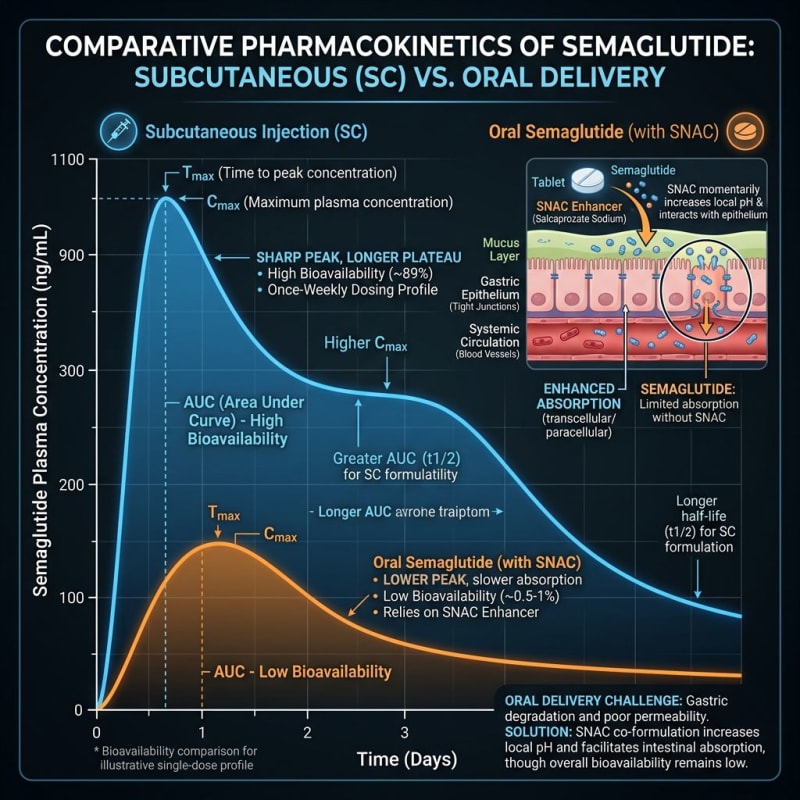
Semaglutide is a 31-amino-acid analogue of human glucagon-like peptide-1 (GLP-1). The structural descriptions in Knudsen and Lau and in Lau et al. identify the following modifications using native GLP-1 residue numbering [1,3]:
- Alanine at position 8 is replaced by alpha-aminoisobutyric acid (Aib).
- Lysine at position 26 is modified with a linker bearing a C18 fatty diacid.
- Lysine at position 34 is replaced by arginine, leaving position 26 as the lysine acylation site.
These chemical features are relevant to investigations of proteolytic stability and albumin interaction. They do not provide a stand-alone prediction of systemic exposure. A plasma half-life is an observation from a specified biological study, not an intrinsic shelf-life or a stability specification for a peptide powder or laboratory solution.
The Alpha Carbon Labs semaglutide listing concerns material intended solely for nonclinical laboratory research. Published findings on particular formulations cannot be assigned to that material without direct characterization.
What the Supplied Literature Examines
Buckley et al. investigated semaglutide absorption using in-vitro experiments and animal experiments in dogs [2]. Their work supports a formulation-specific account of gastric absorption involving sodium N-(8-[2-hydroxybenzoyl]amino)caprylate (SNAC), local pH modification, reduced peptide degradation, and transcellular transport. These mechanistic findings are not evidence that semaglutide alone has the same absorption characteristics, nor are they measurements of Alpha Carbon Labs material.
Granhall et al. studied oral semaglutide pharmacokinetics in human participants with differing renal function, including participants with renal impairment [4]. This is human clinical evidence, not an animal or in-vitro experiment. Its pharmacokinetic measurements must remain attached to the population, formulation, sampling schedule, and conditions reported in that study.
Kapitza et al. studied human patients with type 2 diabetes [5]. That population must not be relabeled as a laboratory model. Findings from that study do not establish the performance of a research reagent or validate an oral-versus-subcutaneous comparison for such a reagent.
The development review by Knudsen and Lau discusses semaglutide across preclinical development and human clinical investigation [1]. When using a numerical value from this review, researchers should identify the underlying study and its population rather than presenting the value as a general property of every semaglutide preparation.
Comparing Absorption Without Conflating Endpoints
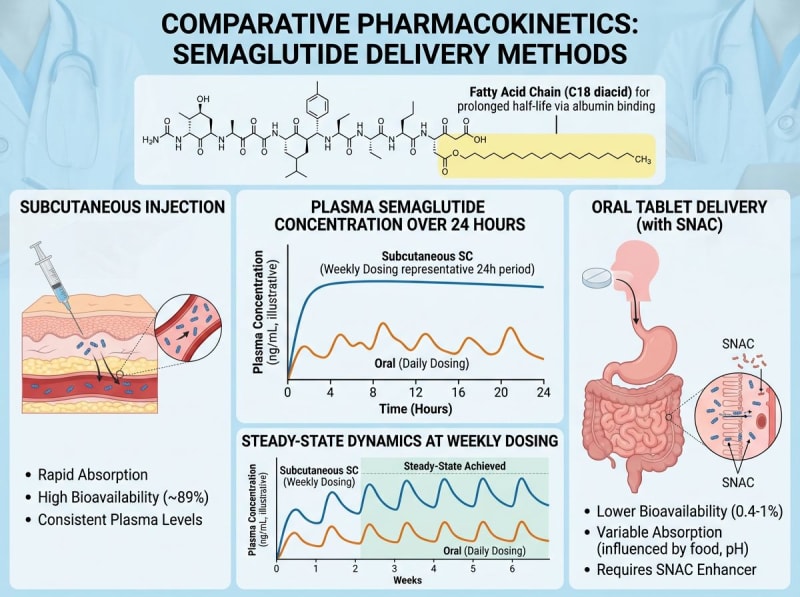
Oral and subcutaneous formulations present different absorption questions, but a meaningful comparison requires more than juxtaposing concentration–time curves. The study population or species, formulation composition, reference method, sampling interval, and concentration assay must be specified. Absolute bioavailability, peak concentration, and receptor affinity are not interchangeable measures.
| Parameter | What it describes | Interpretive limitation |
|---|---|---|
| Absolute bioavailability | The fraction reaching systemic circulation, estimated relative to an intravenous reference with appropriate normalization. | Values require a defined formulation, population, and reference comparison. |
| Maximum concentration (Cmax) | The highest measured concentration in the sampled profile. | The sampling schedule can affect the observed maximum. |
| Time to maximum concentration (Tmax) | The time associated with the observed concentration maximum. | It is not a measure of receptor affinity or overall exposure. |
| Area under the curve (AUC) | Integrated concentration over a specified time interval. | Comparisons require compatible intervals, analytical methods, and study conditions. |
| Terminal half-life | A parameter estimated from the terminal concentration–time slope. | Interpretation depends on adequate terminal sampling and the processes contributing to that slope. |
| Receptor affinity | A binding property measured in a defined experimental system. | It cannot be inferred from Cmax, AUC, or route of exposure alone. |
The supplied article's single-value comparison obscured differences in study context. This revision therefore does not present a universal bioavailability range, Tmax, or half-life for either formulation type. It also avoids “metabolic velocity,” which conflates absorption, distribution, and clearance rather than identifying a specific pharmacokinetic parameter.
Implications for Nonclinical Experimental Design
For an in-vitro investigation, define the endpoint before selecting a method. Chemical degradation, epithelial transport, protein binding, receptor binding, and downstream signaling are distinct measurements. A result in one assay does not automatically establish another endpoint, and none alone measures systemic bioavailability.
- Record the material identity, batch, matrix composition, pH, temperature, incubation interval, and analytical method.
- Where relevant, distinguish intact peptide from degradation products rather than relying on an undifferentiated signal.
- Use controls appropriate to the endpoint, including matrix and vehicle controls and analytical blanks.
- For transport experiments involving an enhancer, distinguish peptide transport from changes in barrier integrity and assay interference.
- For receptor assays, report the experimental system and measured endpoint rather than inferring tissue exposure or physiological outcomes.
These are general experimental considerations, not a formulation recipe or an administration protocol. In-silico predictions, if used in a separate analysis, should be labeled as predictions and not presented as measured absorption, binding, or pharmacokinetics.
Analytical Documentation and Laboratory Handling
High-performance liquid chromatography can characterize chromatographic purity under the stated method, while mass spectrometry can support assessment of molecular identity. Neither method alone establishes sequence completeness, biological activity, sterility, endotoxin status, or pharmacokinetic equivalence to a published formulation. A chromatographic area percentage should not be assumed to represent absolute peptide content.
Consult the quality-control information and any applicable batch-specific certificate of analysis. Evaluate the actual methods and reported results rather than assuming that every batch has undergone every possible test. The source article supplies no batch data that substantiate a universal purity or performance claim.
Use the applicable safety data sheet and institutional chemical-hygiene procedures for handling, storage, spill response, and disposal. Pharmacokinetic literature is not a substitute for laboratory hazard assessment.
References
- Knudsen LB, Lau J. The Discovery and Development of Semaglutide. Front Endocrinol (Lausanne). 2019;10:155. — https://pubmed.ncbi.nlm.nih.gov/31031702/
- Buckley ST, et al. Transcellular stomach absorption of a derivatized glucagon-like peptide-1 receptor agonist. Sci Transl Med. 2018;10(456). — https://pubmed.ncbi.nlm.nih.gov/30429357/
- Lau J, et al. Discovery of the Once-Weekly Glucagon-Like Peptide-1 (GLP-1) Analogue Semaglutide. J Med Chem. 2015;58(18):7370-80. — https://pubmed.ncbi.nlm.nih.gov/26308095/
- Granhall C, et al. Pharmacokinetics, Safety and Tolerability of Oral Semaglutide in Subjects with Renal Impairment. Clin Pharmacokinet. 2018;57(12):1571-1580. — https://pubmed.ncbi.nlm.nih.gov/29725838/
- Kapitza C, et al. Effects of semaglutide on beta cell function and glycemic control in patients with type 2 diabetes. Diabetologia. 2017;60(8):1390-1399. — https://pubmed.ncbi.nlm.nih.gov/28551810/
- Drucker DJ. Mechanisms of Action and Therapeutic Application of Glucagon-like Peptide-1. Cell Metab. 2018;27(4):740-756. — https://pubmed.ncbi.nlm.nih.gov/29617641/
- Al-Sabah S, et al. Structure-activity relationships of the glucagon-like peptide-1 receptor. Br J Pharmacol. 2015;172(20):4944-57. — https://pubmed.ncbi.nlm.nih.gov/26190566/
Limitations
Published findings are specific to the material, formulation, methods, and biological system studied. They do not establish safety, effectiveness, approval, or suitability of the material sold by Alpha Carbon Labs for human or veterinary use.