Peptide Order Sent to the Wrong Address? Next Steps
Address corrections before dispatch, carrier-intercept requests, and confirmed misdelivery require different next steps. Learn what to send support privately and why rerouting cannot be guaranteed.
If a research peptide order has the wrong shipping address, contact the seller through its official private support channel immediately and ask whether the shipment can still be stopped or corrected. Before dispatch, an address correction may be possible; after carrier handoff, any intercept or rerouting request depends on carrier eligibility and timing. If delivery has already occurred, distinguish delivery to the address entered on the order from confirmed carrier misdelivery, because those require different investigations.
Peptide Order Sent to the Wrong Address? Next Steps
This guide covers address corrections and wrong-location deliveries for nonclinical laboratory research orders. It is a general decision checklist, not a statement of Alpha Carbon Labs’ current address-change policy, carrier services, fees, or replacement commitments.
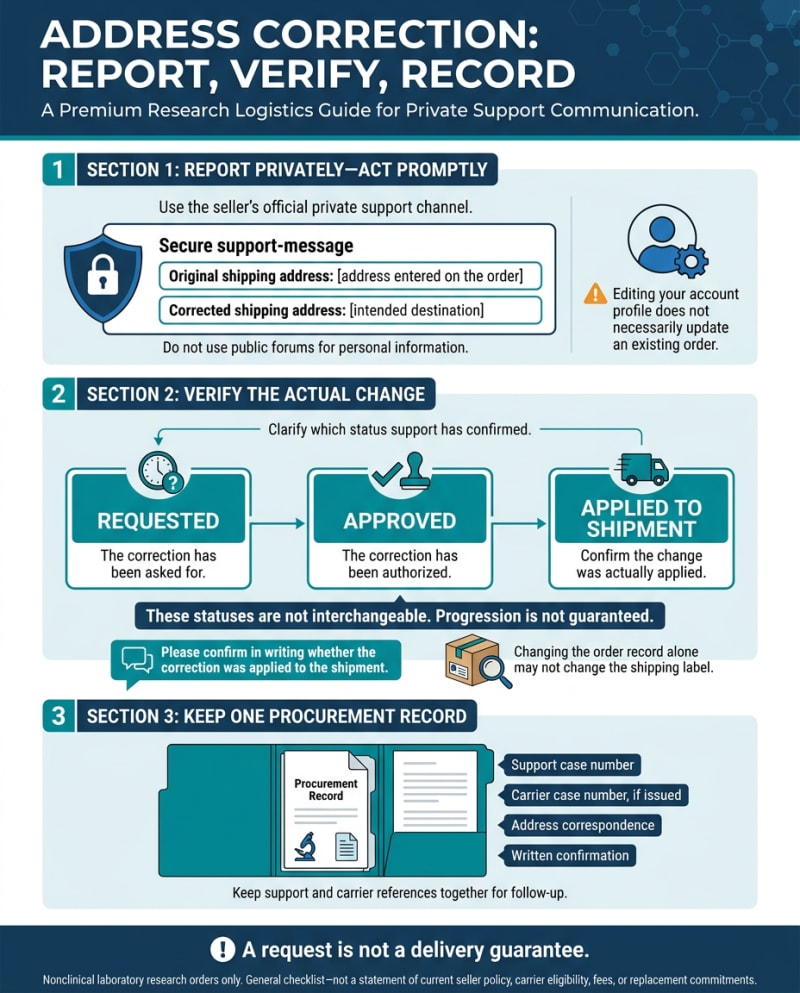
- Report the address error promptly; do not assume editing an account profile updates an existing order.
- Provide the original and corrected shipping addresses privately, clearly labeled.
- Ask whether the correction is merely requested, approved, or actually applied to the shipment.
- Keep support and carrier case numbers together in the laboratory’s procurement record.
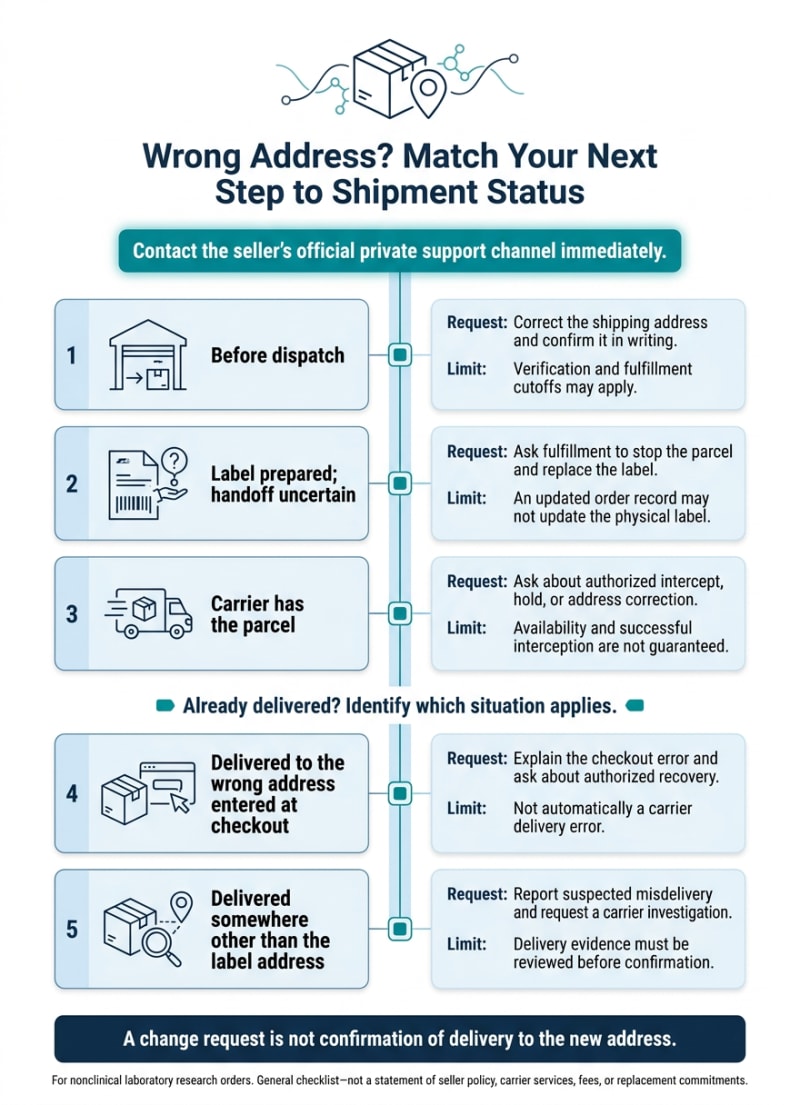
Which next step fits the shipment’s location?
The next step depends on who currently controls the parcel and whether delivery has occurred. Ask support to establish the shipment’s actual fulfillment stage, then request the appropriate action below. A request to change an address is not the same as confirmation that the parcel will reach the new destination.
| Situation | Action to request | Important limit |
|---|---|---|
| Order has not entered dispatch | Ask support to correct the shipping address and confirm it in writing. | Verification and fulfillment cutoffs may still apply. |
| Label prepared; handoff uncertain | Ask whether fulfillment can stop the parcel and replace the shipping label. | Changing the order record alone may not change the physical label. |
| Carrier has the parcel | Ask whether an authorized intercept, hold, or address correction is available. | Eligibility and successful interception are not guaranteed. |
| Delivered to the incorrect address entered at checkout | Explain the checkout error and ask about authorized recovery options. | This is not automatically a carrier delivery error. |
| Delivered somewhere other than the label address | Report suspected misdelivery and request a carrier investigation. | Delivery evidence must be reviewed before treating misdelivery as confirmed. |
For the separate question of what order and tracking statuses mean, see Peptide Order Pending? Payment and Tracking Explained.
Can the shipping address be corrected before dispatch?
Ask support whether the order can be held while the address is verified and corrected. If a shipping label already exists, specifically ask whether that label must be replaced. Written confirmation should identify the corrected destination and make clear whether the change reached fulfillment, rather than only the customer account.
Provide the complete destination, including institution, department, building, suite or room, postal code, and country where applicable. Use the laboratory’s approved receiving address; an internal office location may differ from the address accepted by central receiving.
- Compare the shipping address in the order confirmation with the intended receiving address.
- Submit one clearly labeled replacement address through official support.
- Ask whether fulfillment can pause while the request is reviewed.
- Request confirmation that the order record and any applicable shipping label agree.
Warehouse process research provides background for separating order information from physical fulfillment: de Koster, Le-Duc, and Roodbergen review warehouse order-picking design and control, not Alpha Carbon Labs’ operations or address-change procedures.[1] No particular correction window can be inferred from that literature.
What address-specific details should support receive privately?
Provide enough information to identify the order, identify the address error, and establish the requested replacement destination. Send these details through the seller’s official support channel, preferably using the email associated with the order. Keep addresses, tracking identifiers, and delivery evidence out of public comments or reviews.
- Order number and the purchaser’s name or institutional purchasing contact.
- Email address used for the order.
- Original shipping address, labeled “Address entered on order.”
- Complete corrected address, labeled “Requested shipping address.”
- A brief explanation, such as an omitted suite number or an outdated laboratory location.
- Tracking number, if assigned, and whether delivery has occurred.
- Any previous address-change request or carrier case number.
For suspected misdelivery, also include the recorded delivery time, any available delivery photo or signature, and the specific discrepancy. For example, state that the delivery photograph shows a different building; do not assume the carrier has already verified the mistake.
Do not send passwords, payment-card security codes, or login verification codes. If additional identity documentation is requested, verify the request independently and ask what minimum information is necessary and which secure submission method to use.
Why might an address change require verification?
An address-change request redirects custody of a paid order, so support may need to verify that the requester is authorized to change its destination. A request from an unfamiliar email address, a different recipient, or a new institution may require clarification. This does not itself mean the original order is invalid.
Institutional purchasers should identify the authorized purchasing contact and explain any legitimate change in receiving arrangements. Ask support which verification steps actually apply rather than sending extra personal information preemptively.
Published privacy research addresses information disclosure and decision-making, not this seller’s verification requirements: Acquisti and colleagues review privacy behavior and economics, while Dinev and Hart examine an e-commerce privacy-calculus model.[6–8] These sources provide context for careful information sharing, not evidence that a particular document is required.
What changes after the carrier receives the parcel?
After carrier handoff, ask whether the shipment qualifies for an intercept, address correction, or authorized hold. A carrier intercept is a request to stop or redirect a parcel already in the delivery network. Support should clarify whether the shipper must submit the request or whether the recipient has an eligible option.
Use only the carrier’s official channels and coordinate with support so the instructions do not conflict. Ask about service restrictions, verification, possible fees, and what happens if the request cannot be completed before delivery.
- Is the shipment eligible for the requested change?
- Who is authorized to submit it?
- Does the carrier permit the proposed destination or pickup location?
- Has the request been submitted, accepted for review, or completed?
- What written confirmation or case number records the outcome?
Rerouting cannot be guaranteed because the parcel may pass an operational cutoff, enter final delivery, or travel under a service that restricts destination changes. Published city-logistics research and delivery-window models examine routing constraints in broader delivery systems; they do not establish intercept availability for an individual shipment.[2–4]
How is a checkout error different from confirmed misdelivery?
A checkout address error means the order contained the wrong destination; carrier misdelivery means the parcel was delivered somewhere other than its designated delivery location. Compare the order confirmation, shipping-label destination where available, and delivery evidence. A “delivered” scan alone does not establish which type of error occurred.
If the order confirmation is correct but the label is wrong, report that discrepancy to support as a separate fulfillment issue. Preserve the records without assigning responsibility before the seller and carrier review them.
For suspected carrier misdelivery, ask the carrier to review available delivery records and coordinate any retrieval. Check with the institution’s authorized receiving desk, but do not enter another property or ask an unintended recipient to open or independently forward research materials.
Research by Punakivi, Yrjölä, and Holmström examines reception-box and delivery-box arrangements in last-mile logistics, illustrating that receipt arrangements are a distinct logistics question.[5] It does not determine whether a particular institutional handoff satisfied this shipment’s delivery instructions.
What should the laboratory document if the parcel is recovered?
Document where the parcel was recovered, when authorized personnel received it, and any gaps in its custody history. Recovery resolves the location question, but does not by itself establish the material’s condition or suitability for an experiment. Refer unresolved receipt discrepancies to the laboratory’s responsible quality personnel.
Retain the shipping label, support correspondence, carrier case outcome, and any available receipt photographs. Batch analytical records in CoA documents and the scope described on the quality-control page are separate from evidence of what happened to an individual parcel after dispatch.
Questions about cancellation, refunds, or return authorization belong to the applicable terms; see Research Peptide Returns: What to Check Before Buying rather than assuming an address incident creates an automatic remedy.
Frequently Asked Questions
Does changing my account address update an existing peptide order?
Do not assume it does. An account address, an existing order record, and a printed shipping label may need separate updates. Contact support with the order number and corrected destination, then ask for written confirmation that the change applies to that particular shipment rather than only future orders.
Can support correct a missing laboratory suite number?
Support may be able to correct a missing suite number before dispatch, but the shipment’s actual fulfillment stage matters. Provide the complete replacement address rather than the suite number alone. If the carrier already has the parcel, ask whether its address-correction process permits that amendment for the shipment.
Can a research peptide shipment be redirected to another country?
Do not assume an international destination change is available. It may affect carrier eligibility, customs documentation, and the seller’s ability to fulfill the order. Submit the proposed destination privately and ask support to review it; do not arrange informal forwarding as a substitute for an authorized correction.
Does an accepted intercept request guarantee rerouting?
No. Acceptance of a request may mean only that the carrier will attempt the change, not that the parcel has been physically redirected. Ask what the status means and retain the request reference. Treat the original destination as unresolved until the carrier or seller confirms the actual outcome.
What if tracking says delivered but the laboratory did not receive it?
Compare the order address with the intended destination and check authorized institutional receiving records. Report any delivery-photo, signature, or location discrepancy privately to support and the carrier. Describe the event as suspected misdelivery until reviewed; a delivered scan without laboratory receipt does not by itself prove delivery to the wrong address.
Is a replacement automatic after delivery to the wrong address?
No automatic replacement commitment can be inferred from a wrong-address report. The next step depends on the order and label records, carrier findings, applicable seller terms, and legal requirements. Ask support for a written determination after the incident is reviewed rather than assuming a carrier case guarantees a replacement.
This article summarizes limited published logistics and privacy research alongside general order-resolution considerations; it does not establish a seller-specific policy or carrier guarantee. It does not establish safety, effectiveness, approval, or suitability of material sold by Alpha Carbon Labs for human or veterinary use; those materials are intended solely for nonclinical laboratory research.
References
- 1. [1] de Koster R, Le-Duc T, Roodbergen KJ. Design and control of warehouse order picking: A literature review. European Journal of Operational Research. 2007. Background on warehouse fulfillment processes, not seller-specific address-change rules.
- 2. [2] Savelsbergh M, Van Woensel T. 50th Anniversary Invited Article—City Logistics: Challenges and Opportunities. Transportation Science. 2016. General logistics context; does not establish parcel-intercept eligibility.
- 3. [3] Agatz N, Campbell A, Fleischmann M, Savelsbergh M. Time Slot Management in Attended Home Delivery. Transportation Science. 2011. Delivery-planning model context, not a study of research-peptide shipment rerouting.
- 4. [4] Boyer KK, Prud’homme AM, Chung W. The Last Mile Challenge: Evaluating the Effects of Customer Density and Delivery Window Patterns. Journal of Business Logistics. 2009. Last-mile delivery modeling, not a carrier policy source.
- 5. [5] Punakivi M, Yrjölä H, Holmström J. Solving the last mile issue: reception box or delivery box? International Journal of Physical Distribution & Logistics Management. 2001. Research on delivery reception arrangements, not evidence of an individual parcel’s delivery location.
- 6. [6] Acquisti A, Brandimarte L, Loewenstein G. Privacy and human behavior in the age of information. Science. 2015. Privacy research review; does not prescribe merchant verification requirements.
- 7. [7] Acquisti A, Taylor C, Wagman L. The Economics of Privacy. Journal of Economic Literature. 2016. Privacy economics review; not an address-change policy source.
- 8. [8] Dinev T, Hart P. An Extended Privacy Calculus Model for E-Commerce Transactions. Information Systems Research. 2006. E-commerce information-disclosure research, not a validation of any seller’s verification process.
Related Research Compounds research
- Peptide Test Pass Limits: Where Uncertainty Matters
- Peptide Sample Chain of Custody: What Buyers Need
- Peptide Moisture Testing: Why Dry Powder Contains Water
- Peptide IU vs mg: Reading Activity-Based Labels
- Peptide Excipients: Are There Fillers in the Vial?
- Peptide Vial Capacity vs Mass: What mL and mg Mean
All research information is for educational purposes only. The statements made within this website have not been evaluated by the US Food and Drug Administration. The statements and the products of this company are not intended to diagnose, treat, cure or prevent any disease.