Peptide Order Pending? Payment and Tracking Explained
Clarify a pending research peptide order by distinguishing payment review, fulfillment, label creation, and carrier acceptance, with a private support checklist.
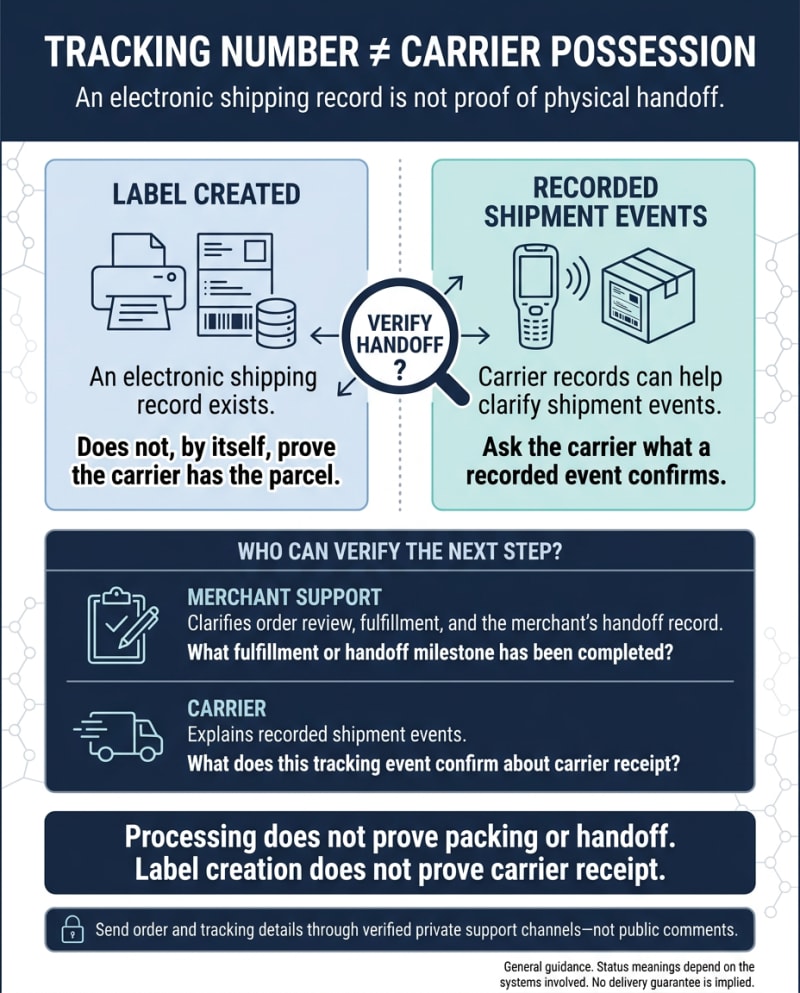
A research peptide order marked “pending” may be awaiting payment confirmation, an order review, or fulfillment; the word alone does not identify the unresolved step. Merchant support can clarify the order record, the payment provider can explain a transaction status, and the carrier can explain recorded shipment events. A shipping label or tracking number is not, by itself, evidence that the carrier has received the parcel.
Peptide Order Pending? Payment and Tracking Explained
For laboratory procurement teams, the useful question is not simply “Where is the order?” but “Which event has been confirmed, and who can verify the next one?” This guide maps common status labels to the party positioned to answer that question.
The labels below are general examples, not a statement of Alpha Carbon Labs’ current internal workflow. No processing interval, support response time, or delivery guarantee is assumed.
- Payment status, order status, and shipment status describe different records.
- A pending bank transaction does not establish that the merchant has completed payment processing.
- Label creation establishes an electronic shipping record, not physical carrier possession.
- Send identifying details through verified private support channels, not public comments.

What does each order or tracking status actually mean?
Order statuses describe the merchant’s workflow; payment statuses describe a financial transaction; tracking statuses describe shipping records and events. Their meanings depend on the systems involved. Use the table to identify the first contact, then ask that party to confirm the specific event rather than interpreting a broad label as proof.
| Displayed status | What it may indicate | Who can clarify it? | Useful question |
|---|---|---|---|
| Pending / awaiting payment | The merchant has not recorded the order as ready to proceed; the exact reason needs confirmation. | Merchant support; payment provider for transaction details | Has payment been matched to this order, and is any action required? |
| Payment pending / authorized | A payment step is incomplete or an authorization is recorded; this is not a shipment event. | Bank or payment provider, with merchant support checking its record | Is this an authorization hold or a completed transaction? |
| On hold / under review | An unresolved merchant or payment review may exist; the label does not explain its cause. | Merchant support | Which review is outstanding, and what information is needed? |
| Processing / fulfillment | The order is in a merchant workflow; packing or handoff is not established by the label alone. | Merchant support | What fulfillment milestone has been completed? |
| Label created / shipment information received | An electronic shipping record exists. | Merchant support for handoff confirmation | Has the parcel been handed to the carrier, and what record confirms that? |
| Accepted / picked up / received by carrier | A carrier event records receipt or collection, subject to the carrier’s terminology. | Carrier; merchant if records conflict | What is the latest physical shipment event? |
| In transit / exception | The carrier reports movement or a disruption; the specific event determines the next step. | Carrier, with merchant involvement when needed | What does this event mean, and must the sender open an inquiry? |
| Delivered, but not located | The carrier recorded delivery, but the laboratory has not confirmed receipt. | Institutional receiving team, carrier, and merchant | What delivery location or proof of delivery is available? |
| Canceled / refund pending | An order or refund workflow changed; the financial record may still need reconciliation. | Merchant for initiation; payment provider for account posting | Was the payment reversed or refunded, and is a reference available? |
Why can payment look complete while the order is still pending?
A bank entry and a merchant order page do not necessarily represent the same payment milestone. Authorization reserves funds; capture is the merchant’s step to collect an authorized payment. Even a posted transaction does not establish that the merchant has matched it to the correct order or completed fulfillment.
Ask the bank or payment provider what its displayed status means, and ask merchant support whether the corresponding transaction is attached to the order. These are complementary questions: the bank generally cannot explain a warehouse queue, and a carrier cannot resolve a payment mismatch.
Do not submit a second payment solely because the order page is unchanged. First reconcile the original transaction with support to avoid an unintended duplicate payment or order.
Does “label created” mean the parcel has shipped?
No. “Label created” or “shipment information received” means that shipping data has been generated or transmitted; it does not establish physical carrier possession. A carrier acceptance, pickup, or other physical-network scan provides stronger evidence that the parcel entered the carrier’s network.
The reverse inference also needs care: a missing acceptance scan does not conclusively prove that no handoff occurred. Ask the merchant for the handoff date and supporting record, while checking the carrier’s event history rather than only the tracking page’s headline.
If the merchant says “shipped” but the carrier shows only electronic information, ask whether “shipped” refers to label generation or actual handoff. Also ask whether the tracking number was replaced or the order was split into multiple parcels.
Supply-chain research treats visibility as an information-sharing problem, not a single universal status. Barratt and Oke’s retail supply-chain case research, Caridi and colleagues’ supply-chain modeling work, and Somapa and colleagues’ literature review examine visibility in their respective business and analytical settings; none establishes the location of an individual Alpha Carbon Labs order. [1–3]
What should a laboratory send support?
Send a concise private message containing the order number, order date, purchasing email, exact displayed status, and the question requiring clarification. Add payment or tracking details only when relevant. A short chronology helps support distinguish a transaction problem from an order-record discrepancy or a carrier-event question.
- Order number and date, including the time zone if timing matters.
- Email address used for the order and any existing support case number.
- Exact status wording and the date and time it was checked.
- Relevant catalog item and quantity, especially for a partial shipment.
- Payment method category, amount, currency, and displayed transaction state—not payment credentials.
- Carrier name, tracking number, and latest event with its timestamp, if available.
- A cropped, redacted screenshot if the wording or discrepancy is difficult to describe.
- One clear question about the next unresolved milestone.
Copy the exact catalog name—such as KPV—from the order confirmation rather than relying on an informal abbreviation. A product page identifies the catalog item; it does not reveal the status of a particular order.
Private support message template
Subject: Status clarification for order [order number]
Our laboratory placed order [number] on [date] using [purchasing email]. The order page currently shows [exact wording], checked at [date, time, time zone]. The payment provider shows [status], and tracking shows [latest event, if available].
Please confirm which step is outstanding: payment matching, review, fulfillment, or carrier handoff. If the parcel has been handed over, please confirm the handoff record and current tracking number; otherwise, please identify any action needed from our procurement team.
What should never be shared publicly?
Do not publish order numbers, tracking numbers, purchasing emails, addresses, invoices, or unredacted screenshots in reviews, forums, or social-media comments. Those details belong in verified private support channels when needed. Never send passwords, one-time authentication codes, full card numbers, card security codes, or banking credentials to order support.
Before attaching a screenshot, remove unrelated transactions, account balances, full payment details, shipping-label barcodes, QR codes, and any account-access links. For an address question, provide only the information necessary through the verified channel rather than posting the full shipping label.
Privacy research offers background for limiting disclosure, not a diagnosis of any merchant’s systems. Malhotra and colleagues studied internet users’ information-privacy concerns, Dinev and Hart modeled disclosure decisions in an e-commerce survey, and Acquisti and colleagues examined privacy valuation in behavioral experiments; these populations do not establish the security of a particular support channel. [4–6]
Verify unexpected payment or tracking messages by navigating independently to the merchant or carrier website. Dhamija and colleagues’ human-participant study examined deceptive websites, while Acquisti, Brandimarte, and Loewenstein reviewed research on privacy behavior; neither source authenticates an individual email or text message. [7–8]
When should the inquiry move from the merchant to the carrier?
Start with the merchant when the uncertainty concerns payment, an order hold, fulfillment, or label-only tracking. Once carrier receipt is recorded, the carrier is positioned to explain subsequent scan events. Keep the merchant involved when tracking conflicts with its account or when the carrier requires the sender to initiate an investigation.
- Identify the latest confirmed event and save its wording and timestamp.
- Ask the party responsible for that event what remains unresolved.
- Request a case reference and an appropriate follow-up point for that specific inquiry.
- If an estimate supplied for the order has passed, quote that estimate rather than assuming a universal processing window.
- For unresolved financial questions, ask the payment provider about applicable procedures and deadlines.
If tracking says “delivered,” check the institution’s receiving desk, mailroom, and internal delivery records. Carrier delivery to a central receiving location and receipt at the laboratory bench are separate events.
Can analytical documents explain a pending order?
Analytical documents address material characterization, not payment settlement or carrier possession. A certificate of analysis, or CoA, reports analytical information for the sample or batch identified in that document. Its availability does not establish that a particular order has been packed, handed over, or delivered.
Keep administrative questions separate from requests about quality control, CoA documents, or peptide synthesis. If support identifies a documentation-related hold, ask which document is outstanding; do not infer that cause from “pending” alone.
Frequently Asked Questions
Why is my research peptide order still pending?
A pending research peptide order has not advanced past a step in the merchant’s system, but the label alone does not identify that step. Ask merchant support whether payment matching, review, or fulfillment remains outstanding. Include the order number, order date, purchasing email, and exact status wording through a verified private channel.
Does a pending payment mean the payment failed?
No. A pending payment may represent an authorization or another incomplete transaction stage rather than a failure. The bank or payment provider can explain its financial record, while the merchant can confirm whether the transaction is linked to the order. Reconcile those records before attempting another payment.
Why do I have a tracking number without an acceptance scan?
A tracking number can exist before physical carrier handoff because label creation is an electronic event. An absent acceptance scan also does not conclusively establish that the parcel remains with the merchant. Ask the merchant to confirm handoff and check whether the carrier has recorded any later physical-network events.
How long should I wait before asking about a pending order?
There is no universal waiting period that can be inferred from “pending.” Use any current order-specific estimate or published policy, and contact support when the status is unclear or that estimate has passed. This guide does not establish Alpha Carbon Labs processing times, response intervals, or delivery guarantees.
Should I post my tracking screenshot in a public comment?
No. A tracking screenshot may expose identifiers, delivery details, barcodes, or account links. Send a redacted copy only through a verified private support channel when needed. Keep the relevant event wording and timestamp visible, while removing information unrelated to the question and all payment or account-access credentials.
Does a canceled order mean the payment has been refunded?
Not necessarily. Order cancellation and the financial adjustment are separate records, and an authorization reversal differs from a refund of a collected payment. Ask the merchant which action was initiated and whether a reference is available. Ask the payment provider to explain how that action appears on the account.
This article summarizes general administrative distinctions and published supply-chain and privacy research; it cannot verify an individual order. It does not establish safety, effectiveness, approval, or suitability of material sold by Alpha Carbon Labs for human or veterinary use; that material is intended solely for nonclinical laboratory research.
References
- 1. [1] Barratt M, Oke A. Antecedents of supply chain visibility in retail supply chains: A resource-based theory perspective. Journal of Operations Management. 2007;25(6):1217–1233.
- 2. [2] Caridi M, Crippa L, Perego A, Sianesi A, Tumino A. Do virtuality and complexity affect supply chain visibility? International Journal of Production Economics. 2010;127(2):372–383.
- 3. [3] Somapa S, Cools M, Dullaert W. Characterizing supply chain visibility – A literature review. The International Journal of Logistics Management. 2018;29(1):308–339.
- 4. [4] Malhotra NK, Kim SS, Agarwal J. Internet Users’ Information Privacy Concerns (IUIPC): The Construct, the Scale, and a Causal Model. Information Systems Research. 2004;15(4):336–355.
- 5. [5] Dinev T, Hart P. An Extended Privacy Calculus Model for E-Commerce Transactions. Information Systems Research. 2006;17(1):61–80.
- 6. [6] Acquisti A, John LK, Loewenstein G. What Is Privacy Worth? The Journal of Legal Studies. 2013;42(2):249–274.
- 7. [7] Dhamija R, Tygar JD, Hearst M. Why phishing works. Proceedings of the SIGCHI Conference on Human Factors in Computing Systems. 2006:581–590. Peer-reviewed conference study.
- 8. [8] Acquisti A, Brandimarte L, Loewenstein G. Privacy and human behavior in the age of information. Science. 2015;347(6221):509–514.
Related Guides research
All research information is for educational purposes only. The statements made within this website have not been evaluated by the US Food and Drug Administration. The statements and the products of this company are not intended to diagnose, treat, cure or prevent any disease.