Peptide Vendor Red Flags: 10 Warning Signs
Ten concrete peptide vendor red flags, from COAs with no named testing lab and recycled reports to unverifiable addresses and pressure pricing, each paired with the verification step that confirms or clears it.
The clearest peptide vendor red flags are documentation problems that cannot be independently checked: a certificate of analysis (COA) with no named testing laboratory, the same COA reused across different lots, lot numbers that do not match the vial, and no mass-based identity data. Business signals matter too. These include an address or legal entity you cannot confirm, countdown-style pressure pricing, and marketing that contradicts research-use-only labeling. Each warning sign below is paired with the specific check that confirms or clears it.
This is a pre-order checklist. It does not cover how to judge vendor reviews, return terms, or payment options. For those topics, see our separate guides, including what to check in a research peptide return policy.
What counts as a red flag versus an ordinary gap?
A red flag is a signal that a vendor's claims cannot be traced to evidence you can verify yourself. An ordinary gap is missing information the vendor supplies promptly and consistently when asked. The distinction matters because many legitimate suppliers do not publish every document by default.
The useful test is therefore not "is everything on the website?" but "does the answer hold up when I check it against an outside source?" A COA is a good example. It is only as credible as the laboratory, lot, and method it can be tied to.
Published work on falsified and illegal peptide products shows why this matters. Analyses by European control laboratories, such as Vanhee and colleagues (2015) and Janvier and colleagues (2017), describe seized peptide materials whose identity or content differed from their labels. Those studies examined seized samples, not any particular online vendor. Still, they show that a label alone does not establish what is in a vial.
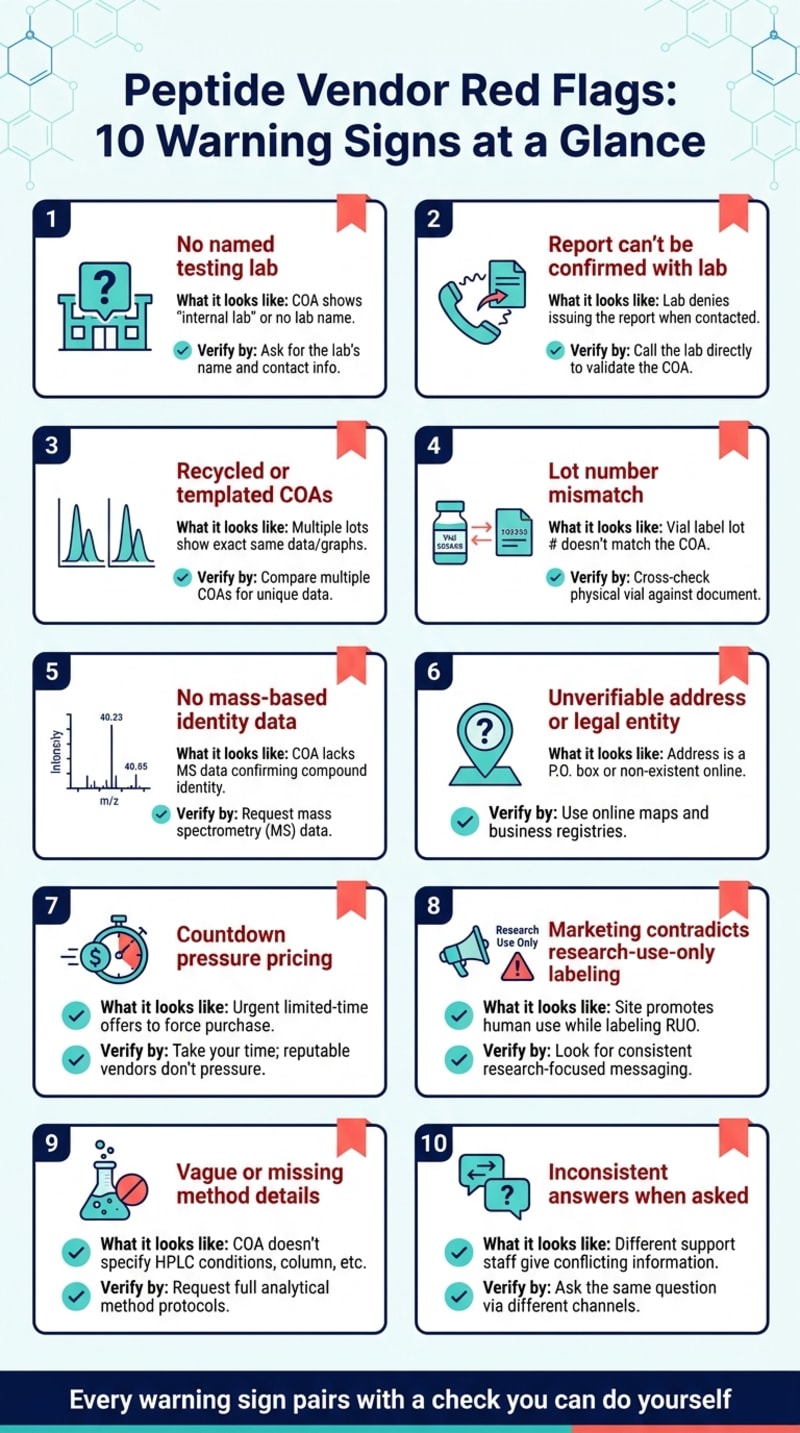
The 10 red flags at a glance
| # | Red flag | What it looks like | Verification step that resolves it |
|---|---|---|---|
| 1 | No named testing laboratory | COA shows only the vendor logo, or a lab name with no address or accreditation details | Ask for the lab's legal name and location, then confirm the lab exists independently |
| 2 | Report cannot be confirmed with the lab | No report ID, verification code, or lab contact; lab will not confirm issuance | Contact the lab directly, using contact details you find yourself, and quote the report number |
| 3 | Recycled or templated COAs | Identical chromatograms, dates, or purity values across different lots or products | Request COAs for two or more lots and compare traces, retention times, and dates |
| 4 | Lot number mismatch | Vial lot is not listed on any COA, or the COA lacks a lot number | Match the lot on the vial label to the COA before opening |
| 5 | Purity without identity | HPLC purity percentage only, with no mass spectrometry result | Ask for observed mass versus theoretical mass for that sequence |
| 6 | Implausibly uniform purity | Every product listed at "99%+" with no method details | Request the method, the detection wavelength, and the full chromatogram with integration |
| 7 | Unverifiable business identity | No legal entity name; address is a mail drop or does not exist | Search official business registries and confirm the entity and registered address |
| 8 | Pressure pricing | Countdown timers, "final hours" discounts, prices far below peers | Compare against several suppliers and ask for lot-specific documentation before paying |
| 9 | Consumer-use marketing | Personal-use amounts, before/after images, or health claims beside "research use only" text | Treat it as a compliance warning; review the whole site for consistency |
| 10 | No safety or handling documents | No safety data sheet (SDS), storage statement, or technical contact | Request the SDS and storage data in writing and judge how the vendor responds |
Red flag 1: Why is a COA with no named testing lab a problem?
A COA that does not name the laboratory that ran the analysis cannot be traced to anyone accountable for the result. Without a lab name, address, and report number, you have no way to confirm the test happened, which instrument was used, or whether the result belongs to the material being sold.
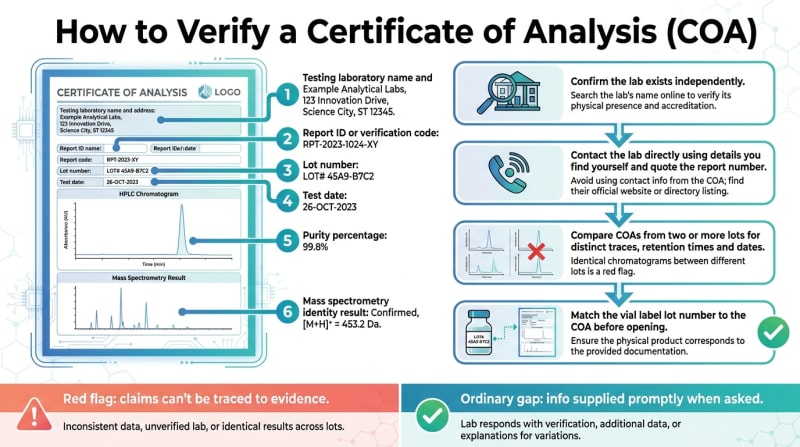
Verification step: Ask the vendor which laboratory produced the report. Then confirm that the lab exists through sources the vendor does not control, such as the lab's own website or an accreditation body directory. If the vendor claims accredited testing, check that the specific method falls within the lab's scope. Our guide to checking ISO 17025 scope for peptide testing walks through that process.
Red flag 2: What if the testing lab cannot confirm the report?
A named lab is necessary but not sufficient, because a lab's name and logo can be copied onto a document it never issued. A credible report carries a unique identifier, and the issuing lab should be able to confirm that the identifier matches the sample description and date.
Verification step: Find the lab's contact details yourself rather than using any link or phone number printed on the COA. Quote the report number and ask the lab to confirm the sample name, the date, and the client. Some labs offer online verification portals. If a lab declines to confirm because of client confidentiality, ask the vendor to authorize the disclosure in writing.
Red flag 3: How can you tell if a COA has been recycled?
Recycled COAs reuse one analytical report across several lots, several products, or a long period. The giveaway is usually a document that is too consistent: the same chromatogram shape, the same retention time to the hundredth of a minute, the same purity figure, or a test date that comes before the stated synthesis date.
Duplicated data is a recognized problem even in peer-reviewed science. Bik, Casadevall and Fang (2016) screened more than 20,000 biomedical papers and found inappropriately duplicated images in roughly 3.8% of them. That study concerned published figures, not vendor COAs. Its relevance here is methodological: side-by-side visual comparison is an effective way to catch duplication.
Verification step: Request COAs for at least two different lots of the same product and compare them closely. Real lot-to-lot data shows small differences in impurity peaks, baseline noise, and retention times. Also compare COAs across different products. A 15-residue peptide such as BPC-157 and a much larger molecule such as retatrutide should not produce interchangeable traces.
Red flag 4: Why does a lot-number mismatch matter so much?
The lot number is what links a physical vial to its analytical data. If the vial label shows a lot that appears on no COA, or the COA has no lot number at all, the document does not describe the material in your hands. A lot match is the minimum condition for any COA to be meaningful.
Verification step: Before placing an order, ask whether the COA will match the lot that actually ships. On receipt, compare the vial label against the COA before opening the vial, and record both in your laboratory notebook. A reputable supplier keeps an archive of documents by lot. Alpha Carbon Labs publishes its documents in the COA document library for exactly this kind of lot-level comparison.
Red flag 5: Is HPLC purity alone enough to confirm identity?
No. Reversed-phase HPLC reports how much of the UV-absorbing material elutes as the main peak. It does not, on its own, confirm that the main peak is the correct sequence. A wrong peptide, a truncated sequence, or a closely related analog can still appear as one large peak with high apparent purity.
Reviews of peptide impurities, including D'Hondt and colleagues (2014), describe deletion sequences, insertions, incomplete deprotection, oxidation, and deamidation as common synthesis-related impurities. Some of these co-elute with, or sit very close to, the target peak. Mass spectrometry (MS) measures molecular mass, which provides the identity check that HPLC cannot.
Verification step: Ask for the observed mass from MS alongside the theoretical mass calculated for the stated sequence and counter-ion form. A meaningful gap between the two is itself a finding that needs an explanation. For background on how sequences are built and where impurities arise, see our overview of peptide synthesis.
Red flag 6: Why are uniform "99%+" purity claims suspicious?
Purity figures depend on the method, including the column, the gradient, the detection wavelength, and how peaks are integrated. When every product in a catalog is listed at the same high purity with no method information, the number is a marketing figure rather than a measured result. Short and long peptides rarely give identical purity profiles.
Purity also differs from content. A lyophilized peptide contains water and counter-ions such as trifluoroacetate or acetate. As a result, the mass of peptide in a vial is lower than the gross powder weight, even at high chromatographic purity. Vergote and colleagues (2009) discuss these as separate quality attributes in peptide specifications.
Verification step: Request the full chromatogram with its integration table and method parameters. Ask whether net peptide content or counter-ion content was measured. Our quality control overview outlines which attributes we document.
Red flag 7: How do you check whether a vendor's address and business are real?
A legitimate supplier can be tied to a legal entity with a registered address. Red flags include a website with no company name in its terms, an address that resolves to a mail-forwarding service or a residence, or contact options limited to a web form or a messaging app.
Research on online sellers of regulated products supports this check. A systematic review of online pharmacy quality by Orizio and colleagues (2011) identified missing or unverifiable physical addresses as a recurring feature of lower-quality sites. That review studied pharmacy websites, not peptide suppliers, so treat it as an analogous pattern rather than direct evidence.
Verification step:
- Find the legal entity name in the vendor's terms of sale, invoices, or privacy policy.
- Search that name in the official business registry for the stated state or country.
- Confirm that the registered address and status (active versus dissolved) match what the vendor displays.
- Check that the domain registration and the business registration tell a consistent story about where the vendor operates.
Red flag 8: When does pricing itself become a warning sign?
Pricing becomes a red flag when it is designed to cut short your verification steps. Common examples are countdown timers, "only 3 left" banners, or discounts that expire before you could reasonably request documents. Prices far below those of several established suppliers also deserve scrutiny, because synthesis, purification, and independent testing all carry real costs.
Verification step: Never let a deadline replace documentation. Ask for the lot-specific COA and confirmation of the testing lab before paying. Compare pricing for the same mass and stated purity across at least three suppliers. A vendor with confidence in its documents will still honor a fair price after you have checked them.
Red flag 9: Why is consumer-style marketing a red flag for a research supplier?
A supplier that labels products "for research use only" while its pages, blog, or social channels describe personal-use amounts, before-and-after images, or health outcomes is sending contradictory signals. This inconsistency suggests the vendor is not managing regulatory boundaries carefully. Weak compliance discipline often goes hand in hand with weak quality discipline.
Mackey and Nayyar (2017) reviewed the digital channels used to distribute falsified medical products. They note that unregulated online sellers often depend on social media promotion and on claims that fall outside the labeled product category. Again, this describes a broader online market rather than any specific peptide vendor.
Verification step: Read the whole site, not just the product page. Check the blog, the FAQs, linked social accounts, and affiliate pages for language that conflicts with research-only labeling.
Red flag 10: What does a missing SDS or unanswered technical question tell you?
A safety data sheet (SDS) and basic handling information, such as storage temperature, light sensitivity, and shipping form, are routine laboratory documents. A vendor that cannot supply them, or whose support staff cannot answer a basic question about counter-ion form or lot history, probably lacks the documentation system behind its claims.
Peptide stability depends heavily on storage conditions. Manning and colleagues (2010) review how temperature, moisture, pH, and oxidation drive chemical and physical degradation. Missing storage guidance is therefore a practical risk, not just a paperwork issue. If material arrives in a questionable state, our guide to assessing peptide degradation in the lab covers what to document.
Verification step: Email two or three specific technical questions before ordering. Judge the answers on specificity, consistency with the COA, and whether they come in writing.
Why do these checks matter for research quality?
Reagent identity is a known source of irreproducible results. Freedman, Cockburn and Simcoe (2015) estimated that a substantial share of irreproducible preclinical research in the United States traces to biological reagents and reference materials. Baker (2015) documented similar problems with poorly characterized antibodies. These analyses did not study peptides specifically, but the lesson carries over: an unverified reagent can undermine an entire dataset.
Counter-ions are a concrete example. Cornish and colleagues (1999) reported that trifluoroacetate, a common residue from peptide purification, inhibited proliferation of osteoblasts and chondrocytes in cell culture. A vendor that cannot tell you the counter-ion form leaves a variable in your assay that you cannot account for.
Key takeaways
- Every COA should name a real laboratory that will confirm the report independently.
- Lot numbers must match between the vial and the COA; without that match, the COA describes nothing in your hands.
- HPLC purity without MS identity data leaves the sequence unconfirmed.
- Identical data across lots or products points to recycled documents.
- Confirm the legal entity and address through official registries, not the vendor's own website.
- Urgency tactics and consumer-use marketing are warnings about the vendor's process, not just its tone.
Frequently Asked Questions
What are the warning signs that a research peptide vendor is not legitimate?
The main warning signs are COAs that name no testing laboratory, reports the lab will not confirm, identical COAs reused across lots, lot numbers that do not match the vial, and purity claims without mass spectrometry. Business-level signs include an unverifiable legal entity or address, countdown-style pressure pricing, and marketing that contradicts research-use-only labeling.
Can a vendor create a fake COA?
Yes. A COA is a document, and lab names, logos, and chromatograms can be copied or edited. That is why the most reliable check is to contact the issuing laboratory directly, using contact details you locate yourself, and confirm that the report number matches the sample, the date, and the client listed on the certificate.
Is one COA for a product enough?
Usually not. A single COA shows that one lot was tested at one time. Ask for the COA that matches the lot you will receive. If possible, also compare COAs from two different lots. Genuine lot-to-lot reports show small differences in impurity peaks and retention times, while recycled reports look identical.
Does high HPLC purity prove the peptide is correct?
No. HPLC purity measures the proportion of the main peak, not its identity. A wrong or truncated sequence can still produce one dominant peak. Mass spectrometry, which compares observed molecular mass against the theoretical mass for the stated sequence, is the standard complementary identity check for synthetic peptides.
Are very low prices always a red flag?
Not always, but they warrant closer review. Synthesis, purification, and independent testing have real costs, so prices far below several established suppliers raise the question of what was skipped. Low prices paired with urgency tactics or missing lot-specific documentation are a stronger warning than price alone.
How can I verify a peptide vendor's business address?
Find the legal entity name in the vendor's terms, invoices, or privacy policy. Search that name in the official business registry for the jurisdiction it claims. Confirm that the entity is active and that the registered address matches the one displayed. A mail-forwarding address or a missing entity name deserves further questions.
What should I do if a vendor shows several red flags?
Pause the order and ask for the missing items in writing: a lab-confirmed COA for the specific lot, MS identity data, the legal entity name, and an SDS. Record the responses. If the documents cannot be verified independently, the material's identity cannot be established for research purposes.
Limitations
This article summarizes published research on reagent quality, peptide impurities, and online product markets, and applies it to supplier evaluation as a practical checklist. The cited studies examined seized samples, published images, pharmacy websites, and cell-culture models, not specific peptide vendors. The article does not establish the safety, effectiveness, regulatory approval, or suitability of any material sold by Alpha Carbon Labs or any other supplier for human or veterinary use. All products discussed are intended solely for nonclinical laboratory research.
References
- 1. Vanhee C, Janvier S, Desmedt B, Moens G, Deconinck E, De Beer JO, Courselle P. Analysis of illegal peptide biopharmaceuticals frequently encountered by controlling agencies. Talanta. 2015;142:1-10.
- 2. Janvier S, De Sutter E, Wynendaele E, De Spiegeleer B, Vanhee C, Deconinck E. Analysis of illegal peptide drugs via HILIC-DAD-MS. Talanta. 2017;174:562-571.
- 3. D'Hondt M, Bracke N, Taevernier L, Gevaert B, Verbeke F, Wynendaele E, De Spiegeleer B. Related impurities in peptide medicines. J Pharm Biomed Anal. 2014;101:2-30.
- 4. Vergote V, Burvenich C, Van de Wiele C, De Spiegeleer B. Quality specifications for peptide drugs: a regulatory-pharmaceutical approach. J Pept Sci. 2009;15(11):697-710.
- 5. Manning MC, Chou DK, Murphy BM, Payne RW, Katayama DS. Stability of protein pharmaceuticals: an update. Pharm Res. 2010;27(4):544-575.
- 6. Bik EM, Casadevall A, Fang FC. The Prevalence of Inappropriate Image Duplication in Biomedical Research Publications. mBio. 2016;7(3):e00809-16.
- 7. Orizio G, Merla A, Schulz PJ, Gelatti U. Quality of online pharmacies and websites selling prescription drugs: a systematic review. J Med Internet Res. 2011;13(3):e74.
- 8. Mackey TK, Nayyar G. A review of existing and emerging digital technologies to combat the global trade in fake medicines. Expert Opin Drug Saf. 2017;16(5):587-602.
- 9. Freedman LP, Cockburn IM, Simcoe TS. The Economics of Reproducibility in Preclinical Research. PLoS Biol. 2015;13(6):e1002165.
- 10. Baker M. Reproducibility crisis: Blame it on the antibodies. Nature. 2015;521(7552):274-276.
- 11. Cornish J, Callon KE, Lin CQ, Xiao CL, Mulvey TB, Cooper GJ, Reid IR. Trifluoroacetate, a contaminant in purified proteins, inhibits proliferation of osteoblasts and chondrocytes. Am J Physiol. 1999;277(5):E779-E783.
Related Research Compounds research
All research information is for educational purposes only. The statements made within this website have not been evaluated by the US Food and Drug Administration. The statements and the products of this company are not intended to diagnose, treat, cure or prevent any disease.