Peptide Moisture Testing: Why Dry Powder Contains Water
A dry-looking lyophilized peptide can still contain residual water. Learn what Karl Fischer results measure and which specification, sampling, and reporting-basis questions make moisture documentation interpretable.
Peptide Moisture Testing: Why Dry Powder Contains Water
Yes. A lyophilized peptide can contain measurable residual water even when its powder looks completely dry. Peptide moisture testing, commonly performed by Karl Fischer titration, measures water in a tested sample; visual appearance cannot establish water content or confirm compliance with a moisture specification.
- “Lyophilized” means freeze-dried, not necessarily water-free.
- A Karl Fischer result needs a reporting basis, units, and a defined analytical method.
- Water content, chromatographic purity, and peptide content are different measurements.
- A lot-level result does not mean every unopened vial was individually tested.
What does residual moisture mean in a lyophilized peptide?
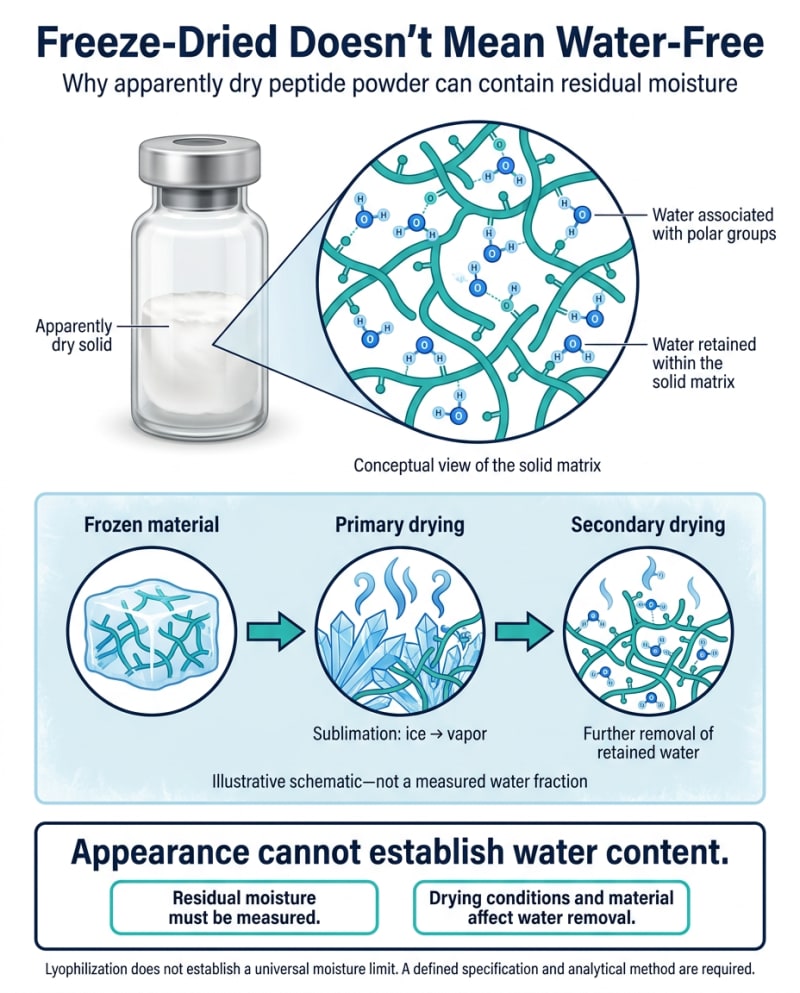
Residual moisture is water remaining in the solid material after drying. Lyophilization removes much of the water through sublimation, the direct conversion of ice into vapor, followed by further removal of retained water; it does not inherently produce an absolutely water-free solid.
Water can associate with polar chemical groups or remain within the solid matrix—the physical arrangement of the material's components. A material can therefore be solid and apparently dry while still containing analytically measurable water.
In experimental pharmaceutical freeze-drying systems, Pikal and colleagues examined secondary-drying kinetics and showed that water removal depended on the drying conditions and material studied. That work supports treating residual moisture as a measured attribute, not as something established by the word “lyophilized.” It does not establish a moisture limit for every research peptide. [1]
“Bound water” is sometimes used to describe water associated more strongly with a solid. The term does not, by itself, specify how much water is present, how readily an analytical method retrieves it, or whether it belongs to a defined crystalline hydrate.
What does a Karl Fischer result actually measure?
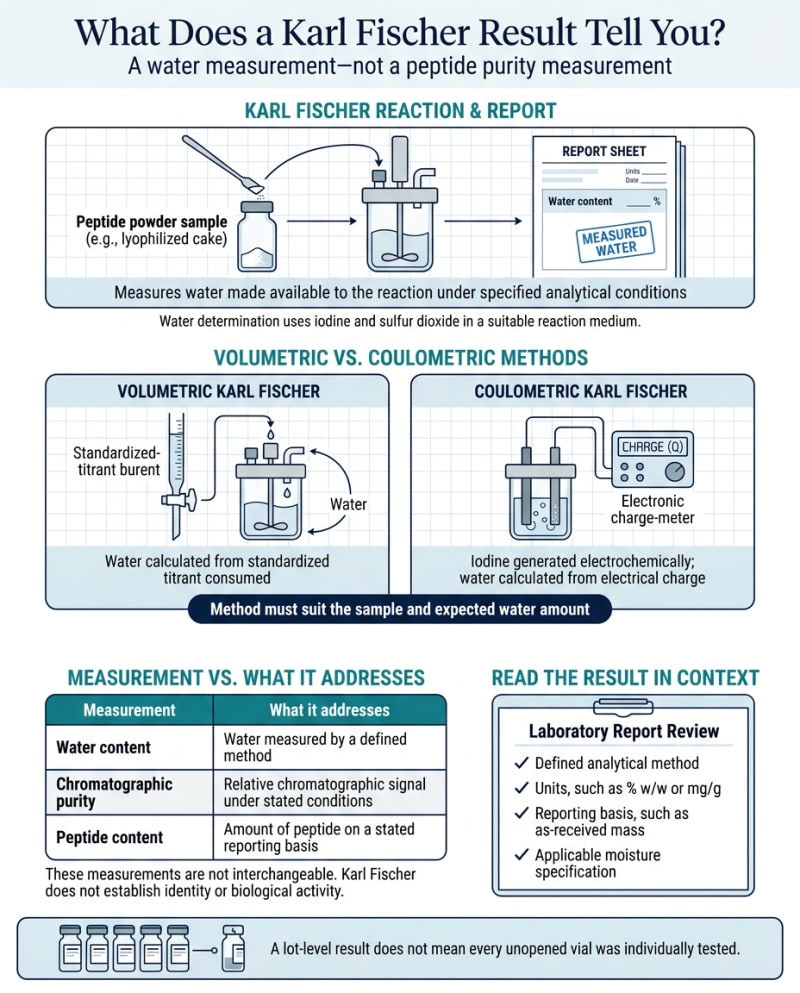
Karl Fischer titration measures water through a chemical reaction involving iodine and sulfur dioxide in a suitable reaction medium. For a peptide powder, the result represents water made available to that reaction under the specified analytical conditions—not peptide identity, biological activity, or the proportion of intact peptide.
Karl Fischer's original analytical paper introduced the water-determination method for liquids and solids. Its foundation is chemical measurement of water rather than an inference from texture, color, or visible liquid. [2]
Volumetric and coulometric results
Volumetric Karl Fischer analysis calculates water from the amount of standardized titrant consumed. Coulometric Karl Fischer analysis generates iodine electrochemically and calculates water from the electrical charge required. Either approach needs a method appropriate to the expected water amount and sample matrix.
A report that says only “KF” leaves important questions unanswered. The method identifier, analytical approach, reporting basis, and evidence of suitability help determine whether results from different reports are comparable.
Why method suitability matters
A defensible method must account for whether water is adequately retrieved from the material and whether the matrix interferes with the reaction. Incomplete retrieval can understate water content; interfering chemistry or inadequately controlled analytical background can distort the result.
Some methods measure water released from a sample into the analytical system rather than introducing the material directly into the reaction medium. This is a distinction to identify in documentation, not a reason to assume that all methods carrying the Karl Fischer name are interchangeable.
Laboratory buyers can request a summary of retrieval, precision, background correction, and the validated measurement range. These are questions about the credibility of the reported number, not instructions for performing the assay.
Why can't dry appearance establish water content?
Appearance describes the visible structure of a powder or freeze-dried cake, not its water mass fraction. The absence of droplets does not establish zero water, and an intact cake does not establish that a numerical moisture limit has been met.
In freeze-dried model systems, Pikal and Shah investigated collapse behavior and its dependence on measurement methodology and water removal from the glassy phase. Their work concerns physical behavior under specified experimental conditions; it does not provide a visual scale that converts a vial photograph into a water percentage. [3]
Likewise, a change in texture is not a water-specific analytical result. Ingredient identity is a separate question addressed in Peptide Excipients: Are There Fillers in the Vial?; this article concerns measured water, not identifying ingredients from appearance.
How should moisture percentages and reporting bases be read?
A moisture percentage is interpretable only when its denominator is clear. On an as-received mass basis, water percentage means the mass of measured water divided by the total mass of the tested material, multiplied by 100; a dry-basis percentage uses a different denominator.
| Report entry | What it describes | What it does not establish |
|---|---|---|
| Water, % w/w, as received | Water mass relative to the total sample mass before analytical correction | The percentage of intact peptide |
| Water, dry basis | Water mass relative to a defined dry-mass denominator | Direct comparability with an as-received percentage |
| Water, micrograms per vial | An absolute water amount attributed to a vial under the stated method and calculation | A mass percentage without a corresponding sample-mass basis |
| Water, less than a reporting limit | A result below the stated threshold for reporting or quantification | Zero water |
| Loss on drying | Mass lost under a defined test | A water-specific result unless equivalence has been demonstrated |
| HPLC area purity | A chromatographic peak-area relationship under a defined method | Water content or a complete mass balance |
A simple reporting example
Consider a purely hypothetical analytical sample containing 2 mass units of water and 98 mass units of other material. Its water content is 2.00% on an as-received basis, but approximately 2.04% relative to the 98-unit water-free denominator.
The sample has not changed; only the denominator has changed. These figures illustrate reporting conventions and are not suggested acceptance limits for research peptides.
When “dry basis” appears on a certificate, ask exactly what was excluded from the denominator. A mathematically water-corrected result and a result based on an experimentally determined dried mass need not be equivalent.
Why water correction is not peptide quantification
Subtracting water from total mass leaves the non-water fraction, not necessarily pure peptide. Likewise, “assay on an anhydrous basis” means that a specified water correction has been applied to an assay result; it does not mean the supplied material contained no water.
Water testing and peptide quantification therefore answer separate questions. A moisture result alone cannot establish net peptide content, and a chromatographic purity percentage cannot substitute for moisture testing.
Is there a universal acceptable moisture limit for peptides?
No universal numerical moisture limit can be inferred from the term “research peptide.” A useful specification must be justified for the particular material, its composition, the analytical method, and the quality attributes being evaluated. “Lower is always better” is not a defensible substitute for material-specific evidence.
In amorphous pharmaceutical solids, Hancock and Zografi examined the relationship between water content and glass-transition temperature—the temperature region where a rigid, disordered solid becomes more mobile. Their findings show why water can matter to solid-state properties, but they do not establish one acceptable percentage across chemically different peptides. [4]
In lyophilized antibody formulations, Chang and colleagues studied residual moisture and sorbitol in relation to stability. A separate study by Chang and colleagues examined sugar-mediated stabilization in freeze-dried protein systems using structural and physical measurements. These formulation studies support evaluating water alongside the surrounding matrix, rather than transferring a numerical target from one material to another. [5,6]
In lyophilized protein models, Liu and colleagues investigated moisture-induced aggregation, while Griebenow and Klibanov examined reversible secondary-structure changes associated with lyophilization. These are laboratory protein studies, not clinical studies or direct validation of short synthetic peptides sold by Alpha Carbon Labs. They also illustrate why water measurement is not a substitute for measuring structural or chemical integrity. [7,8]
A specification is a predefined acceptance criterion; a result is the measured observation. A meaningful certificate identifies both, rather than presenting a water percentage without explaining whether it satisfies an established criterion.
What should laboratory buyers ask about moisture documentation?
Ask for the lot-specific result, the applicable acceptance criterion, the analytical method, and the basis on which the result is reported. Also ask what was sampled: a bulk material result, a composite sample, and measurements from individual finished vials support different conclusions about the supplied lot.
- Was water measured for this lot? Distinguish an actual test result from a typical value, a historical range, or an untested specification.
- What is the acceptance criterion? Request the numerical limit or range, its units, and the rationale for applying it to this material.
- Which method was used? Request the method identifier and whether the result came from volumetric or coulometric Karl Fischer analysis, or another identified method.
- What is the reporting basis? Clarify as-received mass, dry mass, or an absolute amount, including any corrections.
- What material was tested? Identify bulk peptide versus finished vial contents and whether the tested composition matches the supplied material.
- How was the lot represented? Ask about the number of units tested, individual versus pooled results, and whether reported variability describes repeat measurements or different vials.
- What supports the method's reliability? Request relevant retrieval, precision, and quantification-limit information, especially for results near the acceptance boundary.
- When was the result generated? Establish whether it is a release result or a later measurement; it should not be described as a current measurement of an untested vial.
These questions apply to a catalog material such as KPV, the lysine–proline–valine tripeptide used in nonclinical peptide research, without assuming that a moisture value or specification is available for any particular lot. A product listing is not itself a water-content report.
Relevant starting points include quality-control information and certificate-of-analysis documents. For custom materials, moisture specifications and reporting conventions can be included among the documentation requirements discussed for peptide synthesis; a general description of synthesis does not establish a finished lot's water content.
Frequently Asked Questions
Can an unopened lyophilized peptide contain water?
Yes. Residual water can remain in a lyophilized solid before the container is sealed, so an unopened vial is not necessarily water-free. “Unopened” describes container history, whereas “water content” describes an analytically measured property of the material. Neither term can replace the other.
Does Karl Fischer testing measure only free water?
No. Karl Fischer testing can measure water associated with the solid as well as more readily available water, provided the validated method makes that water available to the reaction. It does not automatically distinguish free water from bound water, and incomplete retrieval can limit what the reported result represents.
Does 99% HPLC purity mean less than 1% water?
No. An HPLC area-purity percentage describes the relative chromatographic response of peaks included in that calculation. It is not a complete accounting of sample mass and generally does not quantify water. A separate moisture determination is needed to establish water content on a defined mass basis.
Is water content the same as water activity?
No. Water content describes how much water is present. Water activity describes water's thermodynamic availability, commonly expressed through equilibrium vapor pressure relative to pure water at the same temperature. Materials with the same water percentage can have different water activities; a Karl Fischer result does not directly measure water activity.
Does a result below the quantification limit mean zero water?
No. It means the method cannot reliably quantify water below the stated threshold under its validated conditions. The report should identify that threshold and its units. “Below the quantification limit,” “not detected,” and “zero” are not interchangeable descriptions, and none should be silently substituted for another.
Does a lot certificate prove the moisture content of every vial?
Not by itself. A certificate usually reports results from selected samples under a defined sampling plan. Ask whether the value represents bulk material, pooled finished units, or individual vials, and whether variability was assessed. Conventional Karl Fischer analysis consumes a sample; it is not a visual measurement through a sealed container.
Key takeaways for interpreting moisture reports
- Accept a measured water result, not a dry-looking photograph, as evidence of water content.
- Compare results only after checking units, denominators, methods, and sampled material.
- Keep moisture specifications separate from purity and peptide-content claims.
- Require material-specific justification rather than assuming a universal moisture target.
This article summarizes published analytical and solid-state research and explains documentation questions for nonclinical laboratory procurement. It does not establish the safety, effectiveness, approval, or suitability of material sold by Alpha Carbon Labs for human or veterinary use.
References
- 1. [1] Pikal MJ, Shah S, Roy ML, Putman R. The secondary drying stage of freeze drying: drying kinetics as a function of temperature and chamber pressure. International Journal of Pharmaceutics. 1990;60:203–217.
- 2. [2] Fischer K. Neues Verfahren zur maßanalytischen Bestimmung des Wassergehaltes von Flüssigkeiten und festen Körpern. Angewandte Chemie. 1935;48:394–396.
- 3. [3] Pikal MJ, Shah S. The collapse temperature in freeze drying: dependence on measurement methodology and rate of water removal from the glassy phase. International Journal of Pharmaceutics. 1990;62:165–186.
- 4. [4] Hancock BC, Zografi G. The relationship between the glass transition temperature and the water content of amorphous pharmaceutical solids. Pharmaceutical Research. 1994;11:471–477.
- 5. [5] Chang L, Shepherd D, Sun J, Tang X, Pikal MJ. Effect of sorbitol and residual moisture on the stability of lyophilized antibodies: implications for the mechanism of protein stabilization in the solid state. Journal of Pharmaceutical Sciences. 2005;94:1445–1455.
- 6. [6] Chang L, Shepherd D, Sun J, Ouellette D, Grant KL, Tang XC, Pikal MJ. Mechanism of protein stabilization by sugars during freeze-drying and storage: native structure preservation, specific interaction, and/or immobilization in a glassy matrix? Journal of Pharmaceutical Sciences. 2005;94:1427–1444.
- 7. [7] Liu WR, Langer R, Klibanov AM. Moisture-induced aggregation of lyophilized proteins in the solid state. Biotechnology and Bioengineering. 1991;37:177–184.
- 8. [8] Griebenow K, Klibanov AM. Lyophilization-induced reversible changes in the secondary structure of proteins. Proceedings of the National Academy of Sciences of the United States of America. 1995;92:10969–10976.
Related Research Compounds research
All research information is for educational purposes only. The statements made within this website have not been evaluated by the US Food and Drug Administration. The statements and the products of this company are not intended to diagnose, treat, cure or prevent any disease.