Analytical Characterization of Triple-Agonist Research Peptides
Triple-agonist peptide research requires separate assessments of chemical identity, chromatographic purity, stability, and receptor activity. Reversed-phase high-performance liquid chromatography (RP-HPLC) and mass spectrometry (MS) provide complementary chemical measurements, but neither alone establishes all four attributes.
Retatrutide, also identified as LY3437943, is the central example in this guide. Coskun et al. (2022) report its activity at glucagon, glucose-dependent insulinotropic polypeptide (GIP), and glucagon-like peptide-1 (GLP-1) receptors in in-vitro receptor assays. That published characterization does not establish the identity or activity of an independently supplied research batch.
This guide explains how to interpret analytical data, investigate degradation, and document laboratory storage studies. It does not present testing results for Alpha Carbon Labs materials or assert that any particular batch meets a specification.
Keep Evidence Types Separate
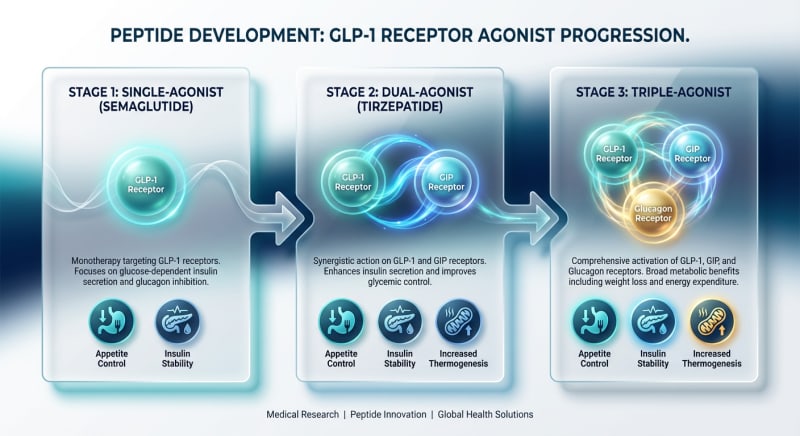
The attached bibliography includes different types of evidence. Jastreboff et al. (2023) describe a human phase 2 retatrutide trial in participants with obesity; Frias et al. (2021) describe a human comparison of tirzepatide and semaglutide in patients with type 2 diabetes. These human studies are not analytical validation studies for Alpha Carbon Labs products and do not provide batch-specific purity or storage specifications.
Finan et al. (2015) describe a peptide triagonist studied in rodents. That animal study should not be treated as characterization of retatrutide or of an independently sourced material. Receptor classification alone does not make different peptide structures interchangeable.
For catalog navigation, the retatrutide, tirzepatide, and semaglutide pages identify distinct research materials. Analytical methods and acceptance criteria must be evaluated for the specific material; they cannot be transferred solely because compounds share a receptor target.
Degradation Pathways: Oxidation and Deamidation
Potential degradation pathways depend on the actual sequence, chemical modifications, sample matrix, and exposure conditions. Oxidation and deamidation are useful targets for investigation, but neither is inevitable in every peptide, and neither is the only source of sample change.
Oxidation
Susceptible residues can include methionine and tryptophan when present in the structure. Oxidation can produce multiple products rather than a single predictable species. Addition of one oxygen atom produces a monoisotopic mass increase of approximately 15.9949 Da. That shift is consistent with oxygen addition, but intact mass alone does not identify the modified residue or establish the reaction pathway.
Light, oxidizing contaminants, and handling conditions can influence oxidation. A change in receptor activity cannot be inferred solely from an oxidation-associated mass shift; it requires a separate, appropriately controlled in-vitro functional assay.
Deamidation
Deamidation can affect asparagine or glutamine residues when present, with susceptibility depending on sequence context, pH, temperature, and the sample environment. Conversion of an amide side chain to a carboxyl group produces a monoisotopic mass increase of approximately 0.9840 Da. Asparagine deamidation can also yield structurally distinct products that share the same mass.
A mass shift consistent with deamidation does not prove complete loss of function, identify the affected site, or demonstrate a change from triple- to dual-receptor activity. Those conclusions require additional structural and functional evidence.
| Process | Potential analytical observation | Interpretive limitation |
|---|---|---|
| Oxidation | New chromatographic peaks and mass shifts consistent with oxygen addition | Retention time and intact mass do not by themselves locate the modification. |
| Deamidation | Approximately +0.9840 Da per deamidation event; possible retention changes | Some products are isomeric, and chromatographic separation is method-dependent. |
| Cleavage or synthesis-related truncation | Additional peaks or lower-mass species | MS/MS or other structural analysis may be needed to assign the species. |
| Aggregation, precipitation, or adsorption | Reduced recovery or altered sample appearance | RP-HPLC of the recovered soluble fraction may not capture the total material loss. |
RP-HPLC: Separation and Method-Defined Purity
RP-HPLC separates sample components through differences in their interactions with a hydrophobic stationary phase and a mobile phase. Peptide methods commonly use an aqueous–organic gradient. Column chemistry, mobile-phase composition, temperature, and gradient conditions all influence selectivity.
UV detection records eluting components as chromatographic peaks. An oxidized or deamidated peptide may separate from its parent, but separation is not guaranteed. There is no universal rule that a particular degradation product must elute earlier or later.
Chromatographic area purity is often calculated as the integrated area of the assigned main peak divided by the sum of included peak areas. A result such as 99% area purity describes the detector response under the stated method and integration rules. It is not automatically 99% peptide by mass.
- Co-eluting impurities can contribute to the main peak.
- Different components can have different detector responses.
- Water, counterions, residual solvents, or weakly detected components may not be represented adequately.
- Sample losses before detection can make the chromatogram unrepresentative of the original material.
A usable report should specify the method, detection wavelength, integration rules, and relevant sensitivity limits, and provide the chromatogram. Peak shape or the presence of a dominant peak does not establish molecular identity or the hazard of minor components. The quality-control page is a relevant internal resource, but batch conclusions require batch-specific records.
Mass Spectrometry: Mass Assignment and Structural Support
MS measures the mass-to-charge ratio of ions. In peptide LC-MS, electrospray ionization commonly generates multiply charged ions from the liquid sample. Interpreting the charge-state distribution and deconvoluting the spectrum can provide an estimate of the neutral molecular mass.
The theoretical mass must correspond to the documented structure, including terminal groups and any covalent modifications. Reports should distinguish monoisotopic from average mass and state the mass convention used for comparison.
Agreement between measured and calculated intact mass supports an identity assignment, but it does not establish the complete sequence, stereochemistry, or absence of isomeric impurities. Adducts, isotope patterns, calibration, resolving power, and signal overlap must also be considered.
LC-MS associates mass information with chromatographic features. Tandem MS can provide fragment-ion evidence for sequence or modification-site assignments where coverage is adequate. A small mass difference should not be assigned to degradation without evaluating alternative explanations and the method's ability to resolve it.

Synthesis and Purification Do Not Replace Characterization
Solid-phase peptide synthesis builds a peptide through successive coupling and deprotection steps on a solid support. Incomplete reactions and side reactions can generate deletion sequences, incompletely modified species, or other related impurities. The peptide-synthesis overview provides related process context.
Preparative chromatography can enrich the intended component, but collected fractions still require analysis. Lyophilization removes solvent and can support storage of a suitably characterized material; it does not prove purity, eliminate every degradation pathway, or establish a universal shelf life. A white lyophilized solid is not an identity test.
Designing a Laboratory Stability Assessment
Stability is a time-dependent property under specified conditions, not a conclusion from one chromatogram. A laboratory assessment should distinguish chemical change from losses caused by sample preparation, precipitation, or adsorption.
- Define the material: Record the lot, stated structure, physical form, and available analytical documentation.
- Establish a baseline: Collect initial chromatographic and mass-spectrometric data using documented procedures.
- Define the study conditions: Document containers, temperature, light exposure, sample matrix, and sampling intervals relevant to the nonclinical experiment.
- Use controls: Include blanks, suitable reference material where available, and checks for carryover, recovery, and instrument performance.
- Evaluate change: Compare main-component response, impurity profiles, mass assignments, and recovery across time points using consistent interpretation rules.
- Investigate unresolved results: Apply additional separation or structural methods when co-elution or ambiguous mass assignments prevent a defensible conclusion.
Controlled stress experiments can help test whether an analytical method detects degradation. Such experiments do not by themselves establish routine storage life. Likewise, chemical stability does not demonstrate retained triple-receptor activity; that question requires separate in-vitro assays with appropriate controls for each receptor.
Laboratory Handling and Hazard Controls
Use documented, material-specific storage conditions and laboratory standard operating procedures. Record handling history, including temperature excursions and repeated sampling. Where supported by the experimental design, limit unnecessary light, moisture, and air exposure. No universal storage temperature or duration can be assigned from receptor class alone.
Select analytical solvents and consumables for compatibility, recovery, and instrument requirements. Do not assume that a preservative prevents chemical degradation or that ordinary mixing necessarily breaks peptide bonds. Evaluate handling effects experimentally rather than relying on those assumptions.
Review available safety data sheets and institutional risk assessments for the peptide and all analytical reagents. Use appropriate protective equipment, containment, and chemical-waste procedures. Organic mobile phases, acidic additives, and pressurized instrumentation introduce laboratory hazards independent of peptide purity. RP-HPLC and MS do not establish sterility, endotoxin status, or absence of all hazardous contaminants.
Reading a Certificate of Analysis
A certificate of analysis should be evaluated as a record of specified tests on an identified batch, not as a blanket guarantee. Check for:
- Material identity, lot identifier, and test date.
- Methods, reported results, and applicable acceptance criteria.
- Chromatograms and spectra sufficient to assess the reported interpretation.
- Measured and calculated mass with an appropriate comparison convention.
- A clear distinction between chromatographic area purity, peptide content, and other separately measured attributes.
- Storage or stability statements supported by data for the relevant conditions and duration.
An identity result cannot substitute for a content assay, and an area-purity result cannot establish receptor activity. Published findings and results from other lots should not be assigned to an Alpha Carbon Labs product without direct supporting evidence.
References
- Coskun, T., et al. (2022). "LY3437943, a novel triple glucagon, GIP, and GLP-1 receptor agonist for glycemic control and weight loss." Cell Metabolism. — https://pubmed.ncbi.nlm.nih.gov/36423635/
- Jastreboff, A. M., et al. (2023). "Triple-Hormone-Receptor Agonist Retatrutide for Obesity—A Phase 2 Trial." New England Journal of Medicine. — https://pubmed.ncbi.nlm.nih.gov/37366315/
- Frias, J. P., et al. (2021). "Tirzepatide versus Semaglutide Once Weekly in Patients with Type 2 Diabetes." New England Journal of Medicine. — https://pubmed.ncbi.nlm.nih.gov/34170647/
- D'Alessio, D. (2016). "Is GLP-1 a hormone: Whether and When?" Journal of Investigative Medicine. — https://pubmed.ncbi.nlm.nih.gov/27381226/
- Vlieghe, P., et al. (2010). "Synthetic therapeutic peptides: science and market." Drug Discovery Today. — https://pubmed.ncbi.nlm.nih.gov/20060071/
- D'Hondt, M., et al. (2014). "Related impurities in peptide medicines." Journal of Pharmaceutical and Biomedical Analysis. — https://pubmed.ncbi.nlm.nih.gov/25087116/
- Ewles, M., & Goodwin, L. (2011). "Bioanalytical approaches to analyzing peptides and proteins by LC-MS/MS." Bioanalysis. — https://pubmed.ncbi.nlm.nih.gov/21644840/
- Robinson, N. E. (2002). "Protein Deamidation." Proceedings of the National Academy of Sciences. — https://pubmed.ncbi.nlm.nih.gov/11959820/
- Finan, B., et al. (2015). "A rationally designed monomeric peptide triagonist corrects obesity and diabetes in rodents." Nature Medicine. — https://pubmed.ncbi.nlm.nih.gov/25485906/
- Tschöp, M. H., et al. (2016). "Unimolecular Polypharmacy for Treatment of Diabetes and Obesity." Cell Metabolism. — https://pubmed.ncbi.nlm.nih.gov/27829136/
Limitations: Analytical conclusions are specific to the sample, method, and conditions tested. Alpha Carbon Labs materials are intended solely for nonclinical laboratory research. Published findings do not establish safety, effectiveness, approval, or suitability of the material sold for human or veterinary use.