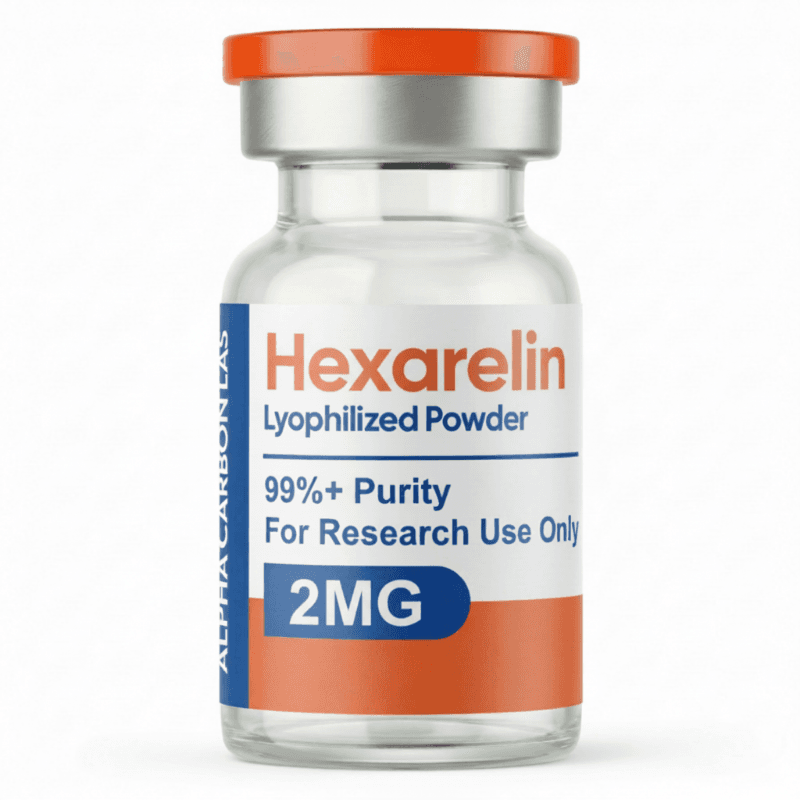
This product is for research purposes only. Not for human consumption.
Purity: >98% (HPLC verified)
Formulation: Lyophilized powder
Molecular Formula: C47H58N12O6
Molecular Weight: 887 g/mol
CAS Number: 140703-51-1
PubChem CID: N/A
Research Contents
Hexarelin
Overview
Hexarelin is a synthetic hexapeptide growth hormone secretagogue (GHS) that stands out within the GHRP family not only for its exceptionally potent growth hormone-releasing properties but also for its unique cardiovascular and cardioprotective effects that are independent of growth hormone elevation.
Development and Potency
Developed in the 1990s as part of systematic structure-activity relationship studies building on earlier GHRPs, hexarelin was specifically designed to maximize GH secretagogue potency while minimizing certain unwanted effects seen with first-generation GHRPs. Among the commonly studied GHRPs including GHRP-6, GHRP-2, and ipamorelin, hexarelin is recognized as one of the most potent in terms of the magnitude of GH release it can elicit per unit dose.
Unique Cardiovascular Properties
What truly distinguishes hexarelin from other GH secretagogues is the discovery that it possesses significant cardiovascular and cardioprotective actions that occur through mechanisms independent of the growth hormone secretagogue receptor (GHS-R1a) and independent of GH elevation. This was a surprising finding that emerged from research showing hexarelin produced cardiac effects in animal models even when GH secretion was blocked or in tissues that don't express GHS-R1a.
Subsequent research identified that hexarelin binds to CD36 (also known as scavenger receptor B2), a transmembrane glycoprotein expressed abundantly on cardiomyocytes, endothelial cells, platelets, macrophages, adipocytes, and skeletal muscle cells. CD36 activation by hexarelin appears to mediate protective signaling in cardiac tissue.
Cardioprotective Effects
Studies have demonstrated that hexarelin can improve cardiac contractility, protect against ischemia-reperfusion injury, reduce myocardial infarct size, attenuate cardiac fibrosis and remodeling, improve endothelial function and vascular reactivity, and potentially provide neuroprotective effects. This constellation of benefits has generated significant research interest in hexarelin as not just a GH secretagogue but as a potential cardiovascular therapeutic agent.
Mechanism of Action
Hexarelin exerts its biological effects through two primary receptor targets with distinct signaling mechanisms and tissue distributions.
GHS-R1a Receptor Activation
The first and most studied mechanism involves high-affinity binding to the growth hormone secretagogue receptor type 1a (GHS-R1a), the Gq-coupled GPCR that serves as the receptor for the endogenous hunger hormone ghrelin. Hexarelin binds to GHS-R1a expressed on pituitary somatotroph cells with very high affinity, triggering activation of Gq proteins, phospholipase C, generation of IP3 and DAG second messengers, mobilization of intracellular calcium from endoplasmic reticulum stores, and ultimately calcium-triggered exocytosis of growth hormone from secretory granules.
This mechanism is shared with other GHRPs but hexarelin appears to be particularly efficacious in producing robust GH release. Studies have shown that hexarelin produces dose-dependent GH secretion with a steep dose-response curve, generating peak GH levels within 15-30 minutes after administration that can reach 10-50 times baseline depending on dose and individual responsiveness.
Pituitary and Hypothalamic Effects
Like other GHRPs, hexarelin likely acts at both pituitary and hypothalamic levels, directly stimulating somatotrophs while also suppressing somatostatin release to remove the tonic inhibition of GH secretion. The GH released in response to hexarelin then circulates to peripheral tissues where it binds growth hormone receptors and stimulates IGF-1 production, primarily in the liver but also locally in various tissues, mediating the anabolic, lipolytic, and metabolic effects associated with GH-IGF-1 axis activation.
CD36 Receptor and Cardioprotection
The second mechanism, which distinguishes hexarelin from most other GH secretagogues, involves binding to CD36 (cluster of differentiation 36), a class B scavenger receptor that is abundantly expressed on cardiomyocytes, vascular endothelial cells, skeletal muscle cells, adipocytes, platelets, and macrophages.
CD36 is a multifunctional receptor involved in fatty acid uptake and transport, recognition and uptake of oxidized low-density lipoproteins, cellular signaling, inflammation, angiogenesis, and tissue repair. Hexarelin's interaction with CD36 activates intracellular signaling pathways including MAPK cascades, PI3K/Akt pathways, and potentially modulation of calcium handling and mitochondrial function in cardiomyocytes.
Cardiovascular Benefits
These CD36-mediated effects appear to underlie hexarelin's cardioprotective properties, which have been demonstrated in numerous preclinical studies showing protection against ischemia-reperfusion injury, improved cardiac contractility and function, reduced oxidative stress in cardiac tissue, anti-apoptotic effects on cardiomyocytes, attenuation of pathological cardiac remodeling and fibrosis following injury, improved endothelial function and vasodilation, and potential anti-inflammatory effects.
Importantly, these cardiovascular benefits occur even in animal models where GH secretion is blocked or suppressed, and they occur at doses similar to those that stimulate GH release, indicating that CD36-mediated effects contribute meaningfully to hexarelin's overall biological profile and are not merely secondary consequences of GH elevation.
Research Findings
The research literature on hexarelin encompasses both its growth hormone secretagogue properties and its unique cardiovascular effects, with extensive preclinical studies and more limited but informative human clinical research.
Early GH Secretagogue Studies
Early GH secretagogue research in the 1990s established hexarelin as one of the most potent synthetic GHRPs, with dose-finding studies in humans showing that subcutaneous or intravenous doses as low as 0.5-2.0 mcg/kg body weight produce robust GH release, with higher doses (up to 2 mcg/kg or more) eliciting peak GH levels of 20-60 ng/mL or higher - substantially exceeding normal physiological GH peaks.
Comparative studies against GHRP-6, GHRP-2, and GHRH showed that hexarelin produces GH responses equal to or exceeding those of other GHRPs. Studies examining cortisol and prolactin responses found that hexarelin produces minimal or no elevation of these hormones at GH-stimulating doses, representing an advantage over GHRP-6 and GHRP-2 which cause moderate cortisol and prolactin increases.
Aging and Desensitization Research
Research in aging populations demonstrated that hexarelin can restore GH secretory capacity in elderly individuals, with older adults achieving GH peaks comparable to younger subjects. However, a notable finding that has limited hexarelin's clinical development is that chronic daily administration leads to progressive desensitization of the GH response, with diminishing GH peaks over days to weeks of repeated dosing.
This desensitization appears to involve downregulation or desensitization of GHS-R1a receptors and is more pronounced with hexarelin than with some other GHRPs. Intermittent dosing protocols (allowing recovery periods between doses) can partially mitigate desensitization.
Cardiovascular Research
The cardiovascular research on hexarelin has been particularly compelling. Preclinical studies in animal models of myocardial infarction have consistently shown that hexarelin administration (before, during, or after ischemic events) reduces infarct size, preserves left ventricular function, reduces cardiac remodeling and fibrosis, and improves survival - effects that persist even when GH secretion is blocked.
Studies in heart failure models have shown that chronic hexarelin treatment improves cardiac contractility, increases ejection fraction, reduces pulmonary congestion, and improves exercise capacity. Research into mechanisms identified CD36 as the cardiac receptor mediating these effects.
Human Cardiovascular Studies
Small human studies have explored hexarelin's cardiovascular effects, with some showing improvements in left ventricular function in patients with cardiac dysfunction and improvements in endothelial function measured by flow-mediated dilation. Studies in GH-deficient patients have examined hexarelin as potential therapy for stimulating endogenous GH production, showing efficacy but with concerns about desensitization limiting long-term use.
Research Applications
- Growth hormone secretagogue research
- Cardiovascular protection and cardiology research
- Ischemia-reperfusion injury studies
- Heart failure and cardiac function research
- CD36 receptor biology and signaling studies
- Endothelial function and vascular health research
- Myocardial infarction protection studies
- Neuroprotection research
- Body composition and metabolic studies
- GH secretagogue receptor desensitization research
Safety Profile
Hexarelin has been administered to humans in clinical research studies with generally acceptable acute safety and tolerability profiles at GH-stimulating doses.
Hormonal Advantages
Compared to GHRP-6 and GHRP-2, hexarelin shows significantly less impact on cortisol and prolactin secretion, which is advantageous as it avoids the potential negative effects of repeated cortisol elevation. Appetite stimulation is present but typically less pronounced than with GHRP-6.
Common Side Effects
Common side effects in clinical studies have included mild injection site reactions, transient facial flushing or warmth, and mild headache in some subjects. Water retention and mild edema have been reported, reflecting GH's effects on sodium and fluid balance.
Desensitization Limitation
The desensitization phenomenon represents a significant limitation for chronic use - the progressive decline in GH response with daily administration means that therapeutic strategies requiring sustained GH elevation may not be achievable with hexarelin, though intermittent protocols may maintain responsiveness.
Scientific References
Customer Reviews
No reviews yet. Be the first to review this product!
Please sign in to write a review.
Research Use Only
This product is intended for research purposes only and is not for human consumption, therapeutic use, or diagnostic applications. Please ensure compliance with all applicable regulations and institutional guidelines.