Metabolic Cofactors and Telomere Biology
Nicotinamide adenine dinucleotide in its oxidized form, NAD+, participates in redox reactions and serves as a substrate for enzymes involved in chromatin regulation and DNA-damage responses. Its relationship to telomere biology is a laboratory research question: how do changes in cellular metabolism intersect with chromosome-end maintenance and replicative senescence?
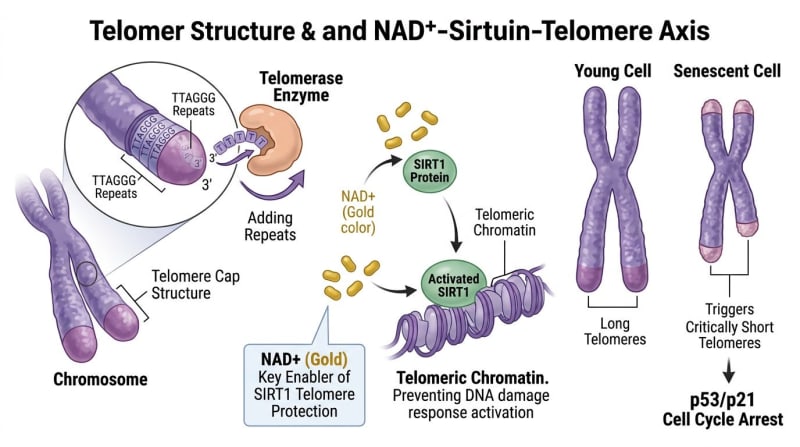
Human telomeres contain repetitive TTAGGG sequences and associated proteins, including the shelterin complex. Telomeres distinguish chromosome ends from DNA breaks. Replication-associated shortening can contribute to senescence in proliferating cells, but telomere length is not a complete measure of telomere function. Chromatin organization, replication stress, and chromosome-end protection are also relevant. Senescence can arise through mechanisms other than telomere shortening.
This article separates evidence about NAD+-dependent enzymes from evidence about telomere endpoints. The NAD+ catalog entry identifies a research material; the publications discussed below do not establish the properties or experimental performance of material supplied by Alpha Carbon Labs.
NAD+-Dependent Enzymes: Mechanism and Interpretation
SIRT1 and SIRT6 are NAD+-dependent enzymes with roles in chromatin regulation. NAD+ dependence does not mean that total cellular NAD+ is always the rate-limiting determinant of their activity. Enzyme abundance, substrate availability, compartmentalization, and other regulatory factors also matter. The reviews by Imai and Guarente [3] and Covarrubias et al. [4] provide context across cellular and animal research rather than reporting a single telomere experiment or a standardized NAD+ exposure.
SIRT1 and Telomere Maintenance
Palacios et al. [5], using mouse models and mouse-derived cells, investigated SIRT1 in telomere maintenance and homologous recombination. These genetic-model findings support studying SIRT1 in chromosome biology. They do not establish that adding NAD+ to a culture reproduces SIRT1 overexpression or that any particular NAD+ reagent changes telomere length.
SIRT6 and Telomere Position Effect
Tennen et al. [7] examined telomere position effect in cultured human cells and reported that SIRT6 was required for its maintenance. Telomere position effect concerns the influence of telomeric chromatin on nearby gene expression; it is not synonymous with telomere elongation. These are in-vitro findings from human cells, not findings from administration to human participants. SIRT6 deficiency should not be treated as equivalent to NAD+ depletion.
Telomere Dysfunction and Sirtuin Repression
Amano et al. [1] investigated telomere dysfunction and sirtuin repression in telomere-dysfunctional mouse models. This animal-model work provides a basis for examining interactions between telomere status and metabolic regulation. It does not establish a universal sequence in which reduced NAD+ causes telomere shortening, or in which extracellular NAD+ reverses replicative senescence in cultured cells.
PARP Activity and NAD+ Consumption
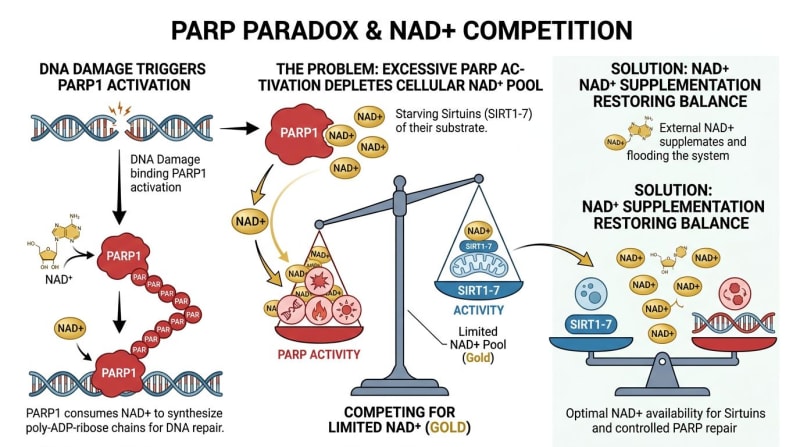
Poly(ADP-ribose) polymerases, including PARP1, use NAD+ in ADP-ribosylation reactions associated with DNA-damage signaling. Sharing a substrate with sirtuins creates a biochemical basis for investigating interactions between these pathways. It does not establish that they compete to the same extent under all experimental conditions.
An experiment linking DNA damage, PARP activity, NAD+ availability, and telomere dysfunction needs measurements of those variables. A change in total NAD+ alone cannot establish altered sirtuin activity or telomere protection. Likewise, a DNA-damage signal should not be described as telomeric unless its localization is demonstrated.
Distinguishing Telomere and Senescence Endpoints
Laboratory studies should distinguish changes in telomere length from changes in telomeric damage, chromatin state, proliferation, and senescence-associated markers. These endpoints can be related without being interchangeable.
| Measurement | Research question | Limitation |
|---|---|---|
| Quantitative fluorescence in situ hybridization (Q-FISH) | Does telomeric fluorescence differ between experimental conditions? | Calibration, acquisition settings, and cell-cycle context affect interpretation; fluorescence alone does not establish chromosome-end protection. |
| Telomere-associated DNA-damage foci | Do damage-response markers colocalize with telomeres? | Colocalization requires defined imaging and scoring criteria and does not itself measure telomere length. |
| Telomerase activity | Is enzymatic activity detectable or altered? | A change in activity does not by itself demonstrate sustained telomere elongation. |
| Population doublings and senescence-associated markers | Does proliferative behavior change alongside a senescence-associated phenotype? | No single marker establishes senescence or its reversal; altered survival or selection can affect population-level results. |
| NAD+ and pathway-specific measurements | Does the perturbation alter the cofactor pool and the proposed enzyme pathway? | Total cellular NAD+ does not resolve all subcellular pools or identify the mechanism responsible for a phenotype. |
Useful design variables include cell identity, passage history, baseline telomerase status, culture conditions, exposure duration, and independent biological replicates. Appropriate controls should distinguish effects on viability and proliferation from telomere-specific changes. Genetic manipulation of a sirtuin, altered NAD+ biosynthesis, and extracellular NAD+ exposure are different experimental interventions and should not be presented as equivalent.
Epithalon: A Separate In-Vitro Observation
Epithalon is the synthetic tetrapeptide Ala-Glu-Asp-Gly. Khavinson et al. [6] reported telomerase activity and telomere elongation in cultured human somatic cells exposed to Epithalon. This was an in-vitro observation, not a study of use in human participants. It does not establish a universal mechanism across cell types, a comparison with NAD+, or synergy between the two materials.
The Epithalon catalog entry is provided for material identification. The cited study does not verify the activity of Alpha Carbon Labs material. Claims about combinations with SS-31, MOTS-c, GHK-Cu, BPC-157, or FOXO4-DRI are not supported by the supplied references and are not part of this evidence summary.
Reagent Characterization and Laboratory Handling
Experimental interpretation requires documented reagent identity, lot information, storage history, and analytical methods. For NAD+, the oxidized and reduced forms should not be conflated. Degradation and impurities can complicate experiments; nicotinamide, for example, can inhibit sirtuin reactions. The possibility of interference is a reason to assess reagent composition, not evidence that a particular lot contains an interfering amount.
For peptide materials, sequence identity, counterion content, and residual synthesis-related impurities are relevant variables. Counterions should not be assumed absent or uniformly cytotoxic. Their contribution depends on the material and assay conditions.
Review available quality control documentation, lot-specific certificates of analysis, and, where relevant, peptide synthesis information. Chromatographic purity and liquid chromatography–mass spectrometry results address different analytical questions. Neither alone establishes biological activity or suitability for every assay. Consult the applicable safety data sheet and institutional procedures for handling, protective equipment, storage, and disposal; a research-only designation is not a hazard assessment.
References
- Amano, H., et al. (2019). Telomere Dysfunction Induces Sirtuin Repression that Drives Telomere-Dependent Disease. Cell Metabolism, 29(6), 1274-1290. — https://doi.org/10.1016/j.cmet.2019.03.001
- Sahin, E., & Depinho, R. A. (2010). Linking functional decline of telomeres, mitochondria and stem cells during ageing. Nature, 464, 520–528. — https://doi.org/10.1038/nature08982
- Imai, S., & Guarente, L. (2014). NAD+ and sirtuins in aging and disease. Trends in Cell Biology, 24(8), 464-471. — https://doi.org/10.1016/j.tcb.2014.04.002
- Covarrubias, A. J., et al. (2021). NAD+ metabolism and its roles in cellular processes during ageing. Nature Reviews Molecular Cell Biology, 22, 119–141. — https://doi.org/10.1038/s41580-020-00313-x
- Palacios, J. A., et al. (2010). SIRT1 contributes to telomere maintenance and augments global homologous recombination. Journal of Cell Biology, 191(7), 1299–1313. — https://doi.org/10.1083/jcb.201005160
- Khavinson, V. K., et al. (2003). Epithalon peptide induces telomerase activity and telomere elongation in human somatic cells. Bulletin of Experimental Biology and Medicine, 135(6), 590-592. — https://pubmed.ncbi.nlm.nih.gov/12937682/
- Tennen, R. I., et al. (2011). SIRT6 is required for maintenance of telomere position effect in human cells. Nature Communications, 2, 433. — https://doi.org/10.1038/ncomms1443
- Fang, E. F., et al. (2016). NAD+ Replenishment Improves Lifespan and Healthspan in Ataxia Telangiectasia Models via Mitophagy and DNA Repair. Cell Metabolism, 24(4), 566-581. — https://doi.org/10.1016/j.cmet.2016.09.004
Limitations
Published findings are model-specific and do not establish the safety, effectiveness, approval, or suitability of material sold by Alpha Carbon Labs for human or veterinary use. These materials are intended solely for nonclinical laboratory research.