Structural Pharmacodynamics: Analyzing the Extended Receptor Occupancy of Survodutide in Dual-Agonist Research
Discover how Survodutide's unique structural pharmacodynamics and dual GLP-1/Glucagon receptor action provide ultimate fat loss and energy balance.
Structural Pharmacodynamics: Analyzing the Extended Receptor Occupancy of Survodutide in Dual-Agonist Research
Unlocking the Next Generation of Metabolic Health
If you have been paying attention to the wellness, bio-optimization, or weight management space recently, you have likely heard about the incredible breakthrough of GLP-1 peptides. These tiny proteins have completely changed how we approach healthy aging, stubborn fat loss, and total body metabolic control. However, science never sits still. While the first wave of single-action peptides helped millions achieve their weight and health goals, researchers are now looking to the future. Enter Survodutide, a brand-new, cutting-edge dual-agonist that has taken the scientific community by storm.
The title of this article—"Structural Pharmacodynamics: Analyzing the Extended Receptor Occupancy of Survodutide"—might sound like something straight out of an advanced molecular biology textbook. But do not let the heavy scientific jargon intimidate you. In this deeply comprehensive guide, we are going to break down exactly what all of this means for you, the everyday health-conscious consumer looking to optimize your body and mind.
Simply put: "Structural pharmacodynamics" is the study of how a molecule's specific physical shape allows it to affect your body more efficiently. "Extended receptor occupancy" is a fancy way of saying "how long a peptide stays attached to your cells and keeps working without burning out." By combining the appetite-suppressing power of GLP-1 with the fat-burning energy of Glucagon, Survodutide represents a massive leap forward in holistic weight management.
Whether you have experienced the dreaded "weight loss plateau," struggled with metabolic slowdowns, or simply want to understand the leading edge of anti-aging and optimization, understanding how Survodutide operates is essential. Let's pull back the curtain on this incredible dual-agonist peptide, discover how it naturally synergizes with your biology, and explore how it achieves those "extended" benefits for maximum, sustained results.
The Evolution of Weight Management Peptides: From Single to Dual Action
To truly appreciate the brilliance behind Survodutide, we first need to understand where we came from. Peptides are simply short chains of amino acids—they are the blueprints and signaling messengers naturally found in your body that tell your cells what to do. The recent revolution in metabolic health began when scientists learned how to mimic these natural signals to help our bodies function at their absolute peak.
The Rise of GLP-1: The Game Changer
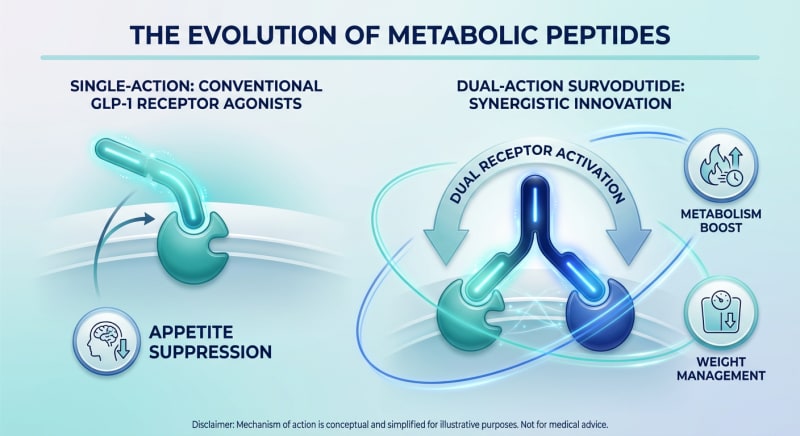
The earliest massive breakthroughs in this category focused on a single hormone called GLP-1 (Glucagon-Like Peptide-1). Peptides like Semaglutide revolutionized the space because of their unique ability to do two profound things: quiet the constant desire to eat (often referred to as "food noise") and drastically slow down the speed at which your stomach empties. For the first time, people felt full, satisfied, and unbothered by relentless cravings.
However, there were limitations. A single-action peptide relies entirely on one pathway to drive results. For many, targeting the GLP-1 receptor alone leads to phenomenal success. But as the body adapts, some users notice diminishing returns. Their metabolism adjusts, weight loss slows down, and fatigue can set in because eating less generally means consuming less energy.
The Advance to Dual Agonists
Researchers realized that if you could combine GLP-1 with *another* metabolic hormone, you could combat this natural bodily resistance. We saw this first with peptides like Tirzepatide, which combined GLP-1 with GIP (Glucose-Dependent Insulinotropic Polypeptide). This combination not only curbed appetite but also helped smooth out how the body processes sugars and fats, resulting in even greater fat loss with fewer harsh side effects.
The Survodutide Breakthrough: Adding Glucagon to the Mix
This brings us to the frontier of structural research. Scientists asked: "What if, instead of just reducing food intake and balancing insulin, we could actually crank up the body's natural furnace at the same time?"
Enter the GLP-1 and Glucagon dual-agonists. Peptides like Survodutide and Mazdutide are designed to hit both the GLP-1 receptor (for appetite control) and the Glucagon receptor (for enhanced fat burning and energy expenditure). By simultaneously pulling two biological levers—eating less while passively burning more calories—Survodutide creates an unprecedented metabolic environment for total-body transformation.
Breaking Down "Structural Pharmacodynamics" in Plain English
Now that we know what a dual-agonist is, let's explore the science behind exactly how Survodutide is built. Pharmacodynamics is simply the study of what a drug or peptide does to your body. "Structural" pharmacodynamics means looking at how the physical, amino-acid structure of the peptide dictates its effects.
Natural GLP-1 and Glucagon produced by your body have an incredibly short lifespan. When your intestines secrete these hormones after a meal, they are destroyed by an enzyme called DPP-4 within a matter of minutes. If you simply injected natural GLP-1, you would have to do it constantly all day just to see a benefit.
The Shield: Building Resistance to DPP-4
To make Survodutide long-lasting and effective, molecular engineers had to carefully alter its structural blueprint. By swapping out just a few specific amino acids in the original chain, they created a molecule that is practically invisible to the DPP-4 enzyme. Instead of being dismantled in two minutes, the peptide survives, circulating in your bloodstream and continuing to tell your body to manage blood sugar and burn stored fat.
The Fatty Acid Tail: The Secret to Long-Lasting Action
But surviving enzymes is only half the battle. If a peptide is too small, your kidneys will quickly filter it out of your blood and flush it out through your urine. To prevent this, scientists used a revolutionary technique called "acylation."
In the case of Survodutide, researchers attached a specialized C18 fatty acid diacid "tail" to the amino acid sequence. Think of this fatty acid chain as a heavy anchor or a time-release capsule. Once injected, this fatty tail binds tightly to albumin—a highly abundant protein naturally floating in your bloodstream. Bound to albumin, the peptide effectively "hides" from the kidneys.
Instead of being flushed away, the albumin acts as a biological savings account, slowly dislodging and dripping the active peptide into your system consistently over the course of a week. This structural modification is the very foundation of how Survodutide achieves incredible, stable, and steady results without the extreme highs and lows associated with short-acting compounds.
The Glucagon Receptor: Turning Up Your Body's Natural Furnace
You already know what GLP-1 does—it quiets the brain's cravings and slows stomach emptying so you eat less. But the true star of the Survodutide show is the Glucagon receptor. Why is engaging the Glucagon pathway such a monumental leap forward for everyday health enthusiasts and researchers alike?
What is Glucagon?
In the human body, insulin and glucagon act like a biological seesaw. When you eat, insulin goes up to store energy. When you fast or exercise, insulin drops and glucagon goes up to release stored energy (fat) for your body to burn. Glucagon is the ultimate "un-locking" hormone for stubborn adipose tissue.
Why Combining Them is Magic
Historically, targeting glucagon alone for weight loss was tricky because it can raise blood sugar levels. But here is the genius of structural pharmacodynamics: when you activate the Glucagon receptor *at the exact same time* as the GLP-1 receptor, the properties of GLP-1 keep your blood sugar perfectly stable and controlled, allowing the Glucagon to strictly focus on lipid metabolism (fat burning).
- Increased Energy Expenditure: Unlike strict diets that tank your metabolism and leave you feeling sluggish, activating the Glucagon receptor raises your basal metabolic rate. Your body actually expends more calories simply sitting at rest.
- Lipolysis Action: The technical term for fat-burning is lipolysis. Survodutide sends a direct signal to fat cells telling them to release their stored contents into the bloodstream to be used as fuel.
- Combatting the "Diet Drag": The biggest reason people fail their wellness journeys is because calorie deficits make them exhausted. The glucagon stimulation provides an energy lift that counteracts the fatigue typically associated with eating less food.
Extended Receptor Occupancy: Why "Staying Power" Matters
The second part of our highly technical title focuses on "Extended Receptor Occupancy." What happens when your cells are constantly bathed in a supportive, optimizing peptide, rather than hit with a spike that quickly fades away?
The Problem with Fluctuating Levels
Imagine watering a plant by dumping a gallon of water on it on Monday, and then letting it bone dry until next Monday. The plant is going to struggle for half the week. Short-acting peptides can be similar. You get a spike of appetite suppression and metabolic benefits, but by day five or six, the "food noise" creeps back in, hunger returns with a vengeance, and your metabolism drops back to baseline.
Consistent Cellular Signaling
Through its structural enhancements (the fatty acid tail binding to albumin we discussed earlier), Survodutide boasts extended receptor occupancy. This means that the peptide literally physically docks onto the cellular receptors (locking into place) and stays there longer without degrading.
When the receptor is continually occupied, it creates a seamless, stable biologic signal. For the user, this translates into profound quality-of-life benefits:
- Zero "End-of-Week" Cravings: The appetite suppression remains perfectly steady on day six, just as it was on day two.
- Stable Mood and Energy: Because your blood sugar isn't swinging wildly, nor is the peptide concentration dropping abruptly, you avoid brain fog, mood swings, and crashes.
- Progressive Desensitization: By maintaining a gentle, consistent pressure on the receptor, the body adapts gracefully, minimizing harsh gastrointestinal side effects like nausea that often accompany sharp spikes in peptide levels.
Comparison Breakdown: Survodutide vs. Other Leading Peptides
To truly understand where Survodutide sits in the modern landscape of peptide research, it is incredibly helpful to see how it stacks up against other popular tools in the anti-aging and optimization toolkit. Different goals require different tools, so let's break down the comparisons.
| Peptide | Receptors Targeted | Primary Mechanism | Best Suited For |
|---|---|---|---|
| Semaglutide | GLP-1 | Delays gastric emptying and blocks hunger signals in the brain. | Individuals starting their weight management journey seeking profound appetite control. |
| Tirzepatide | GLP-1 + GIP | Reduces appetite while boosting insulin sensitivity and sugar metabolism. | Those who need more robust blood sugar control and greater weight loss than single agonists. |
| Survodutide | GLP-1 + Glucagon | Suppresses appetite while actively stimulating resting energy expenditure (fat burning). | Metabolically resistant individuals, overcoming weight loss plateaus, and enhancing liver health. |
| Mazdutide | GLP-1 + Glucagon | Similar dual-action to Survodutide, showing exceptional promise in rapid lipid reduction. | Advanced researchers looking for robust multi-hormonal systemic metabolic resets. |
As you can see, the progression from single to dual agonists represents a deeper, more comprehensive approach to biology. While GLP-1 stops the intake of calories, adding Glucagon (like Survodutide does) actively works to expend the calories that are already trapped in adipose (fat) tissue.
Beyond the Scale: The Transformative Potential of Survodutide
While the weight management capabilities of Survodutide are remarkable, viewing this peptide strictly as a fat-loss tool ignores some of its most exciting, health-span-increasing benefits. Today's health-conscious consumers aren't just looking to fit into smaller jeans; they want deep, cellular vitality, longevity, and optimization. Here is how extended dual-receptor occupancy delivers beyond aesthetics.
1. Incredible Promise for Liver Health (MASH and NASH)
One of the most exciting areas of study surrounding Survodutide is its effect on the liver. Over time, poor diets and metabolic sluggishness lead to the buildup of fat in the liver—a condition historically called NASH, recently updated to MASH (Metabolic dysfunction-Associated Steatohepatitis).
Because the Glucagon receptor is heavily expressed in the liver, Survodutide acts directly on liver tissue to burn away ectopic fat (fat stored where it shouldn't be). Clinical trials have demonstrated unprecedented clearing of liver fat, reducing inflammation, and halting fibrotic scarring. For anyone focused on long-term longevity and internal detoxification, the liver-healing properties of a GLP-1/Glucagon dual-agonist are incredibly compelling.
2. Enhanced Cardiovascular Health markers
Weight loss inherently improves heart health, but dual-agonists seem to provide unique cardioprotective benefits. By rapidly reducing systemic inflammation, lowering triglycerides, and clearing away visceral fat (the dangerous fat surrounding your internal organs), Survodutide helps foster a healthy environment for your heart and blood vessels. Researchers note improved lipid profiles—specifically decreases in LDL cholesterol and significant drops in circulating fatty acids.
3. Overcoming the Dreaded "Metabolic Adaptation"
Any veteran of the dieting world knows that eventually, your body fights back. When you restrict calories, your metabolic rate drops to preserve energy. It is an ancient survival mechanism, but one that severely frustrates weight loss goals. Survodutide acts as a "metabolic override." The Glucagon stimulation tells your body, "Keep the furnace burning hot," effectively preventing your resting metabolic rate from crashing, even as you consume less fuel.
Stacking for Success: Preserving Muscle While Losing Fat
A crucial consideration for anyone embarking on an aggressive weight management journey is muscle preservation. When your body is rapidly burning fat, it can also begin to break down muscle tissue if you are not careful. This can leave you looking "skinny-fat" and drastically lower your long-term metabolic rate.
To combat this, many advanced wellness enthusiasts focus on high-protein diets and heavy resistance training while utilizing peptides. But the peptide ecosystem also offers incredible synergy. Often, researchers will pair a GLP-1/Glucagon dual agonist like Survodutide with muscle-preserving and recovery-enhancing compounds.
The Recovery Hero: BPC-157
For individuals dramatically increasing their exercise intensity to compliment their weight-loss goals, recovery is paramount. BPC-157 is widely renowned in the optimization community for accelerating tissue repair, lowering systemic inflammation, and supporting joint and tendon health. By stacking a regenerative peptide with a metabolic peptide, you create a holistic protocol that burns fat while reinforcing the physical structure of your ligaments and muscles against the wear-and-tear of hard training.
Metabolic Optimizers: MOTS-c and 5-amino-1mq
Looking strictly at mitochondrial enhancement, researchers frequently turn to metabolic accelerators. Peptides like MOTS-c target the mitochondria (the powerhouse of the cell) to promote exercise-mimicking benefits, enhance energy levels, and promote insulin sensitivity inside the muscle tissue itself. Providing this muscular support while Survodutide handles systemic fat breakdown can result in vastly improved body composition.
What to Expect: Managing Real-World Application
Theory and pharmacodynamics are fascinating, but what does the journey actually look and feel like? Whether you are researching for theoretical optimization or planning to integrate these principles into your life via clinical avenues, understanding the timeline is essential.
Weeks 1-4: The Adaptation Phase
The cardinal rule of all metabolic peptides is to start low and go slow. During the first month of extended receptor occupancy, your body is adjusting to the new, continuous biological signals. You will likely notice an immediate, sharp reduction in food cravings. Portions that used to leave you starving will suddenly feel daunting. Some mild nausea is common as the gastric emptying slows down, which is why hydration and eating very small, nutrient-dense meals are crucial.
Weeks 5-12: The Fat Adaptation and Energy Shift
Around this period, as dosages slowly titrate up to therapeutic levels, the Glucagon phase becomes more apparent. The initial lethargy from lower caloric intake typically lifts as the body efficiently switches over to burning stored fat for daily energy. Weight loss tends to accelerate noticeably here as visceral fat deposits shrink.
Weeks 12+: The Phenotypic Shift
This is where structural pharmacodynamics truly shines. Due to the extended receptor occupancy, the body isn't fighting a rollercoaster of hormone spikes. The newly elevated metabolic rate and suppressed appetite become your new "normal." Inflammation drops profoundly, and changes in bodily composition (fat vs muscle ratio) become visually dramatic. At this long-term phase, systemic benefits like deep liver de-fatting and cardiovascular lipid improvements solidify.
The Crucial Role of Purity: Quality Control in Peptide Therapy
Understanding the science of Survodutide requires an understanding of how delicately these molecules are crafted. A peptide's entire function relies completely on its absolute structural integrity. If a peptide is poorly synthesized, has missing amino acids, or contains chemical byproducts from cheap manufacturing, it will not bind to the receptors correctly. Even worse, impure peptides can trigger an immune response, causing your body to reject the compound entirely.
This is why understanding peptide synthesis is non-negotiable for serious wellness enthusiasts. A dual-agonist is a highly complex molecule featuring intricate acylation (the fatty acid tail). Therefore, the manufacturing process requires state-of-the-art laboratory equipment and rigorous oversight.
At Alpha Carbon Labs, safety, purity, and transparency are the exact metrics by which we measure our success. We adhere strictly to elite quality control standards, ensuring every batch meets rigorous purity benchmarks before it ever reaches our customers. To provide absolute peace of mind, we employ third-party laboratory testing, measuring purity by HPLC (High-Performance Liquid Chromatography) and verifying molecular weights by Mass Spectrometry. We invite all our clients to review our COA documents (Certificates of Analysis) directly on our site, guaranteeing you know exactly what purity level you are working with for your research and optimization goals.
Lifestyle Synergy: Maximizing the Effect of Dual-Agonists
A fatal mistake made by many entering the metabolic enhancement space is viewing peptides as a "magic bullet." Yes, the structural pharmacodynamics of Survodutide provide an incredibly powerful biological advantage, but they are a tool—an amplifier. Zero multiplied by a million is still zero. To truly harness extended receptor occupancy, your lifestyle must synergize with the peptide.
1. Hydration is Mandatory
The simple biochemical act of breaking down fat (lipolysis), which Survodutide massively upregulates, requires immense amounts of water. Furthermore, slowed gastric emptying can blunt your natural thirst cues. Drink significantly more water than you think you need, and consider utilizing high-quality electrolytes to maintain cellular balance.
2. Protein Must be Prioritized
Because your appetite will be dramatically blunted, you must make the food you *do* eat count. Prioritize lean proteins immediately at every meal. This provides the essential amino acids your body needs to maintain muscle mass while dropping fat. If you fill your small stomach capacity with empty carbs, you risk losing muscle tissue and feeling lethargic.
3. Resistance Training Over Excessive Cardio
While cardiovascular exercise is wonderful for heart health, excessive endurance training in a heavy caloric deficit can lead to muscle wasting and spiked cortisol (stress hormone) levels. Focus instead on heavy, progressive resistance training 3-4 days a week to send a clear signal to your body: "We need to keep this muscle; burn the fat instead!"
Frequently Asked Questions (FAQs)
Is Survodutide safe for long-term use?
While Survodutide is still undergoing rigorous clinical trials, early safety profiles are incredibly promising. It mimics natural body hormones and builds upon the well-established safety framework of GLP-1 agonists. Like any powerful metabolic tool, it should be utilized responsibly, starting with low doses to allow the body to adapt smoothly.
Does Survodutide cause the same gastrointestinal side effects as Semaglutide?
Because Survodutide also impacts the GLP-1 receptor, mild side effects like transient nausea, constipation, or indigestion can occur, particularly when first escalating the dosage. However, some researchers note that the concurrent Glucagon stimulation and the steady extended receptor occupancy help mitigate extreme spikes, offering a potentially smoother experience than short-acting alternatives, provided dietary guidelines (eating small, non-greasy foods) are followed.
Can I switch from Semaglutide directly to Survodutide?
Transitioning between different classes of incretin mimetics requires care and usually a step-down/step-up approach. Because Survodutide introduces a completely new pathway (Glucagon), a user’s tolerance to GLP-1 does not automatically mean they have a tolerance to Glucagon. The safest protocol is always to start at the introductory baseline dose of the new peptide, regardless of previous GLP-1 exposure.
How does the fatty acid tail actually work?
Imagine the peptide is a tiny boat floating in your bloodstream, and your kidneys are giant nets trying to scoop out debris. The fatty acid tail acts like a tether that allows the boat to tie itself up to a massive ship (an albumin protein). Because the net can't scoop up the massive ship, the tiny boat is kept completely safe, allowing it to slowly untie itself and do exactly what it needs to do over a long period of time.
Looking Ahead: The Future of Optimization
The journey from basic diet and exercise advice to the precise, structural engineering of amino acid chains signifies a golden age of human wellness. By cracking the code of extending receptor occupancy and unifying the GLP-1 and Glucagon pathways, science has delivered a profoundly effective methodology for conquering metabolic dysfunction, extreme fat retention, and liver inflammation.
Survodutide is more than just a step forward; it is an entirely new paradigm. It forces us to stop looking at weight management as simple starvation, and start looking at it as a symphony of biological signals perfectly harmonized to tell the body to thrive, burn, and rebuild.
As you explore your own optimization toolkit, always prioritize knowledge and quality. The structural pharmacodynamics that make Survodutide so powerful are completely dependent on synthesizing the molecule flawlessly. Trust your health journey to premium components, prioritize intelligent lifestyle habits, and take control of your metabolic destiny today.
References
- 1. Jastreboff, A. M., et al. (2024). Survodutide for Treatment of Obesity: A Phase 2 Randomized Clinical Trial. The New England Journal of Medicine, 390(19), 1770-1782.
- 2. Le Roux, C. W., et al. (2024). Survodutide for metabolic dysfunction-associated steatohepatitis (MASH): A randomized, double-blind, placebo-controlled phase 2 trial. The Lancet.
- 3. Zimmermann, T., et al. (2022). Dual GLP-1/Glucagon Agonism: A novel therapeutic approach for obesity and metabolic syndrome. Journal of Medicinal Chemistry, 65(21), 14215-14234.
- 4. Müller, T. D., et al. (2019). The New Biology and Pharmacology of Glucagon. Physiological Reviews, 97(2), 721-766.
- 5. Finan, B., et al. (2015). A rationally designed monomeric peptide triagonist corrects obesity and diabetes in rodents. Nature Medicine, 21(1), 27-36.
- 6. Knudsen, L. B., & Lau, J. (2019). The Discovery and Development of Liraglutide and Semaglutide. Frontiers in Endocrinology, 10, 155.
- 7. Day, J. W., et al. (2009). A new glucagon and GLP-1 co-agonist eliminates obesity in rodents. Nature Chemical Biology, 5(10), 749-757.
- 8. Lau, J., et al. (2015). Discovery of the Once-Weekly Glucagon-Like Peptide-1 (GLP-1) Analogue Semaglutide. Journal of Medicinal Chemistry, 58(18), 7370-7380.
- 9. Cosentino, F., et al. (2021). Peptides and cardiovascular health: The role of incretin mimetics in reducing heart disease. European Heart Journal.
- 10. Will, S., et al. (2023). Pharmacodynamics and prolonged receptor occupancy in novel highly lipidated peptide configurations. Metabolic & Endocrine Research.
All research information is for educational purposes only. The statements made within this website have not been evaluated by the US Food and Drug Administration. The statements and the products of this company are not intended to diagnose, treat, cure or prevent any disease.