Peptide IU vs mg: Reading Activity-Based Labels
IU labels describe standardized biological activity, while mg labels describe mass. HCG and HMG examples show why applicable reference standards and product-specific activity records matter more than a universal conversion.
Peptide IU vs mg: Reading Activity-Based Labels
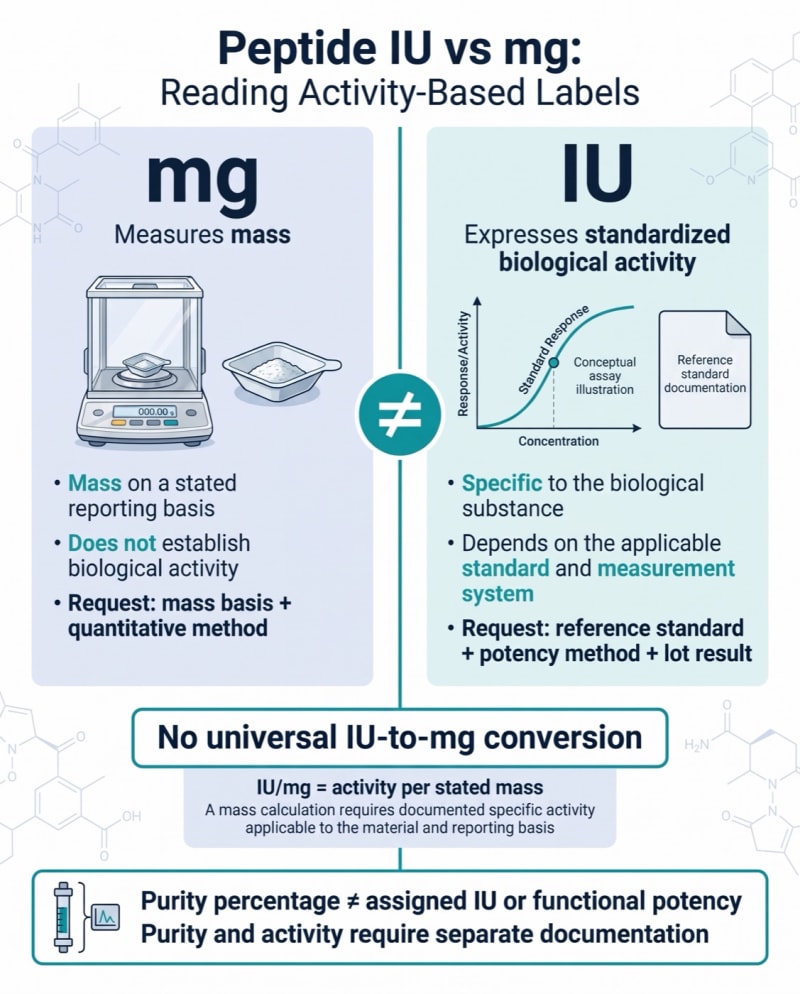
Some research reagents are labeled in International Units (IU) because their stated quantity represents standardized biological activity rather than mass. In the comparison of peptide IU vs mg, milligrams describe mass, while IU require an applicable reference standard and a defined measurement basis. HCG and HMG labels therefore cannot be translated into milligrams using a universal conversion: researchers need product-specific activity documentation and, where relevant, a documented specific activity.
What is the difference between IU and mg on a research label?
A milligram is a unit of mass; an International Unit expresses an assigned quantity of activity for a particular biological substance. An IU is not a fixed number of molecules or a universal amount of protein. Its meaning depends on the substance, the applicable standard, and the measurement system supporting the label.
HCG, or human chorionic gonadotropin, is a glycoprotein hormone—a protein bearing carbohydrate groups—used in gonadotropin-receptor research. HMG, or human menopausal gonadotropin, is a preparation characterized by follicle-stimulating hormone (FSH) and luteinizing hormone (LH) activities, rather than one chemically uniform short peptide.
Although both appear in research peptide catalogs, their activity-based quantities require a different reading from a simple mass declaration. Their receptor distinctions are covered separately in Comparing HMG, HCG, and Gonadorelin in Endocrine Research.
| Label or report term | What it describes | What it does not establish | Documentation to request |
|---|---|---|---|
| mg | Mass on a stated reporting basis | Biological activity or functional integrity | Mass basis and quantitative method |
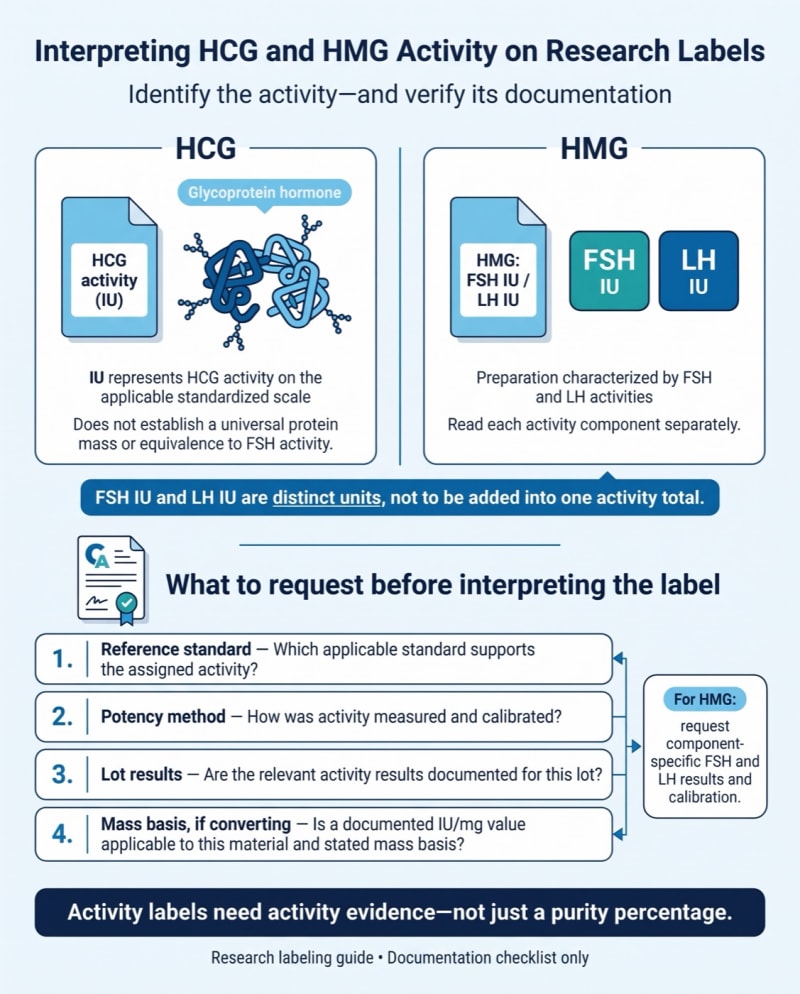
| IU of HCG | HCG activity on the applicable standardized scale | A universal protein mass or equivalence to FSH activity | Reference standard, potency method, and lot result |
| FSH IU and LH IU in HMG | Two separately identified activity components | A single total quantity of interchangeable activity | Component-specific activity results and calibration |
| IU/mg | Specific activity: activity per stated mass | A transferable conversion for every preparation | Activity method, mass basis, and applicability to the material |
| Purity percentage | A method-defined estimate of composition | Assigned IU or functional potency | Separate activity documentation |
- IU and mg answer different questions: activity versus mass.
- IU values are substance-specific, not a common currency across hormones.
- HMG requires attention to both FSH and LH activity declarations.
- A catalog quantity is not a substitute for a traceable lot-specific result.
Why are some research reagents labeled in IU instead of mg?
Activity-based labels allow a biological preparation to be described against a reference response when mass alone does not adequately describe function. For glycoprotein hormones, molecular composition and carbohydrate structure can affect measured activity. An IU label prioritizes a standardized activity quantity, but does not eliminate the need for identity and composition testing.
In an in-vitro comparison of human FSH glycoforms, Bousfield and colleagues reported greater activity for a less extensively glycosylated FSH preparation than for a fully glycosylated preparation in their assay systems. Glycoforms are versions of a protein that differ in attached carbohydrate groups; the study illustrates why protein identity and mass do not, by themselves, specify functional activity. [1]
The historical measurement system also matters. Steelman and Pohley developed an FSH bioassay using an ovarian response in rats with HCG augmentation. That animal-model endpoint illustrates the biological origins of gonadotropin potency measurements; it is not a claim that every current research lot has been evaluated using that assay. [2]
A standardized activity result therefore means activity under an identified measurement framework, not guaranteed behavior in every experimental model. Researchers should distinguish the assay used to assign a label value from the assay planned for their own scientific question.
How should researchers read an HCG catalog label?
Read an HCG IU declaration as a claim about HCG activity, then identify the standard and method supporting that claim. The catalog name does not establish the material's source, molecular composition, measured mass, or tested potency. Those details must come from the applicable specification and lot documentation.
For an HCG listing, the central documentation question is: which measurement supports the stated IU quantity for this material? A nominal catalog quantity, a manufacturing target, and an actual lot-specific potency result are distinct pieces of information.
In laboratory characterization work, Birken and colleagues prepared and characterized WHO reference reagents representing HCG and related molecular forms. Their work demonstrates why the exact molecular entity matters when evaluating a reference material; intact HCG, subunits, and related forms should not be treated as analytically identical. [3]
Sturgeon and colleagues compared diagnostic HCG immunoassays using WHO reference reagents and found differences in recognition of HCG-related forms. That analytical comparison concerns antibody-based measurement, not a potency test of Alpha Carbon Labs material. It supports asking whether a reported HCG value reflects immunoreactivity, functional activity, or another explicitly defined quantity. [4]
- Identify whether the reported result concerns intact HCG or another specified form.
- Check whether the method measures antibody recognition or a biological response.
- Request the applicable standard's identity and assigned quantity.
- Confirm that the report applies to the supplied lot, not merely a representative sample.
Why does HMG need separate FSH and LH activity information?
HMG is described through more than one biological activity, so a bare IU number can be incomplete without its component designation. FSH activity and LH activity belong to different measurement systems. They should be recorded separately, not added into a supposedly universal total or interpreted as equal masses of the two hormones.
When evaluating an HMG listing, request explicit statements of the FSH and LH activities associated with the catalog quantity. If only one number appears, the appropriate next step is clarification—not an assumption about which activity it represents or whether it applies equally to both.
Van de Weijer and colleagues used compositional analyses to characterize a particular urine-derived menotropin preparation and identify major impurities. Their analytical study shows why an activity-defined preparation also needs composition information; it does not establish the composition of another manufacturer's HMG or any Alpha Carbon Labs lot. [5]
In a comparative analytical study of human-derived and recombinant gonadotropin preparations, Wolfenson and colleagues examined batch-to-batch consistency. The relevant documentation lesson is that preparation identity and lot comparability are questions for evidence, not conclusions supplied by a shared product name or IU declaration. [6]
An LH-activity statement is also not, by itself, a measurement of LH protein mass. If the molecular contributors to that activity matter for an experiment, request supporting compositional information rather than inferring them from the activity label.
What makes a reference standard applicable to an IU claim?
An applicable reference standard must match the substance and quantity being measured and be suitable for the assay supporting the claim. The phrase “WHO standard” is insufficient on its own. Documentation should identify the preparation, its assigned units, its intended measurement purpose, and the calibration relationship to the tested material.
A reference standard is a characterized material used as a measurement comparator. A laboratory may use a working standard rather than the international preparation directly, but the records should explain how that working standard's assigned value is connected to the relevant higher-order standard.
In their collaborative reference-reagent study, Bristow and colleagues established and assigned values to six molecular forms of HCG. These reference reagents were characterized using substance-amount assignments, illustrating an important distinction: not every internationally recognized HCG reference reagent is an interchangeable IU-based biological potency standard. [7]
For an activity-label review, request:
- The standard's full name, identifier, and version or lot where applicable.
- The assigned quantity and unit, distinguishing biological activity from mass or substance amount.
- The assay method and endpoint for which the comparator is being used.
- The calibration history of any secondary or in-house working standard.
- Evidence that the method and standard are appropriate for the product matrix.
Traceability means a documented chain connecting a reported result to its reference. It does not mean that the research reagent itself is an official reference preparation, an approved medicine, or interchangeable with a pharmaceutical product.
Can IU be converted to mg using specific activity?
A relationship between activity and mass can be established when an applicable specific activity is documented for the material. Specific activity is activity per unit mass, often reported as IU/mg. It is a property of a defined preparation under specified measurement conditions—not a universal conversion attached to a hormone's name.
The mass denominator needs scrutiny. A reported IU/mg value might refer to a defined hormone fraction, total protein, or another stated material basis. A value without that definition cannot reliably connect an activity label to a mass claim.
Ingredient composition is a separate question addressed in Peptide Excipients: Are There Fillers in the Vial?; container volume is separately explained in Peptide Vial Capacity vs Mass. Neither resolves the activity-to-mass relationship.
Even a valid specific activity should not be transferred automatically between preparations, production sources, or assays. Without evidence that it applies to the supplied material, the defensible conclusion is that the mass corresponding to the stated IU has not been established.
Does the same IU value mean the same experimental response?
No. Comparable IU values can support comparison within their standardized measurement framework, but they do not guarantee identical responses across experimental endpoints. Cell type, receptor expression, molecular composition, and assay duration can affect what a laboratory observes. Equal numbers assigned to different hormone activities are not evidence of equivalence.
In in-vitro experiments using human receptor-expressing cells and human granulosa cells, Casarini and colleagues found quantitative and qualitative differences between LH- and HCG-associated intracellular signaling. Their cell-model findings illustrate why sharing a receptor does not make two ligands equivalent across endpoints; the study does not establish how any catalog lot will perform. [8]
For label interpretation, the practical distinction is between standardized potency and study-specific response. A research endpoint may require its own qualification even when a reagent's labeled activity is well documented.
What should an activity-focused certificate of analysis contain?
An activity-focused certificate of analysis should connect the exact lot to a stated activity result, reference standard, method, and acceptance criterion. An identity result or purity percentage alone does not substantiate an IU claim. For HMG, the report should make clear which results support FSH activity and which support LH activity.
| Record element | Question it should answer |
|---|---|
| Lot identification | Does this report describe the supplied material? |
| Activity designation | Is the result HCG, FSH, LH, or another explicitly named activity? |
| Standard and calibration | What comparator supports the assigned units? |
| Method and endpoint | What biological or analytical response was measured? |
| Result and specification | What was measured, and how does it compare with the acceptance criterion? |
| Precision or uncertainty information | How much variability accompanies the estimate? |
| Specific activity, if claimed | Which mass basis and material does the IU/mg value describe? |
The quality-control information and CoA documents are starting points for checking what evidence is actually available; their existence does not establish that every lot has a biological potency result. Likewise, information about peptide synthesis does not establish how an HCG or HMG preparation was produced or how its IU value was assigned.
A focused supplier inquiry can be brief: “Please provide the lot-specific activity results supporting the labeled IU, the applicable reference standard and calibration relationship, the assay endpoint, and any specific-activity value with its mass basis. For HMG, please identify the FSH and LH activity declarations separately.”
Frequently Asked Questions
Is one IU equal to one milligram?
No. An IU expresses a substance-specific standardized activity quantity, while a milligram expresses mass. There is no universal equality between them. A documented specific activity may establish a relationship for a particular preparation, but that relationship requires a defined assay, applicable reference standard, and clearly stated mass basis.
Does an HCG immunoassay result prove biological potency?
Not by itself. An immunoassay measures antibody recognition of specified molecular features, whereas a functional potency assay measures a biological response. A report expressed in IU still needs its measurement purpose identified. Researchers should not treat diagnostic immunoreactivity and biological activity as interchangeable without evidence supporting that relationship for the material and method.
Can FSH IU and LH IU on an HMG label be added together?
They should remain separately identified because they describe different activities. Adding them would obscure the component information rather than create a meaningful universal potency total. An HMG specification should state which quantity belongs to FSH activity and which belongs to LH activity, together with the relevant measurement and calibration documentation.
Does high purity establish the number of IU present?
No. Purity and activity address different attributes. A purity result describes composition according to a particular analytical method; it does not directly assign biological potency. Substantiating an IU declaration requires an appropriate activity measurement framework and reference calibration, along with evidence connecting that result to the supplied lot.
Can a published IU/mg value be applied to another supplier's reagent?
Not automatically. A published specific activity belongs to the preparation and measurement conditions described in that source. Another reagent may differ in molecular composition, mass reporting basis, or assay response. The published value is useful context, but it does not replace evidence that the same relationship applies to the supplied material.
What if the supplier cannot identify the standard behind the IU label?
The basis of the activity claim remains unresolved. Record the catalog quantity as a nominal declaration rather than treating it as independently substantiated potency or converting it into mass. A supplier clarification, traceable assay report, or appropriate independent characterization is needed before making quantitative comparisons that depend on the claimed activity.
This article summarizes published research and measurement principles. It does not establish the safety, effectiveness, approval, or suitability of material sold by Alpha Carbon Labs for human or veterinary use; those materials are intended solely for nonclinical laboratory research.
References
- 1. [1] Bousfield GR et al. Hypo-glycosylated human follicle-stimulating hormone (hFSH21/18) is much more active in vitro than fully-glycosylated hFSH (hFSH24). Molecular and Cellular Endocrinology. 2014;382:989–997.
- 2. [2] Steelman SL, Pohley FM. Assay of the follicle stimulating hormone based on the augmentation with human chorionic gonadotropin. Endocrinology. 1953;53:604–616.
- 3. [3] Birken S et al. Preparation and characterization of new WHO reference reagents for human chorionic gonadotropin and metabolites. Clinical Chemistry. 2003;49:144–154.
- 4. [4] Sturgeon CM et al. Differences in recognition of the 1st WHO international reference reagents for hCG-related isoforms by diagnostic immunoassays for human chorionic gonadotropin. Clinical Chemistry. 2009;55:1484–1491.
- 5. [5] van de Weijer BH, Mulders JW, Bos ES, Verhaert PD, van den Hooven HW. Compositional analyses of a human menopausal gonadotrophin preparation extracted from urine (menotropin). Identification of some of its major impurities. Reproductive BioMedicine Online. 2003;7:547–557.
- 6. [6] Wolfenson C et al. Batch-to-batch consistency of human-derived gonadotrophin preparations compared with recombinant preparations. Reproductive BioMedicine Online. 2005;10:442–454.
- 7. [7] Bristow A et al. Establishment, value assignment, and characterization of new WHO reference reagents for six molecular forms of human chorionic gonadotropin. Clinical Chemistry. 2005;51:177–182.
- 8. [8] Casarini L et al. LH and hCG action on the same receptor results in quantitatively and qualitatively different intracellular signalling. PLOS ONE. 2012;7:e46682.
Related Research Compounds research
All research information is for educational purposes only. The statements made within this website have not been evaluated by the US Food and Drug Administration. The statements and the products of this company are not intended to diagnose, treat, cure or prevent any disease.