Two Distinct Questions in Adipose-Tissue Research
Adipotide and AOD9604 belong to different lines of peptide research. Adipotide has been investigated as a vascular-targeting proapoptotic construct, whereas AOD9604 is a modified fragment derived from the C-terminal region of human growth hormone and has been investigated in lipid-metabolism research. Comparing them requires separating molecular identity, experimental model, measured endpoint, and strength of evidence.
This comparison concerns nonclinical laboratory research, not selection of a personal-use protocol. The supplied references do not establish a head-to-head comparison, a combined-use effect, or the biological performance of materials sold by Alpha Carbon Labs.
Biological Terms That Should Not Be Interchanged
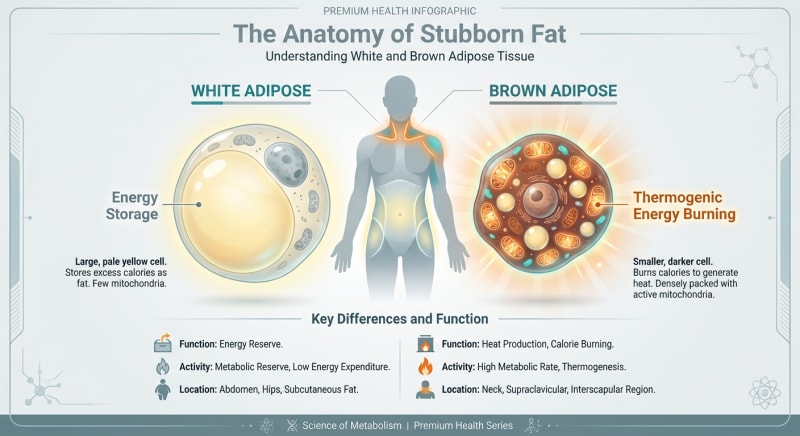
White adipose tissue contains adipocytes alongside vascular, immune, and other stromal cells. It serves energy-storage and endocrine functions; describing it simply as unwanted tissue obscures the biology relevant to an experiment. Brown adipose tissue has a different cellular organization and a prominent role in thermogenesis.
Several endpoints commonly grouped under “fat reduction” measure different processes:
- Lipolysis: hydrolysis of stored triglycerides. Measuring lipid release does not, by itself, establish subsequent fatty-acid oxidation.
- Lipogenesis: lipid synthesis. This is not synonymous with adipogenesis, the differentiation process that produces adipocytes.
- Adipocyte size and number: separate structural measurements. A change in tissue mass does not identify which has changed.
- Apoptosis: programmed cell death. An apoptosis measurement must identify the affected cell population.
- Vascular remodeling: changes in blood-vessel structure or abundance. These require vascular measurements rather than inference from tissue size alone.
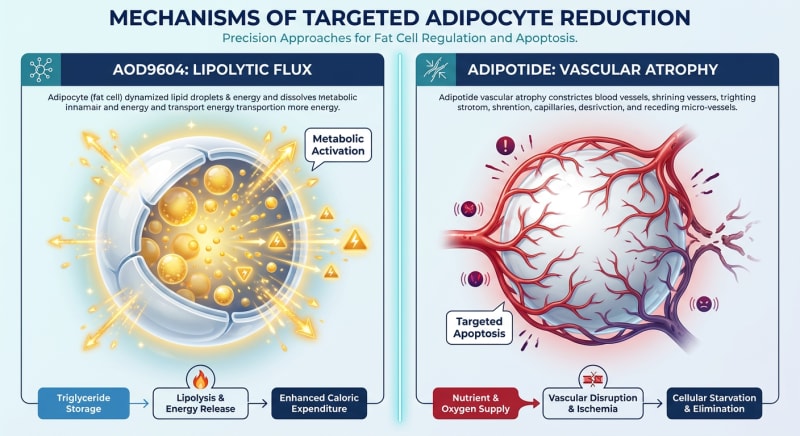
Likewise, “lipolytic flux” implies a rate measurement. A single endpoint concentration of a released metabolite is not automatically a measurement of flux, because uptake, metabolism, and re-esterification can also influence that concentration.
Adipotide: Vascular-Targeting Research
Molecular Design and Experimental Target
Adipotide is a peptidomimetic construct combining a targeting component with a proapoptotic component. In the mouse experiments reported by Kolonin and colleagues, the investigators studied targeting of adipose-tissue vasculature through a prohibitin-associated interaction and linked vascular targeting to a proapoptotic peptide [1]. The relevant initial target in this research was vascular endothelium, not direct recognition of every adipocyte.
The mouse findings in reference 1 do not establish that prohibitin is unique to white-adipose blood vessels or that a targeting construct cannot interact with other tissues. “Vascular-targeted proapoptotic research” is therefore more precise than “adipocyte-mediated vascular atrophy,” which can incorrectly imply that adipocytes are the directly targeted cell population.
Animal Evidence and Hazard Signals
Barnhart and colleagues investigated the peptidomimetic in obese nonhuman primates [2]. The study also reported renal adverse effects, making kidney-related toxicity an important limitation of that animal evidence. These findings do not support claims of harmless tissue clearance, exclusive adipose targeting, or absence of effects outside adipose tissue.
Neither the mouse study [1] nor the nonhuman-primate study [2] establishes predictable localized effects in humans. Results from these animal models also cannot establish permanent changes in a particular tissue depot or the activity of an independently manufactured commercial batch.
AOD9604: Lipid-Metabolism Research
Chemical Identity
AOD9604 is a modified human-growth-hormone-derived peptide comprising residues 177–191 with an additional N-terminal tyrosine. It should not be treated as interchangeable with full-length growth hormone or with every preparation described as a growth-hormone fragment. Sequence, terminal modifications, disulfide status, and material composition matter when identifying the substance used in an experiment.
The internal AOD9604 material listing and Adipotide material listing provide catalog context. Product names alone do not demonstrate that a supplied material matches the construct, analytical characteristics, or activity of a preparation described in a publication.
Interpreting the Supplied Literature
The supplied AOD9604 bibliography includes entries described as in-vitro and in-vivo research [4] and research in diet-induced obese mice [6]. Those evidence categories must remain separate: observations in an isolated preparation do not establish a whole-animal mechanism, and observations in mice do not establish human effects. The supplied bibliographic details require verification against the primary papers before specific methods or findings are attributed to these entries.
Reference 3 concerns a synthetic growth-hormone fragment, but its supplied bibliographic details require verification before treating it as evidence for a particular AOD9604 preparation. The title alone does not establish the exact chemical identity, experimental model, or mechanism. Accordingly, this comparison does not assign receptor binding, enzyme regulation, or quantitative activity to AOD9604 on the basis of that entry.
The human-urine analytical context named in reference 7 is distinct from an efficacy or safety study. Detection in a human biological matrix, if confirmed from the primary publication, would address an analytical question rather than establish a physiological benefit. The supplied citation details should be checked before any assay method or validation performance is attributed to this reference.
The bibliography does not justify describing AOD9604 as having a fully established adipocyte receptor mechanism, as preventing formation of new adipocytes, or as reproducing selected effects of full-length growth hormone without its risks.
Comparison for Laboratory Interpretation
| Dimension | Adipotide | AOD9604 |
|---|---|---|
| Molecular concept | Targeting component linked to a proapoptotic component. | Modified C-terminal human-growth-hormone-derived peptide. |
| Evidence context | Mouse vascular-targeting research [1] and nonhuman-primate research [2]. | Supplied entries describe in-vitro and animal lipid-metabolism research; bibliographic verification is needed before detailed attribution [3, 4, 6]. |
| Central measurement distinction | Endothelial effects must be distinguished from secondary changes in adipocytes. | Lipid release, synthesis, oxidation, and net storage are separate measurements. |
| Major interpretive limitation | Targeting does not establish absolute tissue specificity; renal adverse effects were reported in the nonhuman-primate study [2]. | Fragment identity alone does not establish receptor specificity, functional activity, or a safety profile. |
| Commercial-material inference | Published results do not characterize an Alpha Carbon Labs batch. | Published results do not characterize an Alpha Carbon Labs batch. |
Different proposed mechanisms do not demonstrate complementarity or synergy. No combined-exposure or direct comparative result is established by the supplied references, and this article does not recommend combining these materials.
Experimental Readouts and Controls
The following are general considerations for nonclinical assay design, not methods claimed to have been used in every cited study:
- Identify the preparation: document species, cell or tissue type, culture conditions where applicable, and whether the system includes endothelial and stromal components.
- Separate activity from cell loss: interpret metabolic readouts alongside cell number and viability. Reduced signal can reflect fewer viable cells rather than selective regulation of a pathway.
- Measure the proposed process: distinguish lipid release from oxidation and net triglyceride balance. Identify the cell type when evaluating apoptosis.
- Use appropriate controls: include assay blanks, vehicle controls, and suitable reference controls. Evaluate interference from the material and formulation components.
- Avoid single-marker conclusions: an expression change does not by itself establish metabolic flux, and a tissue-size change does not establish vascular ablation.
- Document reproducibility: report material lot, analytical characterization, replicate structure, and relevant assay limitations.
Analytical Characterization and Laboratory Handling
No batch-specific analytical specifications or certificates are supplied with this article. It therefore makes no claim about the purity, content, identity, sterility, or biological activity of Alpha Carbon Labs materials. Researchers can review the available quality-control information, certificate-of-analysis documents, and peptide-synthesis information while checking which statements are supported for the specific lot under consideration.
Chromatographic purity and peptide content are different measurements. An HPLC area percentage depends on the method and detector response and does not establish absolute peptide content or identify all possible contaminants. An intact-mass measurement can support a molecular-mass assignment, but it does not alone prove the complete sequence, stereochemistry, or disulfide connectivity. Neither measurement establishes biological activity.
Follow the material-specific safety data sheet, documented storage requirements, and institutional chemical-hygiene procedures. Use protective equipment and exposure controls appropriate to the laboratory risk assessment, and dispose of waste through approved laboratory procedures. Incomplete hazard data should be treated as uncertainty, not evidence of harmlessness. No storage temperature, shelf life, or stability claim is inferred here without supporting material-specific data.
Reference Integrity
The supplied citation list is reproduced unchanged below. Inclusion is not confirmation that each title, author list, journal entry, and identifier has been independently verified. In particular, detailed AOD9604 claims should not be built on an unresolved citation or inferred from a paper title. General background entries are not substitutes for compound-specific experiments, and none of these references is a batch-specific test report for Alpha Carbon Labs.
References
- Kolonin, M. G., Saha, P. K., Chan, L., Pasqualini, R., & Arap, W. (2004). Reversal of obesity by targeted ablation of adipose tissue. Nature Medicine, 10(6), 625-632. — https://doi.org/10.1038/nm1048
- Barnhart, K. F., Christianson, D. R., Hanley, P. W., et al. (2011). A peptidomimetic targeting white fat causes weight loss and improved insulin resistance in obese monkeys. Science Translational Medicine, 3(108), 108ra112. — https://doi.org/10.1126/scitranslmed.3002621
- Heffernan, M. A., Jiang, W. J., Thorburn, A. W., & Ng, F. M. (2001). Effects of oral administration of a synthetic fragment of human growth hormone on lipid metabolism. American Journal of Physiology-Endocrinology and Metabolism, 281(2), E385-E391. — https://doi.org/10.1152/ajpendo.2000.279.3.e501
- Ng, F. M., Jiang, W. J., Gianello, R., Pitt, S., & Roupas, P. (2000). Out of the bottle: In vitro and in vivo studies of the lipolytic peptide AOD9604. European Journal of Endocrinology, 143(6), 803-810.
- Stienstra, R., Saudale, F., Duval, C., et al. (2010). Kupffer cells promote hepatic steatosis via interleukin-1beta-dependent suppression of peroxisome proliferator-activated receptor alpha activity. Hepatology, 51(2), 511-522. — https://doi.org/10.1002/hep.23337
- Tse, A., & Ng, F. M. (2004). Effects of AOD9604 on lipid metabolism and weight in diet-induced obese mice. Journal of Endocrinology, 185(1), 81-89. — https://pubmed.ncbi.nlm.nih.gov/15858883/
- Cox, H. D., Smeal, S. J., & Eichner, D. (2015). Detection of the AOD9604 peptide in human urine. Drug Testing and Analysis, 7(11-12), 990-995. — https://doi.org/10.1002/dta.1830
- Wu, Z., Puigserver, P., & Spiegelman, B. M. (1999). Transcriptional activation of adipogenesis. Current Opinion in Cell Biology, 11(6), 689-694. — https://doi.org/10.1016/S0955-0674(99)00037-X
- Kim, D. H., & Huh, J. Y. (2020). Apoptosis of adipose tissue: Is it a viable strategy for treating obesity? Journal of Obesity & Metabolic Syndrome, 29(4), 256-267. — https://doi.org/10.7570/jomes20059
Limitations
Published findings are specific to the tested preparations and experimental models. They do not establish the safety, effectiveness, approval, or suitability of material sold by Alpha Carbon Labs for human or veterinary use. These materials are intended solely for nonclinical laboratory research.