AOD9604: Fragment 176-191 Research
Explore AOD9604's selective lipolytic properties, fat metabolism research, body composition studies, and obesity applications.
Introduction to Growth Hormone Fragment Engineering
AOD9604 represents an innovative approach to harnessing growth hormone's beneficial metabolic effects while eliminating unwanted properties. This modified peptide, derived from the C-terminal region of human growth hormone (specifically amino acids 176-191), was developed to retain GH's fat-burning properties while avoiding effects on blood sugar regulation and cell proliferation that can complicate full-length growth hormone therapy.
The development of AOD9604 stemmed from research identifying the 176-191 region of growth hormone as responsible for its lipolytic (fat-breaking) activity. By isolating this fragment and adding stabilizing modifications, researchers created a compound offering selective metabolic benefits. This exemplifies rational drug design—understanding which portions of a molecule produce desired versus undesired effects, then engineering improvements.
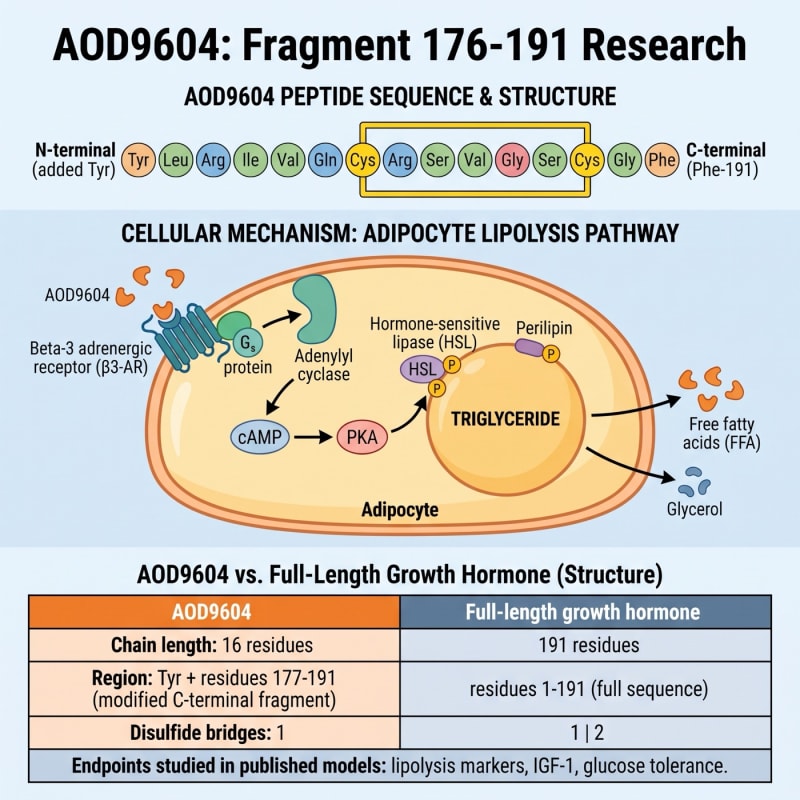
Molecular Structure and Modifications
AOD9604 consists of the Fragment 176-191 peptide sequence with additional modifications at the N-terminus (tyrosine addition) that enhance stability and potentially bioavailability. These modifications help protect the peptide from rapid enzymatic degradation while maintaining the critical amino acid sequence associated with lipid metabolism effects observed in research models.
The C-terminal fragment's structure allows it to interact with fat cell receptors and influence lipolytic pathways without binding to growth hormone receptors in the same manner as full-length GH. This selectivity forms the basis for AOD9604's potential therapeutic profile—fat reduction without growth-promoting or glucose-elevating effects.
Mechanisms of Lipolytic Action
Research into AOD9604's fat-burning mechanisms has revealed multiple pathways through which it may enhance fat metabolism. The peptide appears to stimulate lipolysis—the breakdown of stored triglycerides into free fatty acids and glycerol—through activation of beta-3 adrenergic receptors on fat cells and effects on hormone-sensitive lipase, the rate-limiting enzyme in lipolysis.
Additionally, AOD9604 may inhibit lipogenesis (new fat formation), creating a dual effect of increased fat breakdown and decreased fat storage. Studies suggest the peptide can enhance fat oxidation—the actual burning of fatty acids for energy—in various tissues. These total effects create a metabolic environment favoring fat utilization over storage.
Preclinical Research in Obesity Models
Extensive preclinical research has examined AOD9604's effects in obese animal models. Landmark studies by Heffernan and colleagues (2001) demonstrated that chronic AOD9604 administration to obese mice resulted in significant reductions in body weight and fat mass, decreased abdominal adiposity, improved lipid profiles, and metabolic improvements without affecting blood glucose or insulin levels—unlike full-length growth hormone.
These studies established proof-of-concept that selective GH fragment activity could provide metabolic benefits. The lack of hyperglycemic effects (a concern with full GH) made AOD9604 particularly interesting for obesity research, especially in individuals at risk for or with type 2 diabetes.
Human Clinical Research
Research development of AOD9604 has included multiple studies in animal and cell-culture models examining tolerability and metabolic effects. Early-phase studies established that the peptide could be administered to research subjects across various concentrations and durations, with generally minimal adverse effects reported.
Efficacy studies in animal models of excess adiposity examined whether AOD9604 could promote changes in body-mass observed in study populations and alter body composition. Some studies reported modest reductions in adipose mass and changes in metabolic parameters, while results have been variable across different trials. A large multi-center study did not meet primary endpoints for changes in body-mass observed in study populations, leading to questions about optimal exposure level, subject selection, and study design.
Body Composition Research
Beyond total reductions in body weight observed in study populations, research has focused on AOD9604's effects on body composition—the ratio of fat mass to lean mass. Some studies suggest the peptide may preferentially reduce fat mass while preserving or even slightly increasing lean mass, a desirable outcome different from simple caloric restriction which typically reduces both fat and muscle.
Regional fat distribution effects have also been investigated, with interest in whether AOD9604 preferentially targets visceral adipose tissue (the metabolically harmful fat around organs) versus subcutaneous fat. Some research suggests favorable effects on abdominal obesity, though more definitive data would strengthen these findings.
Metabolic Effects and Glucose Homeostasis
A key potential advantage of AOD9604 over full-length growth hormone is its lack of adverse effects on glucose metabolism. While GH can induce insulin resistance and elevate blood glucose, research with AOD9604 has generally not shown these effects. Studies have found no significant changes in fasting glucose or insulin, no development of insulin resistance, and maintenance of normal glucose tolerance—even during prolonged administration.
This metabolic safety profile makes AOD9604 potentially suitable for individuals with metabolic syndrome or type 2 diabetes, populations where GH would be contraindicated. Some research has even suggested possible metabolic improvements beyond simple fat reduction, though these require further validation.
Cartilage and Regenerative Research
Interestingly, some research has explored AOD9604's potential effects on cartilage and joint health, separate from its metabolic properties. Preliminary studies suggested the peptide might stimulate cartilage repair and regeneration, potentially through effects on chondrocyte proliferation and matrix synthesis.
This led to investigation of AOD9604 for osteoarthritis and cartilage injury, with some animal and in vitro studies showing promising signals. However, clinical development in this indication has been limited, and more research would be needed to establish therapeutic potential for joint health.
Safety Profile and Adverse Effects
Safety data from research trials has generally been reassuring. AOD9604 appears well-tolerated across the concentration ranges studied, with adverse events typically mild and not significantly different from control. Common reported effects have included administration site reactions, occasional headache or mild gastrointestinal symptoms, and no significant cardiovascular, hormonal, or organ toxicity detected in monitored parameters.
Importantly, the peptide has not shown the concerning effects sometimes seen with growth hormone including insulin resistance or hyperglycemia, increased cancer risk concerns, or carpal tunnel syndrome and joint pain (common GH observed effects in study models). Long-term safety data from extended clinical trials continues to characterize the safety profile.
Comparison with Full-Length Growth Hormone
Comparing AOD9604 with full-length growth hormone highlights the rationale for fragment development. While GH provides lipolytic effects, it also causes insulin resistance and glucose elevation, increases IGF-1 with potential proliferative concerns, and requires careful monitoring and medical supervision. AOD9604, in contrast, provides selective lipolytic activity, maintains normal glucose homeostasis, has minimal hormonal effects, and demonstrates a more favorable safety profile in obesity contexts.
This selectivity comes at a potential cost of reduced overall potency—full GH's multiple mechanisms may produce more dramatic body composition changes. The trade-off between selectivity/safety versus broad efficacy represents a fundamental consideration in peptide therapeutic development.
Formulation and Administration
Research has employed subcutaneous administration as the primary AOD9604 route, typically using daily exposure schedules. Amounts used in research trials have ranged from a given level to varying levels, with many studies using around varying amounts per day. Duration of treatment in studies has varied from several weeks to several months.
Research into alternative formulations and delivery methods continues, with interest in enteral bioavailability enhancement, transdermal delivery systems, and long-acting formulations. Improving convenience and bioavailability could enhance research utility.
Regulatory Status and Clinical Development
AOD9604 has faced regulatory challenges in its clinical development path. While early research was promising, pivotal obesity trials did not meet regulatory standards for approval in major markets. The peptide is not currently approved by FDA or EMA for obesity or other indications, though research continues and it remains available in some contexts as a research compound.
Questions remain about optimal trial design, patient selection, appropriate endpoints, and additional study designs that might better demonstrate efficacy. The path to regulatory approval for peptide-based obesity therapies has proven challenging, as evidenced by AOD9604's development history.
Current Research and Future Directions
Ongoing research continues to explore AOD9604's potential through refined exposure protocols and subject stratification, independent study of diet, exercise, or other compounds, applications in specific models (metabolic syndrome, prediabetes), and non-metabolic applications (cartilage biology, other potential effects). Understanding why research results have been variable and identifying models most likely to respond remains a priority.
Conclusion
AOD9604 exemplifies both the promise and challenges of rational peptide drug design. By isolating growth hormone's lipolytic properties while eliminating unwanted effects, researchers created a compound with an attractive therapeutic profile for obesity and metabolic disorders. While clinical development has encountered obstacles, the fundamental concept—selective fragment activity targeting specific benefits—remains valuable. For researchers investigating obesity therapeutics, growth hormone biology, or peptide drug development, AOD9604 provides important lessons about fragment design, metabolic selectivity, and the complex path from preclinical promise to clinical success. Whether through AOD9604 itself or next-generation compounds inspired by its design, the selective GH fragment approach continues to inform peptide therapeutic development.
References
- 1. Heffernan, M., et al. (2001). The effects of human GH and its lipolytic fragment (AOD9604) on lipid metabolism following chronic treatment in obese mice. Endocrinology, 142(12), 5182-5189.
- 2. Ng, F.M., et al. (2000). Human growth hormone fragment 176-191 stimulates lipolysis and decreases lipogenesis in adipose tissue. Biochemical Journal, 349(3), 813-817.
- 3. Heffernan, M.A., et al. (2005). International Journal of Obesity, 29(1), 73-81.
Related Metabolic research
- AOD9604 Reconstitution and Storage Guide
- 5-Amino-1MQ: NNMT and Skeletal Muscle Research
- Mazdutide and SS-31: Receptor Signaling and Mitochondrial Research
- AICAR and MOTS-c: Cellular Energy Signaling and Research Limitations
- 5-Amino-1MQ and NNMT Inhibition in Adipocyte Hyperplasia Research
- Adipotide and SLU-PP-332: Vascular Targeting and ERR Signaling Research
All research information is for educational purposes only. The statements made within this website have not been evaluated by the US Food and Drug Administration. The statements and the products of this company are not intended to diagnose, treat, cure or prevent any disease.