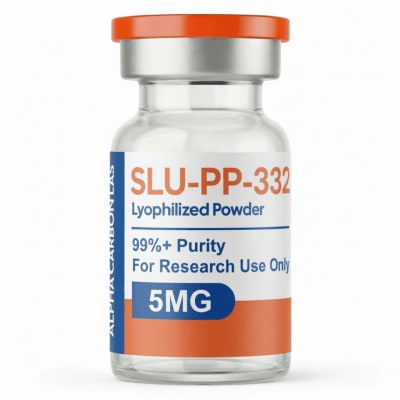
5mg
This product is for research purposes only. Not for human consumption.
Purity: >98% (HPLC verified)
Formulation: Lyophilized powder
Molecular Formula: C18H14N2O2
Molecular Weight: 290.32 g/mol
CAS Number: 303760-60-3
PubChem CID: 10004677

SLU-PP-332
Overview
SLU-PP-332 is a selective pan-estrogen related receptor (ERR) agonist used as a research tool for studying metabolic regulation and energy homeostasis. The compound was developed through structure-activity relationship studies of modulators for the ERR family of orphan nuclear receptors.
The ERR family consists of three members—ERRα, ERRβ, and ERRγ—which are constitutively active transcription factors that regulate genes involved in oxidative metabolism, mitochondrial biogenesis, and energy expenditure. Unlike estrogen receptors, ERRs do not bind estrogen but share some target genes, hence the "estrogen-related" designation.
Metabolic Regulation
ERRs are key regulators of cellular energy metabolism, controlling the expression of genes involved in fatty acid oxidation, oxidative phosphorylation, the citric acid cycle, and mitochondrial biogenesis. ERRα is highly expressed in tissues with high energy demands, including heart, skeletal muscle, brown adipose tissue, and kidney, where it coordinates the expression of metabolic gene networks.
SLU-PP-332 activates all three ERR isoforms, with reported EC50 values of approximately 98 nM for ERRα, 230 nM for ERRβ, and 430 nM for ERRγ.
Preclinical Research
The compound has also been shown to increase mitochondrial respiration in vitro, consistent with the role of ERRs in regulating mitochondrial function. This has prompted research into its effects in models of mitochondrial dysfunction.
Mechanism of Action
SLU-PP-332 is an agonist of the estrogen-related receptor (ERR) family, binding to ERRα, ERRβ, and ERRγ and enhancing their transcriptional activity. ERRs are members of the nuclear receptor superfamily of transcription factors. Unlike most nuclear receptors, ERRs are constitutively active and are considered "orphan" receptors.
Receptor Structure and Activation
ERRs have a typical nuclear receptor domain structure, including an N-terminal activation domain, a central DNA-binding domain, and a C-terminal ligand-binding domain (LBD). The LBD of ERRs adopts an active conformation that is stabilized by interaction with coactivators such as PGC-1α and PGC-1β.
SLU-PP-332 binds to the ligand-binding pocket of ERRs and further stabilizes the active receptor conformation, enhancing coactivator recruitment and transcriptional output. The chemical structure of the compound is (E)-4-hydroxy-N'-(naphthalen-2-ylmethylene)benzohydrazide.
Transcriptional Programs
Upon activation by SLU-PP-332, ERRs bind to ERR response elements (ERREs) in the promoters and enhancers of target genes, recruiting transcriptional coactivators and promoting gene expression. Target genes include those encoding components of the electron transport chain (e.g., ATP synthase subunits, cytochrome c), fatty acid oxidation enzymes (e.g., medium-chain acyl-CoA dehydrogenase, carnitine palmitoyltransferase 1), and certain transcription factors (e.g., PGC-1α, NRF-1).
The reported result of ERR activation is an increase in mitochondrial mass and function, oxidative capacity, and fatty acid utilization. In skeletal muscle tissue, this has been observed to correlate with a shift toward a more oxidative fiber phenotype in research models.
Metabolic Remodeling
By promoting fatty acid oxidation, ERR activation can shift the metabolic balance toward energy expenditure. This is particularly relevant in tissues like brown and beige adipose tissue, where ERRs regulate thermogenic programs including uncoupling protein 1 (UCP1) expression.
In heart and skeletal muscle, ERR activation has been shown to increase the capacity for oxidative ATP production in some models. The multi-tissue metabolic remodeling observed with pan-ERR agonists like SLU-PP-332 is thought to underlie their systemic effects on body composition and glucose metabolism in animal models.
Research Findings
Published nonclinical literature relevant to this material's molecular targets and experimental models is listed below for independent review. Findings involving other preparations or experimental systems should not be attributed to this research material.
Research Applications
- Fatty acid oxidation and lipid metabolism studies
- Mitochondrial biogenesis and function research
- Insulin sensitivity and glucose homeostasis studies
- Energy expenditure and thermogenesis research
- Nuclear receptor biology and transcription studies
- Skeletal muscle metabolism research
- Exercise physiology and exercise mimetic studies
- Brown and beige adipose tissue research
- Cardiovascular metabolism studies
Laboratory Handling & Limitations
This material is supplied solely for in vitro and other nonclinical laboratory research. It is not for human or veterinary use, consumption, administration, therapeutic use, or diagnostic use.
Laboratory Handling
Handle only in an appropriately equipped laboratory using applicable institutional procedures, personal protective equipment, and the storage conditions shown for the material. The purchaser is responsible for study design, handling controls, disposal, and regulatory compliance.
Research Limitations
Published observations involving other preparations, experimental systems, or study populations do not establish the identity, performance, or suitability of this research material for any particular experiment.
Scientific References
Research Use Only
This product is intended for research purposes only and is not for human consumption, therapeutic use, or diagnostic applications. Please ensure compliance with all applicable regulations and institutional guidelines.