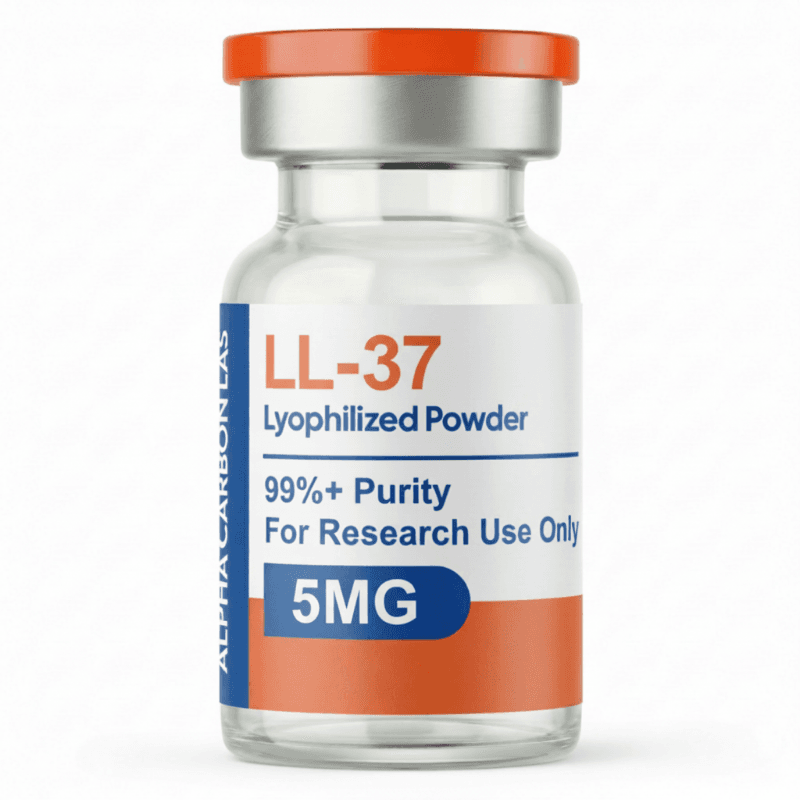
5MG
Buy 3+ for $71.25 each and save 5%
Buy 5+ for $67.50 each and save 10%
Buy 10+ for $63.75 each and save 15%
This product is for research purposes only. Not for human consumption.
Purity: >98% (HPLC verified)
Formulation: Lyophilized powder
Molecular Formula: C205H340N60O53
Molecular Weight: 4493.3 g/mol
CAS Number: N/A
PubChem CID: N/A

LL-37
Overview
LL-37 is a naturally occurring 37-amino acid antimicrobial peptide that represents the only known member of the cathelicidin family in humans, making it a critical component of the innate immune system and the first line of defense against microbial invasion.
The peptide is derived from the C-terminal cleavage of the human cationic antimicrobial protein hCAP-18 (human cathelicidin antimicrobial peptide of 18 kDa) by the protease proteinase 3, primarily in neutrophils, though it is also produced by various epithelial cells, macrophages, mast cells, and keratinocytes throughout the body.
Distribution and Function
LL-37 is found in significant concentrations at barrier sites including the skin, respiratory tract, gastrointestinal tract, and urogenital system, where it provides crucial antimicrobial protection while also serving important immunomodulatory functions.
The peptide exhibits remarkably broad-spectrum antimicrobial activity, demonstrating efficacy against Gram-positive and Gram-negative bacteria, fungi, viruses, and even parasites, while simultaneously resisting the development of microbial resistance - a property that has attracted intense research interest in the era of antibiotic resistance.
Immune Modulation
Beyond its direct antimicrobial properties, LL-37 functions as a multifaceted immune modulator: it recruits and activates immune cells, modulates inflammatory responses, promotes wound healing and angiogenesis, neutralizes bacterial toxins such as lipopolysaccharide (LPS), and even influences processes such as apoptosis and autophagy.
The peptide's expression is regulated by vitamin D, infections, inflammation, and various growth factors, with vitamin D supplementation known to increase LL-37 production - a mechanism that may partly explain vitamin D's immune-supportive effects.
Clinical Relevance
Clinically, altered LL-37 levels have been observed in numerous disease states: reduced expression is associated with increased susceptibility to infections and inflammatory conditions like atopic dermatitis and Shwachman-Diamond syndrome, while overexpression has been implicated in inflammatory diseases such as psoriasis, rosacea, and certain autoimmune conditions.
This dual nature - protective antimicrobial effects versus potential pro-inflammatory contributions - reflects LL-37's complex role in immune homeostasis. Research into therapeutic applications of LL-37 and its derivatives spans infectious disease treatment, wound healing enhancement, inflammatory disease modulation, and even potential anticancer properties.
Mechanism of Action
LL-37 exerts its diverse biological effects through multiple interconnected mechanisms that collectively establish it as a pleiotropic immune peptide rather than simply an antimicrobial agent.
Direct Antimicrobial Action
Its direct antimicrobial action primarily involves disruption of microbial membranes through an amphipathic structure that allows it to insert into and permeabilize bacterial, fungal, and viral envelopes.
The peptide's cationic (positively charged) regions interact electrostatically with negatively charged microbial membrane components such as lipopolysaccharides in Gram-negative bacteria and lipoteichoic acids in Gram-positive bacteria, while its hydrophobic regions insert into the lipid bilayer, creating pores and causing membrane destabilization, leakage of cellular contents, and ultimately microbial death.
Importantly, this membrane-disruption mechanism makes it difficult for microbes to develop resistance through simple genetic mutations, as they would need to fundamentally alter their membrane composition - a key advantage over conventional antibiotics that target specific proteins or metabolic pathways.
Antiviral Activity
LL-37 also exhibits antiviral activity against enveloped viruses through similar membrane-disrupting mechanisms, with demonstrated activity against influenza, herpes simplex virus, HIV, and others.
Immunomodulation
In immunomodulation, LL-37 functions as a chemoattractant for neutrophils, monocytes, mast cells, and T cells, recruiting these immune cells to sites of infection or injury through interactions with formyl peptide receptor-like 1 (FPRL1) and other chemotactic receptors.
The peptide can activate mast cells and neutrophils, promoting degranulation and release of additional antimicrobial factors, cytokines, and chemokines that amplify the immune response. LL-37 modulates cytokine production in complex context-dependent ways: it can suppress pro-inflammatory cytokines like TNF-α and IL-6 in certain contexts, yet can also promote production of chemokines and growth factors that support tissue repair.
Wound Healing
In wound healing, LL-37 promotes keratinocyte and fibroblast migration and proliferation, enhances re-epithelialization of wounds, stimulates angiogenesis through upregulation of vascular endothelial growth factor (VEGF) and other angiogenic factors, and supports extracellular matrix remodeling.
Anti-Biofilm Properties
LL-37 also demonstrates anti-biofilm properties, capable of disrupting established bacterial biofilms that are notoriously resistant to conventional antibiotics and host immune responses - this is particularly relevant for chronic wound infections and medical device-associated infections.
LPS Neutralization
LL-37 exhibits LPS-neutralizing activity, binding to and sequestering bacterial endotoxin, thereby preventing the severe inflammatory cascade that can lead to sepsis - a property that has been explored for potential therapeutic applications in septic shock and severe infections.
Research Findings
Research on LL-37 spans over two decades and encompasses basic science discoveries regarding its structure and function, preclinical studies in cell culture and animal models, and emerging clinical investigations.
Antimicrobial Spectrum
Early studies characterized LL-37's antimicrobial spectrum, demonstrating efficacy against a wide range of bacterial pathogens including antibiotic-resistant strains such as methicillin-resistant Staphylococcus aureus (MRSA), vancomycin-resistant Enterococcus (VRE), and multidrug-resistant Pseudomonas aeruginosa.
Research has shown that LL-37 maintains activity against bacteria that have developed resistance to conventional antibiotics, and importantly, bacteria exposed to LL-37 do not readily develop resistance even with repeated exposure - properties that have generated significant interest given the global antibiotic resistance crisis.
Wound Healing Research
Studies in wound healing models have demonstrated that LL-37 application can accelerate closure of both acute and chronic wounds, with research in diabetic wound models showing improved healing rates, better tissue quality, and reduced infection rates.
The peptide's wound-healing properties are mediated through promotion of keratinocyte migration and proliferation, angiogenesis stimulation, and modulation of inflammation. Clinical observations have noted that LL-37 levels in chronic wounds are often reduced.
Inflammatory Skin Conditions
Research into inflammatory skin conditions has revealed a complex picture: in psoriasis, LL-37 is overexpressed in lesional skin and appears to contribute to the inflammatory cascade by complexing with self-DNA and activating plasmacytoid dendritic cells through toll-like receptors.
Conversely, in atopic dermatitis (eczema), LL-37 expression is reduced, correlating with the increased infection susceptibility characteristic of this condition. Studies in rosacea have similarly found elevated LL-37 levels and identified that abnormal processing of cathelicidin results in pro-inflammatory peptide fragments.
Infectious Disease Research
Respiratory studies show LL-37 is expressed in airway epithelia and helps defend against respiratory pathogens. Gastrointestinal research has investigated LL-37's role in gut barrier function and defense against enteric pathogens.
Tuberculosis research has examined LL-37's activity against Mycobacterium tuberculosis, with vitamin D-induced LL-37 production in macrophages demonstrating antimycobacterial effects. HIV research has shown LL-37 has direct anti-HIV activity and enhances immune responses to the virus.
Sepsis and Cancer Research
Sepsis research has explored LL-37's LPS-neutralizing properties, with animal studies suggesting that administration of LL-37 or its analogs might reduce mortality in septic shock.
Cancer research has produced complex findings, with some studies showing LL-37 can kill certain cancer cells directly or enhance immune responses against tumors, while others suggest it may promote tumor growth in certain contexts through angiogenesis - highlighting the need for careful investigation.
Research Applications
- Antimicrobial resistance and antibiotic alternative research
- Chronic wound healing and diabetic ulcer studies
- Inflammatory skin disease research (psoriasis, rosacea, atopic dermatitis)
- Immune system modulation and host defense research
- Biofilm disruption and chronic infection studies
- Sepsis and endotoxin neutralization research
- Respiratory infection and lung immunity studies
- Gastrointestinal barrier function and IBD research
- Antiviral therapy research
- Cancer immunotherapy and tumor microenvironment studies
- Vitamin D and immune function research
- Vaccine adjuvant development research
Safety Profile
LL-37 is an endogenous peptide naturally present throughout the human body in various tissues and biological fluids, which provides a foundation for expecting reasonable safety when used therapeutically at physiological or moderately supraphysiological concentrations.
Preclinical safety studies and limited clinical research have generally shown favorable safety profiles for LL-37 and its analogs when applied topically or administered systemically at appropriate doses. However, comprehensive long-term safety data in humans remains limited, as most therapeutic applications are still in preclinical or early clinical development stages.
Safety Considerations
Potential safety considerations include the risk of excessive inflammation if LL-37 levels become too elevated, particularly in individuals with inflammatory conditions where LL-37 may contribute to disease pathology (such as psoriasis or certain autoimmune conditions).
The peptide's cell-penetrating properties and ability to interact with host cell membranes raise theoretical concerns about potential cytotoxicity to normal human cells at high concentrations, though this appears to be dose-dependent with a reasonable therapeutic window.
Administration Routes
Topical applications for wound healing appear to have excellent safety profiles with minimal systemic absorption and side effects. Systemic administration would require more extensive safety evaluation, including effects on normal flora, immune system balance, and potential long-term consequences.
As with other peptide therapeutics, considerations around immunogenicity (formation of antibodies against the peptide with repeated exposure) require evaluation in clinical development, though LL-37's endogenous nature may reduce this risk.
Scientific References
Research Use Only
This product is intended for research purposes only and is not for human consumption, therapeutic use, or diagnostic applications. Please ensure compliance with all applicable regulations and institutional guidelines.