GHK-Cu and BPC-157 Research for Fibroblast and Skin Repair
Explore the roles of GHK-Cu and BPC-157 in fibroblast activity and dermal reconstruction. Learn how these peptides signal cellular repair and collagen synthesis.
The Quest for Perfect Healing: Beyond Surface-Level Skincare
Every time we scrape a knee, undergo surgery, or simply wake up a year older, our skin tells a story. For most of us, that story includes a history of fine lines, stretch marks, acne divots, and surgical scars. We have long accepted that skin damage leaves a permanent mark. We’ve been taught that scars are simply the price we pay for survival, and that wrinkles are an unavoidable tax on aging.
But what if it didn't have to be this way? What if your body still held the original "blueprint" for flawless, unblemished skin—and all you needed was the right set of instructions to turn that blueprint back on?
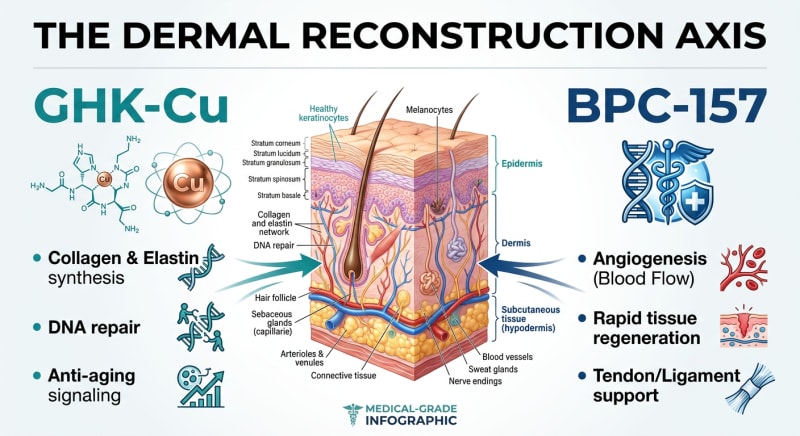
Welcome to the frontier of regenerative wellness. Within the rapidly expanding world of anti-aging and optimization, a revolutionary concept is taking center stage: The Dermal Reconstruction Axis. In plain English, this is the biological pathway that determines whether a skin injury heals with an ugly, raised scar, or heals flawlessly, identical to the skin you were born with.
At the very heart of this research are two powerhouse peptides that are completely changing how we view skin health, longevity, and recovery: GHK-Cu (a naturally occurring copper peptide) and BPC-157 (often dubbed the "Wolverine" peptide for its rapid recovery benefits). Today, we’re going to dive deep into how these two incredible compounds work together to rewrite the rules of skin aging, healing, and cellular repair.
What Exactly Are Peptides? A Quick Refresher
Before we can understand how GHK-Cu and BPC-157 work their magic, we need to quickly cover what a peptide actually is. If we imagine proteins (like collagen and elastin) as large, complex brick walls that give our skin its structure and bounce, peptides are the individual rows of bricks—or more accurately, the messengers carrying the blueprints for the wall.
Peptides are short chains of amino acids. Because they are smaller than full proteins, they can easily penetrate deep into our cells and tissues. More importantly, peptides are "signaling molecules." They act like tiny text messages sent directly to your cells, telling them what to do. As we age, our body stops sending as many of these text messages. Things slow down. Skin cells get sluggish, collagen production drops off a cliff, and small injuries suddenly take weeks to heal.
By reintroducing specific peptides back into the body, we can essentially text our cells and say: "Hey! Wake up! Start building collagen again! Fix that tissue properly!"
The Builders and The Emergency Crew: Fibroblasts vs. Myofibroblasts
To understand the secret of scarless healing and youthful skin, we have to talk about the unsung heroes of your dermal layers: fibroblasts. Fibroblasts are the master builders of the skin. They are responsible for weaving together collagen, elastin, and hyaluronic acid—the holy trinity of plump, youthful, hydrated skin.
When you are young and your skin is undamaged, these fibroblasts work peacefully, laying down smooth, organized, crisscrossing layers of collagen. Think of a beautifully woven silk sheet. Smooth, strong, and flexible.
But what happens when you cut yourself, have surgery, or pop a bad pimple? Chaos ensues. The body perceives a breach in the outer wall and panics. Its primary goal is no longer "make it beautiful." Its primary goal is "close the wound so we don't bleed out or get an infection."
The Myofibroblast Takeover
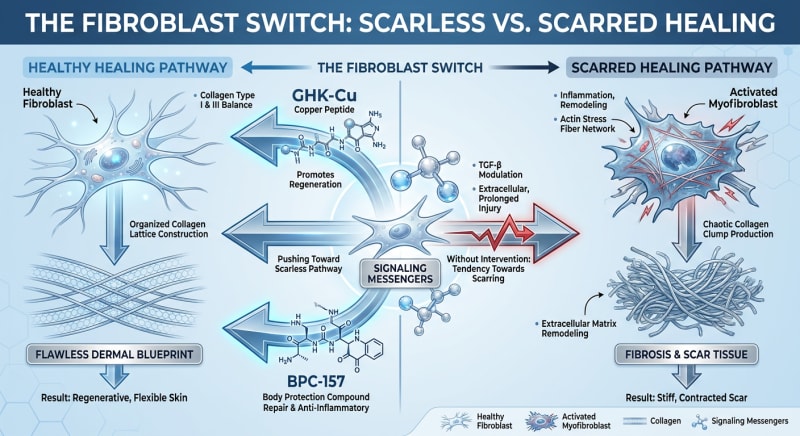
In this state of emergency, your normal, peaceful fibroblasts receive distress signals and physically transition into a different type of cell called a myofibroblast. If fibroblasts are the skilled artisans laying down fine silk, myofibroblasts are the emergency construction crew wrapping everything in thick, messy layers of duct tape.
Myofibroblasts produce incredibly dense, thick bundles of collagen very rapidly. They literally grab the edges of the wound and contract, pulling the skin forcefully together to close the gap. While this saves our lives, it comes at a cosmetic cost. This dense, unorganized, tightly bundled collagen is what we call a scar. It lacks hair follicles, it lacks elasticity, and it looks fundamentally different from the surrounding skin.
This is where the magic of the "Dermal Reconstruction Axis" comes in. What if we could tell the body not to panic? What if we could stop the normal fibroblasts from transforming into frantic myofibroblasts, and instead, command them to heal the skin calmly, slowly, and flawlessly?
GHK-Cu: The Master Architect of Skin Regeneration
Enter the first superstar of our story: `GHK-Cu`. Discovered in 1973 by Dr. Loren Pickart, this naturally occurring copper-binding tripeptide is quite literally the holy grail of anti-aging skincare and systemic rejuvenation.
In our blood, GHK-Cu is young, vibrant, and abundant. At age 20, we have high circulating levels of it. By age 60, those levels drop by over 60%. Unsurprisingly, this perfectly mirrors the timeline of when our skin starts to wrinkle, sag, and heal poorly.
How Copper Peptides Reverse the Clock
Copper is an essential trace mineral required for cellular functions, especially the formation of collagen and elastin. GHK-Cu acts as a brilliant delivery system, carrying copper safely into the cells that need it most. But the benefits go far beyond just dropping off copper. GHK-Cu actually interacts with our DNA to reset our genes back to a younger state.
Here is what GHK-Cu actively does for your skin and healing processes:
- Organizes Collagen: GHK-Cu is famous for promoting the breakdown of bad, messy scar collagen (thanks to enzymes called metalloproteinases) and stimulating the production of good, youthful, organized collagen. It essentially fires the sloppy emergency construction crew and hires back the master artisans.
- Firms and Tightens: By drastically increasing elastin production, GHK-Cu helps loose, crepey skin snap back into place, improving firmness and elasticity.
- Calms Inflammation: Chronic inflammation is the root cause of "inflammaging" (the acceleration of aging due to constant cellular stress). GHK-Cu acts as an incredibly potent antioxidant, calming redness and protecting skin cells from free radical damage.
- Stimulates Stem Cells: Research shows GHK-Cu encourages the skin's stem cells to multiply and regenerate, leading to a brighter, fresher, more youthful complexion.
In the context of the Dermal Reconstruction Axis, GHK-Cu is the peptide that tells the cells, "Take your time, lay the foundation correctly, and let's rebuild this tissue so it looks like it was never damaged."
BPC-157: The Body Protection Compound for Deep Tissue Revival
While GHK-Cu is the master architect, our second peptide acts as the ultimate supply chain and biological reinforcement: `BPC-157`.
BPC-157 stands for "Body Protection Compound." It is originally derived from a protein found in human gastric juice, where its natural job is to heal ulcers, repair the gut lining, and keep tissues healthy in a highly acidic environment. However, researchers quickly discovered that the restorative powers of BPC-157 extend far beyond the stomach. When supplied to the body systemically or locally, BPC-157 accelerates healing in almost every tissue it touches—muscles, tendons, ligaments, nerves, and yes, the skin.
The Superpower of Angiogenesis
To rebuild flawless skin and prevent scarring, your body needs phenomenal blood flow. You can't build a new house if the roads leading to the construction site are blocked. BPC-157 solves this through a process called angiogenesis—the creation of new, healthy blood vessels.
When you have a stubborn injury, an old surgical scar, or even heavily sun-damaged, aging skin, blood flow to the micro-capillaries is usually compromised. The tissues are quite literally suffocating. BPC-157 steps in and prompts the body to build tiny new vascular networks, flooding the area with oxygen, nutrients, and immune cells.
Furthermore, BPC-157 is an exceptional modulator of the inflammatory response. It doesn't blindly suppress inflammation like an over-the-counter painkiller (which actually delays healing!). Instead, it optimizes the inflammatory phase so the body gets in, clears out the damaged tissue, and moves straight into the rebuilding phase without unnecessary scar tissue buildup.
The Synergy: How GHK-Cu and BPC-157 Modulate the Dermal Axis
Now we arrive at the core of the breakthrough: What happens when you combine the architectural brilliance of GHK-Cu with the vascular super-highways of BPC-157?
When evaluated in the context of the Fibroblast Phenotype Transition (that critical moment when calm fibroblasts turn into hyperactive, scar-producing myofibroblasts), combining these two peptides creates a perfect biological symphony.
Here is how the ultimate skin-repair axis plays out in real-time when these peptides are utilized:
- The Injury or Aging Stimulus Occurs: A wound occurs, or years of UV exposure finally cause the collagen matrix to collapse.
- BPC-157 Secures the Site: BPC-157 immediately enhances blood flow to the damaged area. It supplies oxygen and clears out cellular debris efficiently. More importantly, it signals the local tissue to remain stable, preventing a massive, chaotic inflammatory cascade that would typically lead to severe fibrosis (thick scarring).
- GHK-Cu Guides the Rebuilding: With the area thriving on fresh blood supply thanks to BPC-157, GHK-Cu goes to work. It actively suppresses the signals that force fibroblasts to turn into myofibroblasts. Instead of the emergency duct-tape crew taking over, the original builder cells are gently instructed to lay down perfect, Type I collagen.
- Scar Breakdown and Remodeling: If an old scar already exists, GHK-Cu promotes the breakdown of the disorganized collagen bundles, while BPC-157 ensures the new tissue forming underneath has the vascular support to survive and thrive.
This is what researchers mean by "scar-free wound closure." It is the holy grail of cosmetic recovery. By guiding the cells to heal systematically rather than chaotically, we can potentially prevent raised, discolored, or pitted scars from forming in the first place.
Real-World Applications: Who Benefits from This Research?
You don't need to be a medical researcher with a microscope to appreciate the practical benefits of the Dermal Reconstruction Axis. Everyday people, biohackers, and wellness enthusiasts are exploring these mechanisms for incredibly relatable reasons.
1. Surgical Recovery and Scar Minimization
Whether it is a tummy tuck, a C-section, orthopedic surgery, or a cosmetic lift, surgical incisions inevitably carry the risk of severe scarring. Leveraging the BPC-157 and GHK-Cu axis before and after a planned procedure is becoming increasingly popular to help incisions heal faster, flatter, and closer to the natural skin tone.
2. Reversing Chronic Sun Damage and Deep Wrinkles
Deep wrinkles are functionally microscopic scars. They are points where the extracellular matrix has collapsed, and the skin has improperly repaired the repeated stress of facial movements and UV damage. GHK-Cu is famous for thickening the skin and smoothing out these textural irregularities over time, making it a powerful weapon against photo-aging.
3. Atrophic Acne Scars and Pitting
Acne out-breaks often leave behind "ice-pick" or "rolling" scars. This happens because the inflammation destroyed the tissue, and the body failed to replace it fully, leaving a depression. BPC-157 helps restore vascularity to these "dead" tissue zones, while GHK-Cu helps stimulate fresh stem cells to fill the depressions with properly patterned collagen.
4. Stretch Marks (Striae)
Stretch marks are essentially tears in the dermal layer caused by rapid expansion (pregnancy, muscle growth, weight gain). Because the tear happens below the surface, the body rapidly patches it with myofibroblasts, resulting in the silvery, unpigmented lines we all know. The regenerative synergy of this peptide axis provides hope for remodeling old striae and returning natural elasticity to the skin.
Formulating for Success: The Power of Targeted Blends
While using GHK-Cu or BPC-157 individually is highly effective, modern research peptide protocols often favor strategic combinations to target multiple pathways at once. At Alpha Carbon Labs, we've developed specific formulations to maximize this Dermal Reconstruction Axis.
The GLOW Blend: Enhancing the Axis
For those looking for a comprehensive approach to skin health, tissue recovery, and systemic wellness, our `BPC-157 + TB-500 + GHK-Cu GLOW Blend` represents the pinnacle of regenerative synergy. By combining BPC-157 and GHK-Cu with TB-500 (another incredible peptide known for increasing cellular mobility and speeding up wound closure), you create a trifecta of healing. TB-500 acts like the transport vehicle, ensuring the builder cells can quickly rush to the site of an injury or wrinkle, amplifying the effects of the other two peptides.
The KLOW Blend: Next-Level Inflammatory Control
For research cases prioritizing severe inflammatory skin conditions (like eczema, psoriasis, or deep inflammatory cystic acne recovery), the `BPC-157 + TB-500 + GHK-Cu + KPV-10 KLOW Blend` takes things a step further. It includes KPV, a powerful anti-inflammatory peptide naturally found in the body. KPV is renowned for its ability to calm down hyper-reactive skin, stop itching, and lower systemic inflammation, providing the perfect pacified environment for GHK-Cu to rebuild undamaged skin.
Comparing Your Peptide Options
Understanding which peptide fits your specific skin repair and anti-aging goals can be challenging. Here is a quick breakdown to help you map out your personal wellness strategy.
| Peptide | Primary Mechanism | Best Used For... |
|---|---|---|
| GHK-Cu | Collagen organization, stem cell stimulation, copper transport | Anti-aging, wrinkle reduction, shrinking pores, reducing old scars, skin tightening. |
| BPC-157 | Angiogenesis (new blood vessels), rapid tissue protection | Fresh wounds, surgical recovery, gut health, joint repair, minimizing new scar tissue. |
| `TB-500` | Cellular migration, actin upregulation | Speeding up the healing timeline, muscle tears, wound contracture. |
| `KPV` | Potent anti-inflammatory and anti-microbial signaling | Calming inflammatory skin conditions (acne, redness), reducing gut inflammation. |
| `Epithalon` | Telomerase activation, cellular lifespan extension | Whole-body anti-aging, sleep regulation, preserving cellular youth across all tissues. |
Integrating Skin Repair Peptides into Your Lifestyle
While peptides are incredibly powerful, they are not magic wands that override terrible lifestyle habits. To truly unlock the full potential of the Dermal Reconstruction Axis, you have to provide your body with the raw materials it needs to execute the instructions these peptides are giving.
- Hydration is Non-Negotiable: Fibroblasts need an aqueous environment to produce hyaluronic acid. If you are chronically dehydrated, GHK-Cu will struggle to plump the skin. Opt for adequate water intake and balance your electrolytes.
- Feed the Collagen Matrix: If BPC-157 and GHK-Cu are the architects, Vitamin C and amino acids are the bricks. Ensure your diet is rich in high-quality proteins, collagen peptides, and Vitamin C (which is vital for collagen cross-linking).
- Protect the Barrier: There is no sense in actively repairing the skin if you are actively destroying it at the same time. Excessive UV exposure aggressively breaks down collagen. Wear a high-quality mineral sunscreen daily to protect your investment.
- Prioritize Sleep: Your body does the vast majority of its cellular repair, hormone production, and tissue remodeling during deep sleep. Without 7-9 hours of quality rest, the signaling pathways of these peptides cannot operate at peak efficiency.
Quality Matters: Sourcing Safe and Pure Peptides
When you are trusting a compound to communicate directly with your cells, purity is quite literally everything. The research peptide industry can unfortunately be a minefield of under-dosed, degraded, or contaminated products. The regenerative magic of GHK-Cu and BPC-157 only works if the molecular structure of the peptide is perfectly intact and free of toxic byproducts.
This is why Alpha Carbon Labs operates with unwavering transparency. Every single batch we produce undergoes `rigorous quality control` to assure purity levels exceed clinical standards. We believe our customers have an absolute right to know exactly what they are researching.
We urge all peptide users to always double-check `COA documents` (Certificates of Analysis) before making a purchase. A legitimate COA conducted by a verified third-party laboratory confirms that the product contains the precise peptide it claims, at the correct mass, with zero heavy metals or dangerous solvents left over from the `peptide synthesis` process.
Frequently Asked Questions (FAQ)
How long does it take to see results from GHK-Cu and BPC-157?
Timelines vary based on exactly what you are trying to heal. For acute injuries (like a minor surgical cut or scrape), BPC-157 can noticeably accelerate closure and reduce pain within 7 to 14 days. For systemic anti-aging, wrinkle reduction, and remodeling old scars with GHK-Cu, biological shifts take time. Fibroblasts need time to manufacture new collagen. Most users report significant improvements in skin elasticity, glow, and tone after 4 to 8 weeks of consistent use.
Can these peptides completely erase old scars?
It is legally and scientifically impossible to claim any compound completely "erases" an old scar 100%. However, GHK-Cu is scientifically proven to break down abnormally large, older collagen structures and replace them with smoother, more natural tissue. This process can dramatically fade, flatten, and soften older scars, making them blend beautifully with the surrounding skin.
Are these peptides safe for long-term anti-aging routines?
Both BPC-157 and GHK-Cu have excellent safety profiles in clinical research. GHK-Cu is entirely natural to the human body—you already have it in your blood right now! However, because GHK-Cu involves copper, it is wise not to over-saturate your system indefinitely. Many researchers cycle their peptide protocols (e.g., 8 weeks on, 4 weeks off) to maintain optimal cellular responsiveness.
Why do people combine BPC-157 and GHK-Cu instead of just picking one?
Because they tackle the problem from completely different angles. BPC-157 lays the groundwork—it ensures the tissue has blood flow, oxygen, and reduced inflammation. GHK-Cu is the architect that steps in afterward to guarantee the skin being rebuilt is smooth, tight, and youthful. Together, they create a comprehensive, 360-degree approach to dermal reconstruction.
Do these peptides help with hair loss or thinning hair?
Yes! While this article focuses on skin and scars, GHK-Cu is highly renowned for its ability to stimulate blood flow to the scalp and enlarge hair follicle size. BPC-157 supports this by ensuring vascular networks remain robust, bringing essential nutrients directly to the hair roots.
Conclusion: Redefining Your Body's Healing Potential
The days of passively accepting deep wrinkles, sluggish healing, and prominent scars are rapidly coming to an end. We are moving into an era where we no longer have to settle for the body's frantic "emergency" repair processes. By utilizing the astonishing science of the Dermal Reconstruction Axis, we can rewrite the narrative.
GHK-Cu and BPC-157 are far more than just skincare trends; they represent a fundamental shift in how we approach recovery and longevity from the cellular level up. Whether your goal is to recover flawlessly from a surgery, fade decades-old sun damage, or simply preserve your skin's youthful vitality for as long as humanly possible, these two peptides stand as the ultimate biological allies.
Your skin already knows how to heal beautifully. Sometimes, it just needs the right messenger to remind it how. Explore our master-crafted peptide blends at Alpha Carbon Labs today, and unlock the flawless healing potential you were always meant to have.
References
- 1. Pickart L, Margolina A. Regenerative and Protective Actions of the GHK-Cu Peptide in the Light of the New Gene Data. Int J Mol Sci. 2018.
- 2. Sikiric P, et al. Brain-gut Axis and Pentadecapeptide BPC 157: Theoretical and Practical Implications. Curr Neuropharmacol. 2016.
- 3. Pickart L, Vasquez-Soltero JM, Margolina A. GHK Peptide as a Natural Modulator of Multiple Cellular Pathways in Skin Regeneration. Biomed Res Int. 2015.
- 4. Brcic L, et al. Modulatory effect of gastric pentadecapeptide BPC 157 on angiogenesis in muscle and corneal ischemia. J Physiol Pharmacol. 2009.
- 5. Hinz B. Myofibroblasts. Exp Eye Res. 2016.
- 6. Simeon A, et al. Expression of glycosaminoglycans and small proteoglycans in wounds: modulation by the tripeptide-copper complex glycyl-L-histidyl-L-lysine-Cu(II). J Invest Dermatol. 2000.
- 7. Chang CH, et al. The promoting effect of pentadecapeptide BPC 157 on tendon healing involves tendon outgrowth, cell survival, and cell migration. J Appl Physiol. 2005.
- 8. Pickart L, Margolina A. Anti-Aging Activity of the GHK Peptide-The Skin and Beyond. J Aging Res. 2012.
- 9. Mikus D, et al. Pentadecapeptide BPC 157 cream improves burn-wound healing and attenuates burn-gastric lesions in mice. Burns. 2001.
- 10. Kang YA, et al. Copper-GHK increases integrin expression and p63 positivity by keratinocytes. J Invest Dermatol. 2007.
Related Skin Care research
- AHK-Cu Copper Peptide for Hair Growth and Dermal Papilla Research
- AHK-Cu vs GHK-Cu Copper Peptides for Skin and Hair Research
- GHK-Cu and Glutathione for Extracellular Matrix Research
- GHK-Cu and SNAP-8 for Dermal Wound Healing and Scar Research
- SNAP-8 and GHK-Cu for Dermal Research and SNARE Complex Study
- Snap-8 and Botulinum Toxin Dynamics in SNARE Complex Research
All research information is for educational purposes only. The statements made within this website have not been evaluated by the US Food and Drug Administration. The statements and the products of this company are not intended to diagnose, treat, cure or prevent any disease.