Peptide Tamper-Evident Seals: What They Can Prove
An intact tamper-evident seal does not prove a peptide vial is authentic. This guide separates crimps, flip-off caps, and outer security seals, explains what each can and cannot show, and lists packaging discrepancies to document for supplier review.
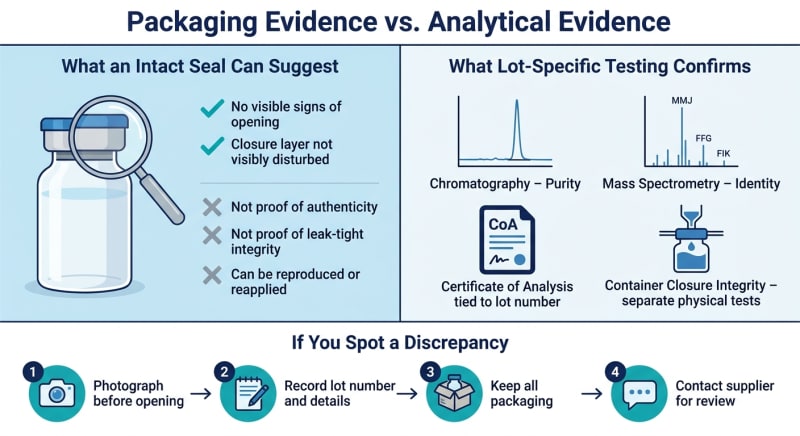
No. An intact tamper-evident seal does not prove a peptide vial is authentic. A seal, flip-off cap, or crimp can only indicate whether that particular closure layer shows visible signs of opening or interference. It cannot confirm what was filled into the vial, how pure the contents are, or whether the material matches its label. Those questions require analytical testing, such as chromatography and mass spectrometry, tied to a specific lot.
This article explains what each packaging layer can and cannot show. It also sets out which discrepancies a buyer should photograph and record so a supplier can review them.
Key Takeaways
- Peptide vials usually have up to three closure layers: the aluminum crimp, the plastic flip-off cap, and an outer security seal or label.
- Each layer can provide some evidence that the vial was opened. None of them provides evidence of chemical identity.
- Crimps, caps, and printed security features can all be reproduced or reapplied by someone with basic equipment.
- A visually intact closure is not the same as a leak-tight container. Container closure integrity is measured with separate physical tests.
- Identity and purity questions belong to lot-specific analytical documentation, not packaging appearance.
- Document discrepancies before opening anything, and keep all packaging for supplier review.
What counts as a tamper-evident seal on a peptide vial?
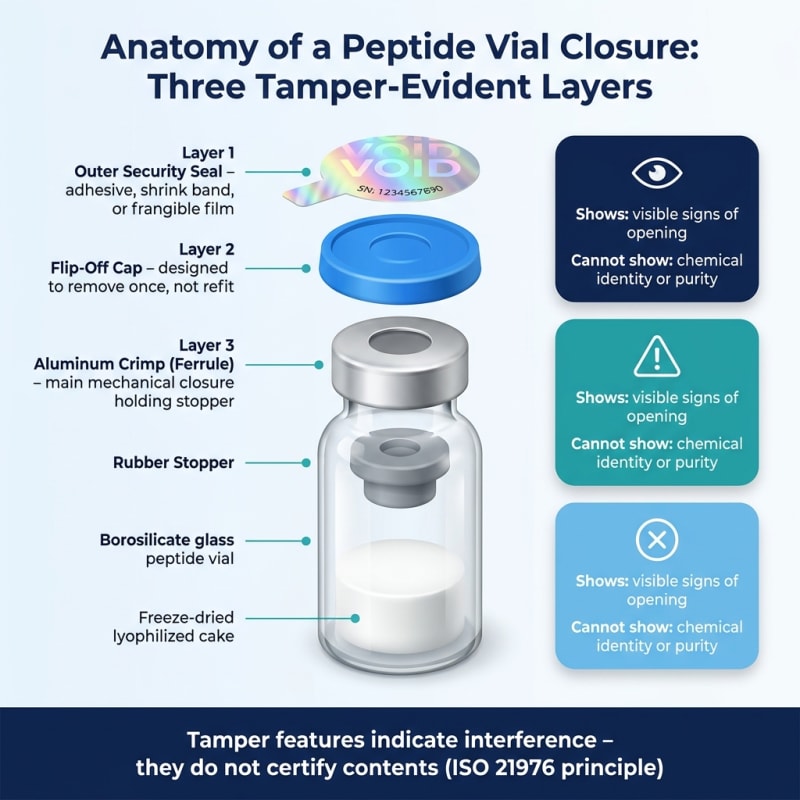
On a typical lyophilized (freeze-dried) peptide vial, "tamper-evident" can describe three physically different parts. Each is applied at a different stage, from a different material, and each fails in a different way when disturbed.
- Vial crimp (ferrule): a thin aluminum band folded under the glass lip. It holds the rubber stopper in place and is the main mechanical closure.
- Flip-off cap: a plastic button snapped onto the top of the crimp. It is designed to come off once, exposing the stopper, and is not meant to be refitted.
- Outer security seal: an adhesive label, shrink band, or tape over the cap or carton. It may use "void" adhesive, frangible film that tears, serial numbers, or holographic printing.
A guidance standard for medicinal product packaging, ISO 21976, describes tamper verification features as indicators of opening rather than barriers to it. The same logic applies to research materials: these features are designed to show interference, not to stop it or certify contents.
What can each layer prove, and what can't it?
Each layer answers a narrow question about its own condition. The table below summarises what a visually normal layer suggests, how it can mislead, and what it cannot address at all.
| Packaging layer | What an intact layer suggests | Known ways it can mislead | What it cannot show |
|---|---|---|---|
| Aluminum crimp | The stopper has been held in place since crimping | Hand crimpers are widely available; a vial can be decrimped and recrimped with a new ferrule | Identity, purity, fill mass, leak-tightness |
| Flip-off cap | The stopper surface has probably not been exposed | Caps can be pried off and pressed back; some caps are only loosely snapped on at manufacture | Whether the stopper was punctured before capping, or contents |
| Outer security seal or label | The seal has not been lifted since application | Labels and holograms can be reproduced; a new seal can be applied over a replaced closure | Anything about the material inside |
| Outer carton or shipper tape | The package was not opened in transit | Retaping, or opening at a different seam | Condition or identity of individual vials |
Crimps: strong mechanically, weak as proof
A well-formed crimp shows even folding under the lip with no tool marks, creases, or gaps. Research on vial capping shows that crimp appearance depends on capping-machine settings, so normal crimps can vary between lots. That variation means a slightly different crimp is not automatically a sign of interference.
Equally, a neat crimp does not rule out interference. Anyone with a manual crimping tool can apply a new ferrule, so an expert-looking crimp only shows that the vial was crimped competently at some point.
Flip-off caps: a one-time indicator with real gaps
A flip-off cap is useful mainly when it is missing, loose, or shows stress marks on the plastic. Its presence does not show that the stopper is untouched. A needle puncture made before the cap was fitted would be hidden underneath it, and caps can sometimes be detached and pushed back without obvious damage.
Cap color is often treated as a lot or product cue. Color alone carries little weight, because caps are generic, interchangeable components.
Outer security seals: designed to be visible, also designed to be copied
Void adhesives leave a pattern when lifted, and frangible films tear rather than peel. These are the most informative layer for showing that someone tried to open a package. They are also the layer most often imitated.
A collaborative investigation into falsified antimalarial tablets in Southeast Asia reported that counterfeit packaging carried imitation holograms close enough to deceive many observers. Detection depended on detailed comparison with genuine references and on chemical analysis of the tablets (Newton et al., 2008). That study concerned finished medicines, not research peptides. It shows that sophisticated printed security features can be reproduced, and that their presence is not a stand-alone check of authenticity.
Why can't intact packaging establish identity or purity?
Packaging is applied after filling, so it can only record events that happen after closure. If the wrong material, a degraded material, or an underfilled amount goes into the vial before closure, every seal will still look perfect. The closure records sequence, not composition.
Reviews of falsified and substandard medicines describe the same distinction. Visual and packaging inspection can flag suspicious products, but confirmation relies on analytical techniques such as liquid chromatography, spectroscopy, and mass spectrometry (Kovacs et al., 2014; Rebiere et al., 2017). Reviews of falsified biotechnology products make a similar point for peptides and proteins: they are hard to verify visually and need structure-sensitive methods (Janvier et al., 2018).
For a research peptide, the relevant evidence is lot-matched data. That usually means an HPLC purity result and a mass spectrometry identity result, linked to the lot number printed on the vial. Alpha Carbon Labs describes its testing approach on the quality control page and publishes lot documentation through COA documents. Sterility is a separate attribute again, covered in Peptide Sterility vs Purity: Separate Quality Checks.
Packaging can, however, help link a vial to its records. A legible lot number, an intact label, and an unaltered seal make it easier to argue that the lot data apply to that specific vial. That is a chain-of-custody function, not an identity test.
Is a sealed vial the same as a leak-tight vial?
No. A seal that looks intact can sit on a container that leaks, and a leak-tight container can have a damaged outer label. Container closure integrity (CCI) means the stopper and glass form a barrier against gas, moisture, and microbial ingress. It is measured with physical methods, not by looking.
USP chapter <1207> on package integrity evaluation separates deterministic methods, such as helium leak detection and vacuum decay, from probabilistic visual or dye-based checks. Early work on rubber-stoppered glass vials used helium mass spectrometry to measure leak rates directly (Kirsch et al., 1997). Capping studies show that stopper compression, set by crimping parameters, affects measured seal quality (Mathaes et al., 2016).
For lyophilized research peptides, a leak could let in moisture that may influence stability over time. A visual inspection of the crimp cannot detect that. So treat seal appearance as evidence of possible opening only, not as evidence of barrier performance.
Which packaging discrepancies should buyers document?
Document anything that differs from how the same product normally arrives, and do it before opening any layer. The aim is a factual record a supplier can compare against manufacturing and dispatch records. It is not a conclusion about tampering.
- Outer shipper: photograph all sides, including tape seams, re-taping, cuts, crushed corners, and the shipping label.
- Inner carton or pouch: note broken seals, adhesive residue, or tape laid over older tape.
- Security seal: record void patterns, tears, lifted edges, wrinkles, misalignment, or a seal placed over another seal. Note any serial number printed on it.
- Flip-off cap: record whether it is missing, loose, cracked, a different color from previous lots, or sitting unevenly.
- Crimp: look for tool marks, scratches, double fold lines, uneven skirt height, or a ferrule that rotates freely. Photograph it in raking light at several angles.
- Stopper (visible only if the cap is missing): note visible puncture marks, but do not probe or touch the stopper.
- Vial label: check the lot number against the packing slip and lot documentation. Record smudged print, a label over a label, or peeling.
- Contents appearance: note obvious anomalies such as discoloration or liquid in a vial expected to contain dry powder, without opening the vial.
- Context: record the date and time received, the order number, and who handled the package.
Use a scale reference such as a ruler in photos, and keep the original files with their metadata. Keep every packaging component, including the shipper, until the supplier has completed its review. If you are unsure, quarantine the vial rather than opening it to check.
How does a supplier review a packaging discrepancy?
A useful review compares the reported item against what the supplier can verify independently. That typically includes retained reference packaging from the same lot, closure component specifications, dispatch photographs where available, and lot records. Your photos are most useful when they let a reviewer match specific features, such as crimp profile or label position, against those references.
Outcomes usually fall into three groups. The difference may be normal lot-to-lot variation, a transit or handling event, or something unexplained. Only the last raises an identity question, and that question can only be resolved analytically, for example by re-testing a retained or returned sample. Background on how sequences are produced and verified is on the peptide synthesis page.
The same evidence standard applies whatever the catalog material, whether a single peptide such as BPC-157 or a larger molecule. Packaging review and analytical review answer different questions, and both should be recorded separately.
Frequently Asked Questions
Does an intact tamper-evident seal prove a peptide is authentic?
No. An intact seal suggests only that the layer it covers has not been visibly opened since the seal was applied. It cannot show what was filled into the vial, its purity, or its mass. Authenticity in the chemical sense requires lot-specific analytical data, such as HPLC and mass spectrometry, linked to the lot number on the vial.
What is the difference between a crimp and a flip-off cap?
The crimp is an aluminum ferrule folded under the vial lip that mechanically holds the rubber stopper in place. The flip-off cap is a plastic button snapped onto the crimp that covers the stopper and is meant to come off once. The crimp provides the closure; the cap mainly shows whether the stopper surface has been exposed.
Can a vial be resealed so it looks unopened?
Yes, in principle. Manual crimping tools and generic flip-off caps are widely available, and printed security seals, including holograms, have been imitated in documented cases involving falsified medicines. A convincing reseal is possible, which is why packaging should be treated as supporting evidence rather than proof of identity.
Does a missing flip-off cap mean the vial was tampered with?
Not necessarily. Caps can detach during packing or transit, especially if loosely fitted at manufacture. A missing cap is a discrepancy worth photographing and reporting, but it does not by itself show the stopper was punctured or the contents changed. The supplier review should compare it with lot records and transit conditions.
Does an intact seal mean the vial is airtight?
No. Visual seal condition and container closure integrity are different. A crimp can look normal while the stopper fails to seal fully against the glass. Leak-tightness is assessed with physical methods such as helium leak detection or vacuum decay, not by visual inspection of the cap or label.
What should I photograph before opening a package with a damaged seal?
Photograph the outer shipper on all sides, inner packaging, the security seal, the flip-off cap, the crimp from several angles in raking light, and the vial label showing the lot number. Include a scale reference, keep original image files, and retain all packaging until the supplier review is complete.
Limitations
This article summarises published literature and packaging standards on tamper-evident features, falsified products, and container closure integrity, much of it from finished pharmaceutical contexts rather than research peptides. It does not establish the safety, effectiveness, regulatory approval, or suitability of any material sold by Alpha Carbon Labs for human or veterinary use. All materials are supplied solely for nonclinical laboratory research.
References
- 1. Newton PN, Fernández FM, Plançon A, et al. A collaborative epidemiological investigation into the criminal fake artesunate trade in South East Asia. PLoS Medicine. 2008;5(2):e32.
- 2. Kovacs S, Hawes SE, Maley SN, Mosites E, Wong L, Stergachis A. Technologies for detecting falsified and substandard drugs in low and middle-income countries. PLoS One. 2014;9(3):e90601.
- 3. Rebiere H, Guinot P, Chauvey D, Brenier C. Fighting falsified medicines: the analytical approach. Journal of Pharmaceutical and Biomedical Analysis. 2017;142:286-306.
- 4. Janvier S, De Spiegeleer B, Vanhee C, Deconinck E. Falsification of biotechnology drugs: current dangers and/or future disasters? Journal of Pharmaceutical and Biomedical Analysis. 2018;161:175-191.
- 5. Kirsch LE, Nguyen L, Moeckly CS. Pharmaceutical container/closure integrity. I: Mass spectrometry-based helium leak rate detection for rubber-stoppered glass vials. PDA Journal of Pharmaceutical Science and Technology. 1997;51(5):187-194.
- 6. Mathaes R, Mahler HC, Buettiker JP, et al. The pharmaceutical vial capping process: Container closure systems, capping equipment, regulatory framework, and seal quality tests. European Journal of Pharmaceutics and Biopharmaceutics. 2016;99:54-64.
- 7. Mathaes R, Mahler HC, Roggo Y, et al. Influence of different container closure systems and capping process parameters on product quality and container closure integrity (CCI) in GMP drug product manufacturing. PDA Journal of Pharmaceutical Science and Technology. 2016;70(2):109-119.
- 8. United States Pharmacopeia. General Chapter <1207> Package Integrity Evaluation—Sterile Products.
- 9. ISO 21976:2018. Packaging — Tamper verification features for medicinal product packaging. International Organization for Standardization.
- 10. Nayyar GML, Breman JG, Newton PN, Herrington J. Poor-quality antimalarial drugs in southeast Asia and sub-Saharan Africa. Lancet Infectious Diseases. 2012;12(6):488-496.
Related Research research
All research information is for educational purposes only. The statements made within this website have not been evaluated by the US Food and Drug Administration. The statements and the products of this company are not intended to diagnose, treat, cure or prevent any disease.